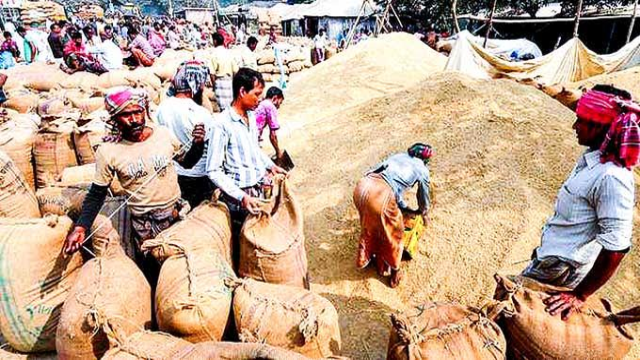
RAJSHAHI, April 25, (V7N) — Farmers and rice traders in the northern districts are reeling from a sudden drop in paddy and rice prices, which has created a dual crisis in production and trade.
In Bagmara’s Gangupara and Damnash markets, Bri‑28 rice has fallen from Tk 1,600 to Tk 1,350–1,400 per maund, Jirashail from Tk 1,900 to Tk 1,600, Bri‑75 from Tk 1,350 to Tk 1,150, and Swarna‑5 from Tk 1,200 to Tk 1,000. Farmers say the decline of Tk 200–400 per maund in just one month has left them unable to recover production costs.
Ohidul Islam, a farmer, said: “It cost about 1,500 taka to produce one maund of rice, but I have to sell it for 1,200 taka. This has caused me a huge loss.” Many had stored rice hoping for higher post‑Eid prices, but instead the market has weakened further.
Shopkeepers like Shahidul Islam of Damnash Hat noted fewer buyers from outside districts due to rising transport costs and oversupply from new harvests. Mill owners in Rajshahi, including Saiful Islam of Nohata, said imported rice has reduced demand for domestic varieties. “Last year at this time, I sold a 50‑kg sack for Tk 3,500. Now it is Tk 3,100,” he explained.
At the wholesale level, Swarna‑5 is selling at Tk 42–43 per kg, Jirashail at Tk 67–68, Kataribhog at Tk 74–76, and Atash at Tk 58–60 — all significantly lower than a month ago. Traders like Helal Ali said they are forced to buy paddy at lower prices, incurring losses per lot.
Traders attribute the fall to higher imports than demand, coupled with transport disruptions linked to the energy crisis. The oversupply of new paddy has further pressured prices.
Rafiqul Islam, president of the Rajshahi District Rice Mill Owners’ Association, urged the government to set prices to stabilize the market. “It is important to ensure minimum profit to protect the interests of both farmers and traders. Currently, farmers are the most affected,” he said.
END/RAR/RH/