Pabna, Oct 11 (V7N) – Patients and their families are facing considerable hardship at Pabna Mental Hospital, where an outpatient rest facility has yet to be established more than seven decades after the institution was founded.
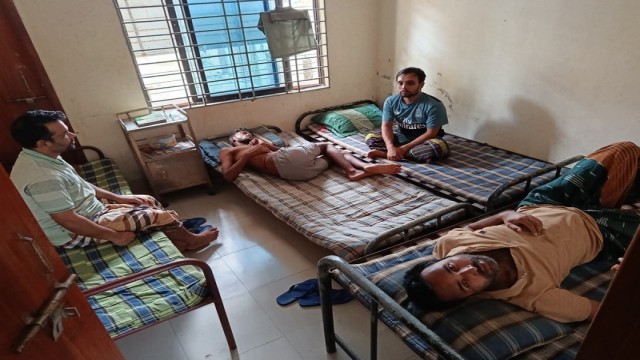
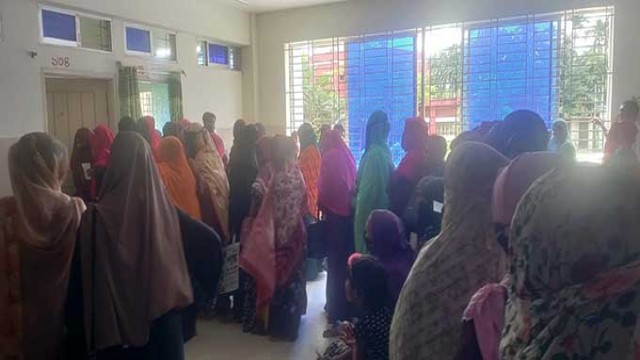
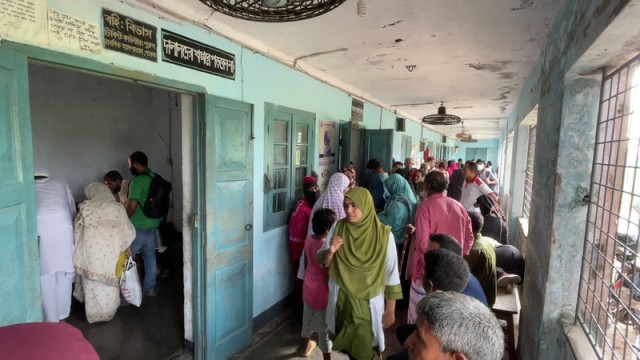
Every day, patients travel from different parts of Bangladesh to receive treatment at the hospital. However, there is no dedicated facility where patients and their accompanying family members can sit comfortably or rest while waiting for medical consultations. Outpatient services continue to operate from a small, old building.
As a result, many families are forced to wait in crowded conditions outside the outpatient department, in open fields or under trees. Those arriving late at night or in the early hours of the morning often struggle to find a place to spend the night.
Abdul Latif, an elderly man from Mehendiganj in Barishal, described his ordeal while waiting outside the outpatient department last Thursday. He had travelled with his son, who has a mental health condition, to seek treatment at the hospital.
Latif said they arrived in Pabna late at night after beginning their journey the previous day and could not find a suitable place to stay. They were eventually forced to spend the night with his son on the veranda of a police outpost beside the hospital.
He described the experience as extremely difficult and distressing.
Latif is not alone. More than a hundred patients and their relatives reportedly face similar difficulties as people travel to the hospital from across the country for treatment.
Parimal Kumar Mondal, who brought a patient from Dighalia in Khulna, said they travelled by train and arrived at Ishwardi Junction at night, where they had to spend the night under difficult circumstances before coming to the hospital the following morning.
He said there was no proper seating or resting arrangement for patients and their relatives at the outpatient department and called for a dedicated rest facility.
Saiful Islam, who travelled from Magura with a patient, also expressed frustration over the lack of accommodation and a comfortable waiting area.
He said families already exhausted by long journeys had nowhere suitable to rest at the hospital and urged the authorities to establish proper facilities for them.
Pabna Mental Hospital psychiatrist Samina Akter stressed the importance of family awareness in caring for people with mental health conditions.
She said families and relatives needed to become more aware of mental health issues and provide appropriate support. She also expressed concern about increasing screen-device dependence among children, adolescents and young people, saying parents should spend more time with their children and encourage them to participate in sports and other activities.
Meanwhile, AKM Shafiul Azam, a resident psychiatrist at the hospital, acknowledged that there was no dedicated resting or accommodation facility for patients and their relatives attending outpatient services.
He said the government was considering a project to transform Pabna Mental Hospital into an internationally standard healthcare institution.
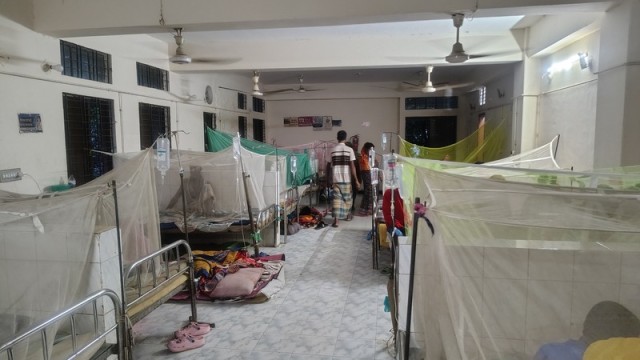
Under the proposed plan, a separate ward would be established to accommodate patients, who could be admitted there in phases. A separate hall or dormitory for patients’ relatives was also being considered, he added.
Established in 1957 with a capacity of 500 beds, Pabna Mental Hospital provides outpatient services to around 100 to 150 patients daily, many of whom travel from distant districts.
Despite the hospital’s longstanding role in mental healthcare, the absence of a dedicated waiting and resting facility continues to place an additional burden on patients and their families.
END/MSR/SMA/