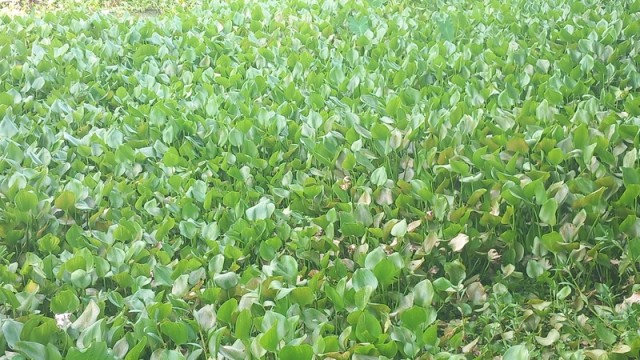
Jhalokathi, Aug 28 (V7N) — An excessive growth of water hyacinth across rivers, canals and low-lying agricultural land in Kathalia upazila of Jhalokathi is disrupting Aman rice cultivation and increasing production costs for local farmers.
Farmers have been forced to spend additional money and labour to remove large quantities of water hyacinth from their fields before planting transplanted Aman rice. The added expense is putting further pressure on farmers at the beginning of the cultivation season.
According to local farmers and the agriculture department, water hyacinth floating downstream through the Bishkhali River and adjoining canals enters low-lying croplands with tidal water. Within weeks, the plants form dense mats, making it difficult for farmers to prepare their land and plant Aman seedlings.
During visits to different fields in the Chenchri Rampur, Amlua, Awrabunia, Kathalia Sadar and Shauljalia unions, farmers were seen hiring day labourers to remove water hyacinth from their fields and pile it on higher ground.
Farmers said they are spending an additional Tk 2,500 to Tk 3,000 per bigha on labour to clear the invasive aquatic plant.
Mohammad Sayed Ali Fakir, a farmer from Chenchri Rampur Union, said the prices of fertiliser, diesel and land preparation had already increased.
“Now half of the cultivation budget is being spent simply on clearing water hyacinth. If we cannot remove it in time, we may miss the Aman planting season,” he said.
Locals also alleged that the filling of canals and the construction of unplanned embankments in several areas have obstructed water drainage, allowing water hyacinth to accumulate and contributing to prolonged waterlogging.
Kathalia Upazila Agriculture Officer Krishibid Fatema Islam said the abundance of water hyacinth in canals connected to the Bishkhali River was somewhat higher this year.
“Farmers have been advised to clear their fields quickly and complete Aman transplantation on time. We are also communicating with local representatives and the administration to clear canals where water flow has become obstructed,” she said.
Environmental concerns
Beyond its immediate impact on agriculture, the uncontrolled spread of water hyacinth can create wider environmental problems when it forms dense, continuous mats over water bodies.
The plant grows rapidly and can block sunlight from reaching the water below. As dense growth dies and decomposes, it can increase the consumption of dissolved oxygen in the water, potentially creating stressful conditions for fish and other aquatic organisms.
Large mats can also obstruct the natural movement of water, interfere with fishing and navigation, and contribute to stagnant water conditions. In waterways already affected by poor drainage, excessive water hyacinth can worsen waterlogging and restrict the normal flow of water.
Water hyacinth can also absorb nutrients and pollutants from water. While this characteristic can have limited applications in controlled settings, uncontrolled growth in natural waterways can become a serious management problem, particularly where nutrient-rich wastewater or agricultural runoff encourages rapid growth.
Environmental experts have long warned that the proliferation of invasive aquatic plants should not be viewed solely as an agricultural nuisance. Healthy rivers and canals depend on adequate water flow, sunlight, oxygen and ecological balance. When a water body becomes covered by dense aquatic vegetation, these natural processes can be disrupted.
For communities in areas such as Kathalia, where agriculture, fisheries and waterways are closely interconnected, the problem therefore has implications beyond the current Aman season. Regular canal maintenance, protection of natural waterways, improved drainage and responsible management of aquatic vegetation are important for reducing both agricultural losses and environmental risks.
As the Aman planting season reaches its peak, farmers fear that the additional labour and financial burden caused by water hyacinth could reduce their profits and increase the overall cost of rice production.
END/MAI/SMA/