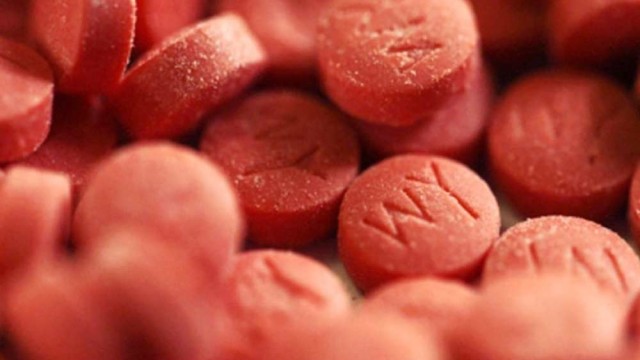
Rajshahi, Oct 08 (V7N) – A disturbing form of drug-related fraud has emerged in Rajshahi, where ordinary low-cost medicines are allegedly being coloured red or pink and sold as yaba to drug users, exposing unsuspecting consumers to unknown medicines and potentially serious health risks.
Local sources and an investigation by V7N found allegations that contraceptive pills and medicines used to treat constipation are being altered to resemble yaba and sold in several areas of Rajshahi city. The tablets are reportedly marketed at significantly higher prices to people looking for yaba amid tighter anti-narcotics operations and reduced availability of the illegal drug.
The alleged practice has been reported in areas including the railway-line area of ID Baganpara, Baro Rasta under Chandrima Police Station, Budhpara, Court Dhalan, Guripara, Rajshahi New Market and Haripur.
According to local sources, low-cost contraceptive pills and Duralax-type constipation tablets are being coated or marked with red or pink ink from sign pens or markers to make them resemble yaba. The locally sold counterfeit tablets are reportedly referred to by some sellers as “Maya tablets.”
Users looking for cheaper drugs are allegedly being targeted by the sellers. Some users told journalists that they purchased the coloured tablets believing them to be yaba and later experienced physical problems after taking them.
One drug user said the supply of genuine yaba had declined in some areas because of intensified anti-narcotics operations. Taking advantage of the shortage, some sellers were allegedly giving coloured medicines to customers as yaba.
A dangerous deception
The central concern, health experts say, is not simply financial fraud but the fact that consumers may ingest medicines without knowing their identity, ingredients or appropriate dosage.
A physician at Rajshahi Medical College Hospital, Dr Md Mehedi Hasan Bhuiyan, warned that taking medicines without a medical indication or professional advice can cause serious health complications. He said unnecessary use of such medicines may lead to dehydration and electrolyte imbalance, including reduced potassium levels, potentially causing longer-term complications.
He also warned that regular consumption of contraceptive medicines by men can disrupt hormonal balance and may cause other health complications.
Public health expert Shankar K Biswas said medicines such as Duralax and contraceptive pills are not narcotics and should never be treated as substitutes for yaba. He warned that altering medicines with colouring substances and consuming them without medical need can create additional health risks.
The exact health effects, however, would depend on the actual ingredients in the tablets and the substances used to alter them. Without laboratory testing, it is not possible to determine precisely what a particular coloured tablet contains or what contaminants may have been introduced.
The World Health Organization (WHO) says falsified or substandard medical products may contain incorrect ingredients, incorrect amounts of active ingredients, contaminants or toxic substances. Such products can cause poisoning, treatment failure and other serious health consequences.
Colouring a medicine does not make it a drug
Experts say the appearance of a tablet provides no reliable indication of its chemical composition.
WHO notes that some falsified medicines can look almost identical to genuine products, making them difficult to identify visually. The organisation advises consumers to obtain medicines only from trusted and licensed sources and to seek medical advice if they experience an adverse reaction after taking a suspicious medicine.
This makes the Rajshahi allegations particularly concerning because the reported method relies on visual deception. A tablet that looks like yaba may contain an entirely different active ingredient—or potentially an unknown mixture if it has been altered outside a regulated pharmaceutical process.
From medicine to counterfeit drug market
The alleged practice also raises questions about how ordinary medicines are being collected, altered and distributed through the illegal drug market.
A previous investigation in Bangladesh documented the manufacture of counterfeit yaba using various pharmaceutical and non-pharmaceutical materials. Law enforcement agencies have also previously encountered different forms and colours of yaba as traffickers attempted to evade detection.
However, the current Rajshahi allegations appear different in one important respect: instead of producing a tablet containing yaba’s active drug ingredients, ordinary medicines are allegedly being passed off as yaba after being visually altered.
Crime analyst Subrata Kumar Pal described the practice as a possible adaptation by illegal drug sellers to shortages created by intensified anti-narcotics operations. He said such tactics can create new forms of crime by exploiting the demand for drugs.
Police unaware of specific allegation
Rajshahi Metropolitan Police spokesperson and Deputy Commissioner Gaziur Rahman said police were continuing operations against yaba and all other forms of narcotics.
He said several drug-selling locations had already been dismantled and people involved in the illegal trade had been arrested. However, he said he was not aware of the specific allegation that contraceptive pills or constipation medicines were being coloured and sold as yaba. He said the police maintained a zero-tolerance policy towards narcotics.
The police position highlights a key challenge: identifying the alleged counterfeit tablets requires more than visual inspection. Laboratory analysis would be necessary to establish their chemical composition and determine whether they contain only the original pharmaceutical ingredients, additional substances or potentially harmful contaminants.
Need for laboratory testing and targeted investigation
Public health specialists say the alleged practice warrants urgent investigation because it sits at the intersection of narcotics trafficking, pharmaceutical misuse and consumer fraud.
Investigators would need to identify where the medicines are obtained, where they are being coloured, who supplies them to street sellers and whether the same network is distributing the tablets in other parts of the city or district.
Samples seized from suspected sellers should also be subjected to laboratory testing to establish exactly what they contain, experts say. Such testing could help determine whether the tablets are genuine pharmaceutical products that have been deliberately misrepresented or whether additional substances have been introduced.
WHO considers substandard and falsified medical products a major global public-health challenge and says stronger regulation, detection, enforcement and public awareness are essential to protect consumers.
For Rajshahi, the alleged rise of “fake yaba” presents a double danger: drug users are being deceived financially while potentially consuming medicines that were never intended for them. The absence of knowledge about what is actually inside a coloured tablet makes the practice particularly hazardous.
Law enforcement agencies, the Department of Narcotics Control, the Directorate General of Drug Administration and health authorities therefore face the task of determining whether the allegations represent isolated street-level fraud or the emergence of a wider counterfeit-drug supply chain.
Until the source and chemical composition of the tablets are established, health professionals warn that no coloured tablet sold as yaba—or any medicine obtained from an unauthorised source—should be considered safe.
END/MRA/SMA/