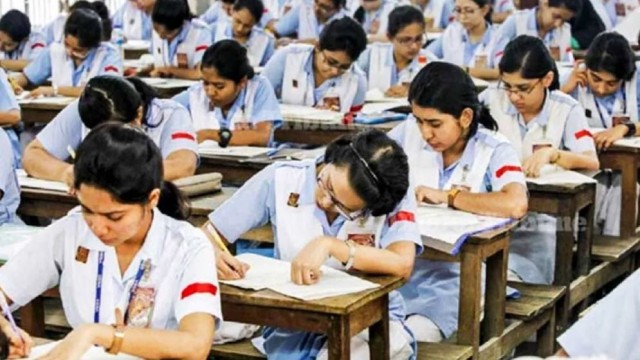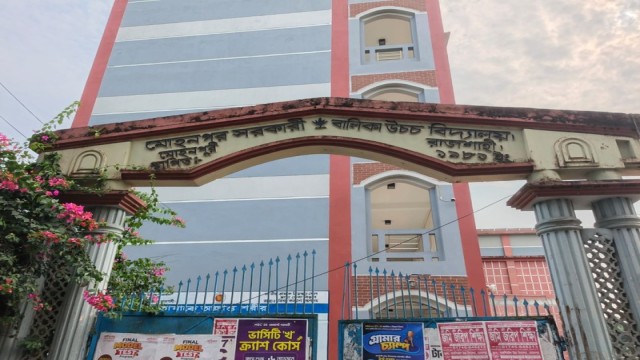
Rajshahi, Nov 12 (V7N) – Mohanpur Government Girls’ High School in Rajshahi has been playing an important role in promoting girls’ education, maintaining good academic results despite a severe shortage of teachers. However, behind its achievements lies a long-standing staffing crisis: only five government teachers are responsible for teaching around 400 students.
The number of approved assistant teacher posts has remained unchanged for nearly 38 years, since five posts were created when the institution was nationalised in 1988. Although student enrolment has increased and new grades and subjects have been introduced, the school’s staffing structure has not been expanded. The institution is also facing a shortage of support staff, affecting both classroom teaching and administrative activities.
According to school sources, Mohanpur Girls’ High School was established in 1981 and nationalised in 1988, when five assistant teacher posts were approved. At the time, classes were held from Grade Six to Grade Eight. Classes Nine and Ten were introduced later in response to students’ needs, but no additional teacher posts were created.
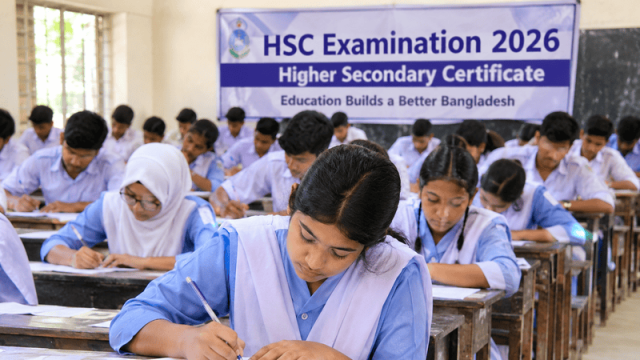
Currently, around 400 girls are studying at the school. Despite the limited number of teachers, the institution has maintained encouraging academic results. In this year’s Secondary School Certificate (SSC) examination, 19 of the 77 candidates achieved GPA-5.
In the same year, 10 students received government scholarships in the junior scholarship examination. Five secured talent-pool scholarships, while the other five received general-grade scholarships.
However, maintaining these results has placed considerable pressure on the five teachers. The school has no subject teachers for English, mathematics, biology, business studies, geography, fine arts, physical education and information and communication technology (ICT). As a result, ensuring regular, subject-based instruction has become difficult, potentially affecting students’ learning.
Acting Headteacher Ashraful Islam teaches Bengali. Senior teacher Abdul Latif handles agricultural education, Mamun Or Rashid teaches social science, Rubel Ahmed teaches physical science, and Rashed Bin Abed teaches religious studies.
The five teachers must manage classes across multiple grades while also performing various administrative duties. This leaves them with little time for lesson planning, individual attention to students and addressing gaps in subject-based learning.
The shortage extends beyond teaching staff. The school has no adequate support personnel, including a peon, office assistant, security guard, cleaner or female attendant, making routine administrative and service-related activities difficult.
Acting Headteacher Ashraful Islam said appointing teachers to vacant posts was essential to ensuring quality education.
“The shortage has created additional pressure on us. Alongside teaching, we have to handle various administrative responsibilities. The school does not even have an attendant, peon or security guard. This makes it difficult to run normal activities,” he said.
Students have also expressed concern over the lack of subject-specific teachers.
Sanjida, a Grade Nine student, said they needed regular teachers for important subjects such as English, mathematics and ICT.
“Sometimes we struggle to understand these subjects. If the school had enough teachers, we would have better opportunities to learn each subject properly. We want teachers to be appointed as soon as possible,” she said.
Afia Tahsin, a Grade Eight student, said they wanted to perform well academically but often faced difficulties understanding lessons because of the shortage of teachers.
“Regular teachers are especially important for understanding difficult subjects,” she said.
Despite these challenges, the school remains active in extracurricular activities. It has an active Girl Guides team to promote students’ mental development, leadership skills and creativity. Students also take part in national day celebrations, debate competitions, poetry recitations and cultural programmes.
School stakeholders say the staffing structure needs to be revised in light of the current student enrolment, number of classes and expanded curriculum. They are demanding the creation of one headteacher post and 21 additional assistant teacher posts, along with the recruitment of necessary support staff.
They believe addressing the long-standing shortage would improve the quality of education and restore normality to administrative operations.
Mohanpur Upazila Additional Secondary Education Officer Md Abu Jafar said the school could not recruit more teachers because additional government posts had not been approved.
“Since the necessary additional posts were not created when the institution was established, it has not been possible to recruit more teachers. Without government-approved posts, there is also no provision to pay the salaries and allowances of newly appointed teachers. We have discussed the matter at a district-level meeting,” he said.
Mohanpur Upazila Nirbahi Officer (UNO) Fahima Binte Akhtar said the school was a government institution operating under the Ministry of Education.
“For the time being, we will try to engage some teachers through outsourcing under the management committee. We will consult the Deputy Commissioner and inform the authorities about the next steps,” she said.
END/MRA/SMA/