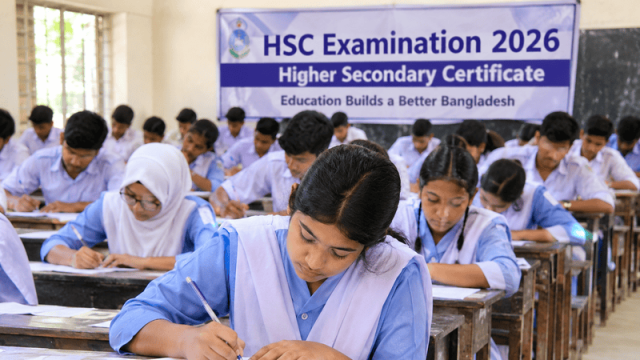
Rangamati, Nov 01 (V7N) – Poor pass rates in the 2026 Higher Secondary Certificate (HSC) examinations have raised fresh concerns about the quality of education in several districts of Bangladesh, with Rangamati recording a pass rate below 32 per cent, Jhalokathi ranking last among six districts under the Barishal Education Board and Ukhiya posting weak results in HSC examinations despite a comparatively strong performance in Alim and Business Management and Technology (BMT) examinations.
The results have renewed questions about the effectiveness of education development projects, teacher shortages, classroom supervision and institutional accountability, particularly in remote and underserved areas.
In Rangamati, only 1,714 of 5,359 candidates from 22 educational institutions passed the HSC examinations, producing a pass rate of 31.98 per cent. Just 15 students achieved a Grade Point Average (GPA) of 5, while 17 of the 22 institutions had no GPA-5 achievers.
Some colleges recorded pass rates below 10 per cent. Naniarchar Government College had a pass rate of 7.72 per cent, Kachalong Government College 7.85 per cent and Ghagra College 9.09 per cent. None of the five candidates from Sujoni Trust School and College passed.
Bangladesh Navy School and College in Kaptai recorded the highest pass rate in Rangamati at 93.53 per cent. Rangamati Government College posted a pass rate of 61 per cent, while Rangamati Government Women's College recorded 28.32 per cent and Rangamati Public College 27.69 per cent.
The results have raised questions about whether education initiatives in the hill district are translating into measurable improvements in student performance.
Development initiatives under scrutiny
Various programmes have been introduced to improve education in the remote hill districts, including e-learning facilities, educational centres and infrastructure development projects. However, concerns remain over shortages of qualified teachers, particularly in mathematics, English and science.
On January 27, 2026, then Chief Adviser Professor Muhammad Yunus inaugurated an e-learning programme at 12 schools. Later, on August 23, State Minister Barrister Mir Mohammad Helal Uddin inaugurated an e-learning centre established through the Rangamati Hill District Council. Online classes began on September 15.
Questions have since emerged over the programme's management, teacher selection, continuity of instruction, financial transparency and overall effectiveness. The extent to which the initiative has improved students' learning outcomes has not been clearly established through publicly available independent assessments.
Education observers say launching projects, constructing buildings or introducing online classes cannot alone guarantee better results. They argue that sustained classroom instruction, qualified subject teachers, regular monitoring and institution-specific assessments are essential to improving educational standards.
They have also called for transparent reporting on project expenditure, implementation progress and measurable learning outcomes.
Ukhiya records mixed results
In Ukhiya, Cox's Bazar, the combined pass rate in the HSC, Alim and BMT examinations was 48.02 per cent. Of the 1,591 candidates who took the three examinations, 764 passed and five achieved GPA-5, according to figures released by the upazila secondary education office.
Alim candidates performed comparatively well. Of the 289 candidates from three madrasas, 250 passed, giving a pass rate of 86.51 per cent. Four students achieved GPA-5.
The HSC results were considerably weaker. Of the 1,112 candidates from Ukhiya College and Ukhiya Government Women's College, 417 passed, producing a pass rate of 37.50 per cent. Only one student achieved GPA-5.
In the BMT examinations, 97 of 190 candidates from Ukhiya College and Nurul Islam Chowdhury Technical (BM) School and College passed, resulting in a pass rate of 51.05 per cent. No student achieved GPA-5 in this category.
Ukhiya Upazila Academic Supervisor Badrul Alam confirmed the figures.
The contrast between the Alim and HSC results highlights differences in performance across examination streams and raises questions about the academic challenges facing students in general higher secondary education.
Jhalokathi ranks last under Barishal Board
Jhalokathi recorded the lowest HSC pass rate among the six districts under the Barishal Education Board, with only 37.09 per cent of candidates passing the 2026 examinations.
According to district-wise results released by the board on Saturday, 4,457 of the 4,699 registered candidates from Jhalokathi took the examinations. Of them, 1,653 passed, including 498 boys and 1,155 girls. A total of 38 students achieved GPA-5, comprising six boys and 32 girls.
Pirojpur recorded the highest pass rate under the board at 51.55 per cent, followed by Barishal at 49.95 per cent, Barguna at 44.66 per cent, Bhola at 39.54 per cent and Patuakhali at 38.51 per cent.
Jhalokathi 's pass rate was 1.42 percentage points below Patuakhali's and 2.45 percentage points below Bhola's.
Students from 31 colleges in Jhalokathi participated in the examinations. Across the Barishal Board, 98,412 of 106,659 registered candidates took the HSC examinations.
Lawmaker calls for accountability in Rajapur and Kathalia
The disappointing results have also prompted concern among educational institutions and local representatives. Rafiqul Islam Jamal, a lawmaker representing Jhalokathi -1, which covers Rajapur and Kathalia, expressed concern over the performance of colleges in the two upazilas and urged institutions to take corrective measures.
In a public warning issued on Saturday, he called on teachers, governing bodies and management committees to identify the reasons behind the poor results and take effective steps to improve educational standards.
The figures cited in his notice showed varying levels of performance among local colleges.
In Kathalia, Monoshwita Women's Degree College recorded a pass rate of 62.16 per cent, with 46 of 74 candidates passing and one student achieving GPA-5. Amua Shaheed Raja Degree College had a pass rate of 50.65 per cent, with 117 of 231 candidates passing. Toffazzal Hossain Manik Mia Government College recorded a pass rate of 49 per cent, with 110 of 224 candidates passing and one GPA-5 achiever. At West Chhitki Secondary School and College, 12 of 25 candidates passed.
In Rajapur, Alhaj Lalmon Hamid Women's Degree College recorded a pass rate of 54 per cent, with 121 of 216 candidates passing and three students achieving GPA-5. However, Baroiya Degree College had a pass rate of 27 per cent, Rajapur Government College 25 per cent and Abdul Malek Degree College only 19 per cent.
Jamal said the results reflected weaknesses in higher secondary education and called for a closer examination of why students were falling behind. He identified irregular classes, inadequate supervision and a lack of commitment to institutional responsibilities as possible contributing factors.
He urged every institution to analyse its results, take firm and effective steps to improve teaching and learning, and ensure accountability among those responsible.
At the same time, he congratulated students who achieved GPA-5 and others who passed with distinction. He praised Monoshwita Women's Degree College for its performance in Kathalia and encouraged unsuccessful candidates to learn from their mistakes and prepare for future examinations with renewed determination.
Beyond pass rates
The results across Rangamati, Ukhiya and Jhalokathi point to a range of challenges rather than a single explanation for poor performance. Teacher shortages, inconsistent classroom instruction, limited access to subject specialists and questions over the implementation of education projects have all emerged as areas requiring closer examination.
The figures also show significant differences among institutions and examination streams. While some colleges recorded pass rates above 90 per cent and Alim candidates in Ukhiya achieved an 86.51 per cent pass rate, several other institutions had pass rates below 30 per cent.
Education specialists and local stakeholders have called for institution-level reviews to identify the specific causes of weak performance. Such reviews could examine attendance, teacher availability, classroom hours, subject-wise results, student preparation and the effectiveness of existing support programmes.
For remote and underserved communities, improving educational outcomes will require more than new infrastructure or the launch of projects. Consistent teaching, qualified educators, effective supervision, transparent use of public funds and regular assessment of student learning will be essential to ensure that development initiatives produce tangible benefits.
END/MVD/SMA/