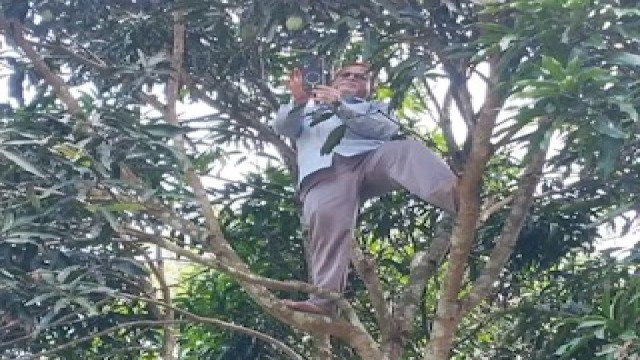
RANGAMATI, June 16, (V7N) – A head teacher in a remote hilly area of Baghaichhari upazila in Rangamati had to climb a mango tree at the risk of his life to ensure online attendance. The incident occurred on Monday, the first day of the government's new online attendance system for government primary schools across the country. Under the new directive, teachers must arrive at school by 9 am daily, take a photo of the attendance register, and send it via WhatsApp to the upazila primary education officer.
Mohammad Abu Taher, head teacher of Pakujjochhari Government Primary School in Rupakari Union of Baghaichhari, faced severe difficulties due to the lack of mobile network coverage at his school. The school is located about 300 to 400 feet below between two hills, and even the school rooftop had no network signal. After searching the surrounding areas and climbing to the top of a nearby hill, he finally climbed a mango tree to get a network connection.
From there, he managed to send the attendance register photo to the upazila education officer's WhatsApp. He said, "I got the network after climbing the tree with great difficulty. I was scolded for being a little late in sending the attendance." Referring to the risk he took to protect his job, he added, "I work to feed my family. To keep my job, I have to take risks."
A photo of the head teacher climbing a mango tree in search of a mobile network went viral on social media, sparking widespread discussion. Many have demanded effective alternatives or special arrangements for the online attendance system, considering the realities of remote and network-deprived areas.
Baghaichhari Upazila Primary Education Officer (Acting) Sanchayan Chakma said that out of 116 government primary schools in the upazila, online attendance was received from 88 schools on the first day. Attendance from 83 teachers of the remaining 28 schools was not received. He said schools with 4G network connectivity were able to send attendance, while teachers from network-deprived areas informed authorities via text message. The incident has once again highlighted the communication and network challenges in remote hilly regions, raising questions about the successful implementation of digital systems without addressing infrastructural limitations.
end/amr/rh/