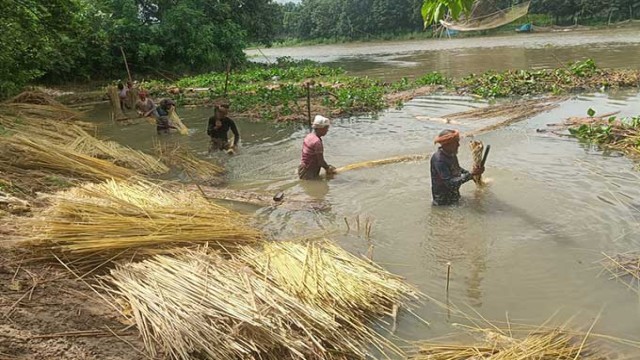
Rajshahi, Aug 12 (V7N) — Jute farmers in Rajshahi are facing growing frustration as the price of raw jute has declined after remaining strong at the beginning of the season, despite favourable production conditions.
Most farmers are unable to store their jute for long and are forced to sell at lower prices to cover labour costs, household expenses and outstanding debts at local shops.
Farmers and traders said jute is currently selling for around Tk 3,200 to Tk 3,800 per maund, while some market estimates put the upper range at Tk 4,000 to Tk 4,500. At the Nawhata market in Paba upazila, one of the major jute trading centres in the area, jute was selling for Tk 3,200 to Tk 3,500 per maund on Thursday.
Traders and middlemen were seen negotiating with farmers and purchasing jute for storage. At the beginning of the season, however, the same quantity was selling for nearly Tk 5,000 per maund.
According to the Department of Agricultural Extension in Rajshahi, jute has been cultivated on 18,399 hectares of land in the district this season, equivalent to around 137,000 bighas. The figure was 17,305 hectares last year, representing an increase of 1,094 hectares, or roughly 8,000 bighas.
The district has set a production target of 49,333 metric tonnes of jute this season, 656 metric tonnes higher than last year's output.
Shahidul Islam, a farmer from Paba, said the cost of seeds, fertilisers, irrigation and labour had increased significantly.
“Jute cultivation involves considerable effort, including retting, drying, processing and transportation. If farmers continue to incur losses after so much work, they may lose interest in cultivating jute next year,” he said.
He said the price should be around Tk 3,800 to Tk 4,500 per maund to make jute cultivation economically viable for farmers.
Several farmers, speaking on condition of anonymity, said they generally produce eight to 10 maunds of jute per bigha. At an average price of Tk 3,500 per maund, their gross earnings amount to around Tk 35,000 to Tk 38,000 per bigha.
Production costs, including labour, weeding, cutting, retting, fibre extraction and transportation, amount to around Tk 30,000 per bigha, leaving farmers with only a small profit. Jute sticks provide some additional income.
Farmers have called for greater opportunities to export jute and measures to ensure fair prices for producers.
Several traders, meanwhile, said they were purchasing jute according to prices set by jute mills. They claimed that new-season jute was being purchased at higher prices than last year, but demand from some countries that traditionally import jute from Bangladesh has declined this year, affecting local markets.
Paba Upazila Agriculture Officer M.A. Mannan said the overall jute situation in the upazila was good this season.
Early-maturing varieties would begin harvesting soon, he said, adding that jute should be retted in clean and sufficiently deep water to produce good-quality fibre.
He also said farmers would not necessarily incur losses if they sold their jute at the prevailing market prices.
END/MRA/SMA/