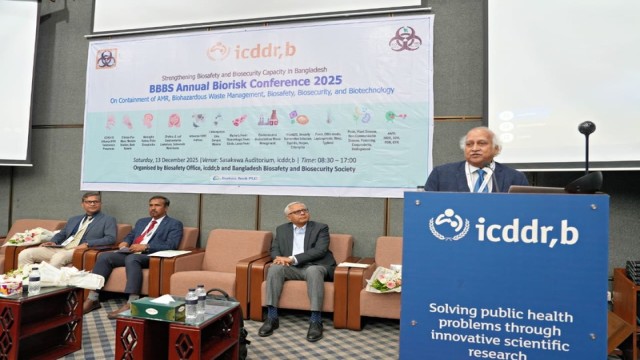
Rangamati, Dec 14 (V7N) – The Annual Biorisk Conference 2025 was held successfully at 9:00 am at the Sasakawa Auditorium of icddr,b, bringing together more than a hundred teachers, researchers, physicians, and policymakers from universities and research institutions across Bangladesh.
The conference, themed on antimicrobial resistance control, biomedical hazardous waste management, biosafety, biosecurity, and biotechnology, was chaired by Professor Dr. Md. Atiar Rahman, Vice-Chancellor of Rangamati Science and Technology University. The chief guest was Professor Dr. S. M. A. Fayez, Chairman of the University Grants Commission of Bangladesh.
Special guests included Professor Dr. Md. Shahinul Alam, Vice-Chancellor of Bangladesh Medical University; Dr. Tahmid Ahmed, Executive Director of icddr,b; Dr. Saifur Rahman, Joint Secretary of the Ministry of Forest, Environment and Climate Change; and Dr. Asadul Ghani, Chairman of the Bangladesh Biosafety and Biosecurity Society.
In his keynote remarks, Professor Dr. S. M. A. Fayez stressed that biosafety and biosecurity must be given the highest priority in research institutions and medical hospitals to effectively confront future pandemics similar to COVID-19. He highlighted the need for robust policies and strengthened institutional capacity to manage biological risks.
Chairing the session, Professor Dr. Md. Atiar Rahman underscored the Bangladesh Biosafety and Biosecurity Society’s significant contributions over the past 15 years in improving biomedical waste management. He urged the UGC to take initiatives to incorporate biosafety and biosecurity into university academic curricula and called for stronger state-led efforts to implement existing national biosafety and biosecurity policy guidelines.
Addressing the conference, icddr,b Executive Director Dr. Tahmid Ahmed recalled the institution’s historic role in developing the oral rehydration solution and cholera vaccine. He emphasized that icddr,b and all related institutions must strictly adhere to established biomedical waste management policies and work to raise public awareness on the issue.
Dr. Saifur Rahman, Joint Secretary of the Ministry of Forest, Environment and Climate Change, assured participants of the ministry’s full cooperation in strengthening biomedical waste management in the future.
Participants described the conference as an important platform for effective dialogue among policymakers, researchers, and stakeholders on strengthening biosafety, biosecurity, and sustainable biomedical waste management in Bangladesh.
END/AMR/SMA/