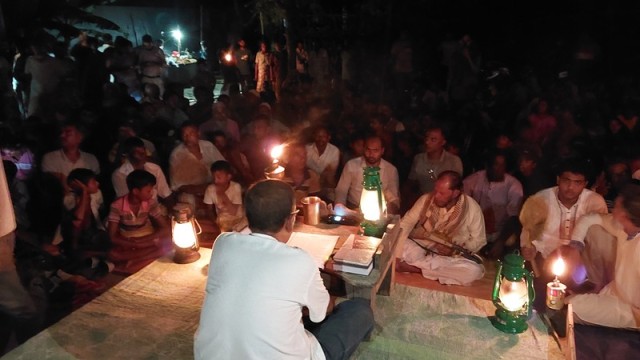
Pabna, Aug 29 (V7N) — A full autumn moon shone in the night sky as villagers sat on mats spread across a rural courtyard. In front of them, a reciter sat on a low wooden platform. The soft glow of hurricane lanterns and traditional oil lamps created a magical atmosphere, while the surrounding silence was occasionally broken by the melodious rhythm of puthi recitation.
A scene that disappeared from rural Bengal several decades ago came alive again on Thursday night (Aug 27) in Sonaharpada village of Bilchalan Union, Chatmohar upazila, Pabna, an area surrounded by the Chalan Beel wetlands.
A puthi recitation session, a traditional form of Bengali folk literature, was organised at the courtyard of the late Kitab Pramanik’s home. Away from the noise of the city, the quiet rural night revealed the timeless beauty of Bengal’s countryside. For many, it felt as though the clock had suddenly turned back to the 1980s.
Sonaharpada is a secluded village on the banks of the Chalan Beel, about four kilometres north of Chatmohar upazila headquarters.
Visitors travelling from Chatmohar had to pass through the rough, dusty road from Chatmohar Jardis intersection towards Mannannagar before entering the village along a brick-paved road. By around 8:30pm, the venue was already drawing visitors.
One side of the courtyard had a stack of straw, while the other had been prepared for the puthi recitation. Despite the intense humidity and heat, people continued to arrive as the organisers made final preparations. Above them, the full moon illuminated the courtyard while oil lamps and hurricane lanterns flickered.
The puthi session began at around 9:15pm and continued until 10:15pm. Before it started, the number of men, women, children, teenagers and young people sitting on the mats steadily increased. Eventually, the courtyard was packed with spectators.
The event attracted not only local residents from Chatmohar but also several culture enthusiasts who travelled from Dhaka.
The programme was hosted by Biplab Acharya. Organiser Dr Atikur Rahman Atik delivered the introductory presentation before the puthi recitation began.
The traditional epic Bibi Sonavan was recited by theatre personality and cultural activist Asaduzzaman Dulal, a prominent figure in the theatre scene since the 1990s. The puthi Gazi Kalu and Champabati was recited by Laimuddin Pramanik.
The organisers later presented honorary crests to the two performers.
The puthi singers captivated the audience with the distinctive melodies and storytelling traditions of rural Bengal. Under the moonlit sky, spectators and listeners were immersed in nostalgia.
Many were moved by the opportunity to experience in person the puthi recitation sessions they had heard about from their grandparents during childhood. For them, it was a return to the sound and spirit of their roots.
More than 70-year-old farmer Hasan Pramanik came to listen to the performance.
“I heard puthi recitation about 40 years ago. At that time, elders in the community used to organise such gatherings. We worked in agriculture and would spend our free time sitting at these sessions and listening to puthi recitation. I really enjoyed seeing such an event again after so many years,” he said.
Retired engineer Imdadul Haque brought his son to the event. He recalled his childhood memories.
“When I was in school, similar puthi recitation sessions used to be held in the sitting rooms of my maternal grandparents’ home. After so many years, watching and listening to puthi recitation took me back to my childhood. Today, we are all immersed in mobile phones. We need to preserve our own cultural heritage,” he said.
Young spectator Faisal Mahmud said he had never experienced puthi recitation before.
“I did not really know what puthi recitation was. I saw preparations for the event on Facebook and called Dr Atik to learn more. I had never watched one before. So I came with my father, and I really enjoyed it,” he said.
Former president of the Chatmohar Press Club Rakibur Rahman Tukun described the event as rare at a time when the world is increasingly immersed in artificial intelligence and digital technology.
“While the entire world is becoming increasingly absorbed in AI technology, organising a puthi recitation session like this is a rare event. We are gradually losing traditions that have existed for hundreds of years. Puthi recitation is an important part of our indigenous cultural heritage. The government should take effective initiatives to preserve it,” he said.
Theatre personality Asaduzzaman Dulal was visibly emotional after taking part in the puthi recitation.
“I have carried the melody of puthi recitation within me since I first heard it in villages. Although I am not a professional puthi reciter, I performed one for the first time today. It made me realise that we need to preserve forgotten rural traditions such as puthi recitation, which can bring people closer together and create a sense of unity,” he said.
“If new puthi stories are written around contemporary issues, they can inspire people to dream of a better path,” he added.
Organiser Dr Atikur Rahman Atik said Bengal has a rich and colourful cultural history, of which puthi recitation is an important part.
“Puthi recitation dates back to the 16th and 17th centuries. The tradition survived, though gradually fading, until the 1980s and 1990s. Today, it is almost completely lost, and many people do not even know what puthi recitation is,” he said.
“We wanted to return to that era and see what a traditional puthi recitation session was like. The main purpose of this event was to introduce the younger generation to this disappearing folk literature and cultural heritage,” he added.
Five-time National Award-winning sound engineer Ripon Nath travelled from Dhaka after learning about the event.
“It is a very good initiative and certainly deserves praise. However, if puthi recitation is to be popularised and brought closer to people today, new stories based on contemporary issues need to be created. That would increase people’s interest in listening and could help revive the tradition,” he said.
Jatra theatre, puppet shows, circuses, puthi recitation and haaturay poetry were once an integral part of rural life in Bengal. However, changing cultural practices, a lack of patronage and the influence of modernisation have pushed many of these traditions to the brink of extinction.
Those involved in cultural preservation have called for government initiatives to protect and revive these valuable elements of Bangladesh’s folk heritage.
END/MSR/SMA/