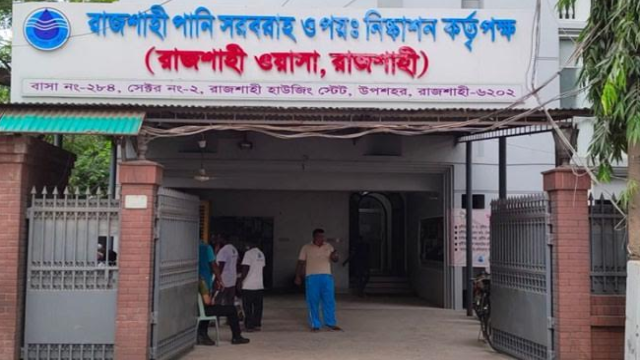
RAJSHAHI, MAY 31 (V7N) – Despite spending crores of taka to modernize the water supply system, Rajshahi WASA has failed to achieve the expected benefits from automation, as most lift pumps are still being operated manually.
The continued manual operation has increased operational costs and financial losses, while the organization under the Local Government Department has reportedly required subsidies worth hundreds of crores of taka in recent years for the water supply sector alone.
Sources said Rajshahi WASA currently operates 121 water lifting pumps across the city. In addition, an above-ground water treatment plant was established on the banks of the Padma River at Shyampur in Rajshahi city at a huge cost several years ago.
However, due to water shortages in the river, the treatment plant reportedly remains operational for only about five months each year and stays idle for the remaining period.
At present, around 153 employees and workers are engaged in pump operations. Their salaries and allowances amount to approximately Tk 25 lakh per month, translating into nearly Tk 3 crore annually.
Besides manpower costs, the annual electricity expenditure for operating the pumps stands at around Tk 9 crore, officials said. They admitted that the revenue generated from water supply is insufficient to cover the operating expenses.
According to WASA sources, around Tk 4 crore was spent nearly two years ago to introduce automation technology aimed at modernizing the system.
Under the project, a centralized control system was developed to automatically switch pumps on and off, regulate water flow and detect technical faults remotely from a control room.
However, despite the technological upgrade, pump operators are still manually controlling operations from individual pump houses.
Officials concerned said full implementation of automation could allow at least 125 pump operators to be reassigned to other duties, reducing operational costs and improving efficiency.
But managerial shortcomings and the absence of skilled technical manpower have prevented the system from functioning effectively.
Rajshahi city currently requires around 134.4 million litres of water daily, while WASA is supplying approximately 86.5 million litres.
Of that amount, only 9 million litres are properly purified, while the remaining water is extracted from underground sources and directly supplied to consumers.
Although Rajshahi WASA has over 53,000 registered customers, officials estimate there are around 35,000 illegal connections across the city.
The total length of WASA pipelines in the metropolis is about 860 kilometres.
According to officials, the cost of extracting and supplying water is Tk 4.56 per litre, while residential customers receive water at a subsidized rate of Tk 2.27 per litre. Commercial consumers, meanwhile, pay Tk 4.54 per litre.
Chief Engineer Parvez Mamud said automation technology is still relatively new for Rajshahi WASA.
“Therefore, the issue of appointing skilled manpower is under consideration. Gradually, these problems can be overcome,” he said.
He also added that reducing unnecessary manpower could help lower operational costs in the future.