Rangamati, Aug 30 (V7N) — Businesses in Bangladesh’s three hill districts are facing a growing capital crisis as restrictions on the transfer and mortgaging of Market Fund land have reportedly prevented many traders from accessing bank loans for years.
Although many traders in Rangamati, Khagrachhari and Bandarban own shops, businesses and land, they are unable to use their Market Fund plots as collateral for bank loans because land-transfer and mortgage deed registration have remained largely suspended amid prolonged administrative complications.
The situation has left many traders with valuable assets on paper but limited access to capital for business expansion and managing financial difficulties, according to local traders and business representatives.
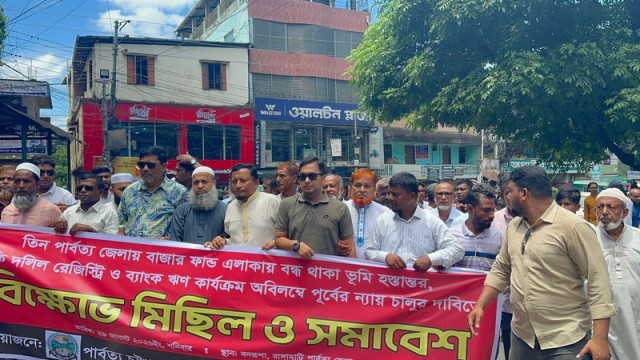
On Saturday (Aug 29), the Parbatya Chattagram Nagorik Parishad (PCNP) and its affiliated organisations held a protest rally and demonstration in Rangamati, demanding the resumption of bank lending against Market Fund land under the previous system.
The procession began at Happy Mor in Rangamati town at noon and passed through several streets before ending in a rally in front of the Banarupa Police Box.
The rally was moderated by Mohammad Habib Azam, general secretary of the central committee of the Parbatya Chattagram Chhatra Parishad (PCCP). PCNP central chairman Kazi Mujibur Rahman and other leaders addressed the gathering.
PCNP leaders said many traders had been operating businesses on Market Fund land for years and that the land and structures built on it represented some of their most important business assets.
However, they said traders were unable to obtain bank loans by mortgaging the land, leaving them without access to capital when needed.
Under normal business practices, entrepreneurs can use land or commercial properties as collateral to secure bank financing. Protesters said this opportunity had become severely restricted for Market Fund land, forcing some traders to seek alternative sources of financing at greater risk and cost.
They said land values have increased over the years, but traders have been unable to effectively use those assets to generate business capital. As a result, many entrepreneurs are facing liquidity pressures despite owning valuable property.
According to speakers at the rally, the then Rangamati deputy commissioner suspended land registration and mutation activities in Market Fund areas in 2017. Although the processes were later resumed following discussions with the authorities, they were suspended again in 2019.
Since then, land transfers, mortgage deed registration and access to bank loans have not returned to normal, they said.
PCNP leaders claimed that the prolonged uncertainty was placing the greatest pressure on small and medium-sized businesses.
They also said the lack of access to bank financing was limiting opportunities for business expansion. Established traders were unable to make fresh investments, while potential new entrepreneurs were being discouraged from entering business, with potential consequences for employment.
The protesters argued that the administrative complications surrounding Market Fund land were no longer merely a land-management issue but had become directly linked to the local economy of the Chittagong Hill Tracts.
A significant portion of traders’ wealth, they said, is tied up in Market Fund plots and the businesses built on them.
According to the protesters, if land cannot be sold, transferred or mortgaged through normal procedures, its economic utility becomes significantly restricted. This reduces traders’ investment capacity and limits the circulation of capital within the local economy, they said.
PCNP leaders warned that the longer the administrative complications continue, the greater the risk that business, investment and employment opportunities in the three hill districts will contract further.
The protesters placed several demands, including extending the lease period of Market Fund plots to 99 years, restoring bank loan facilities against the land and abolishing the existing three-tier LR Fund system governing land purchase, sale and mutation in favour of a land management and registration system similar to that used in other districts of Bangladesh.
They also demanded the abolition of the requirement for certificates from Circle Chiefs in matters including land transactions, business, employment and education.
In addition, they called for arrangements to allow land taxes and government dues to be paid through upazila land offices instead of Headman offices.
Among those present at the rally were PCNP central vice-chairman and standing committee member Mohammad Rezaul Karim Master; Mohammad Mahfuzur Rahman, associate professor at Chattogram Cantonment Public College; PCNP Rangamati district president Maulana Abu Bakkar Siddique; Khagrachhari district convener Abdul Majid; Bandarban district general secretary Nasir Uddin; Parbatya Chattagram Jubo Parishad central president Nur Hossain; Mahila Parishad president Morsheda Akhter; PCCP Rangamati district president Tajul Islam; and general secretary Mohammad Alamgir, along with other leaders and activists.
PCNP leaders warned that if the complications surrounding Market Fund land are not resolved quickly and mortgage deed registration and bank lending are not restored, stronger movements will be launched across the three hill districts.
For many traders, the central concern remains whether land and business establishments that have been recognised as their assets for years can actually serve an economic purpose when they cannot be used as collateral to secure financing when it is most needed.
END/AMR/SMA/