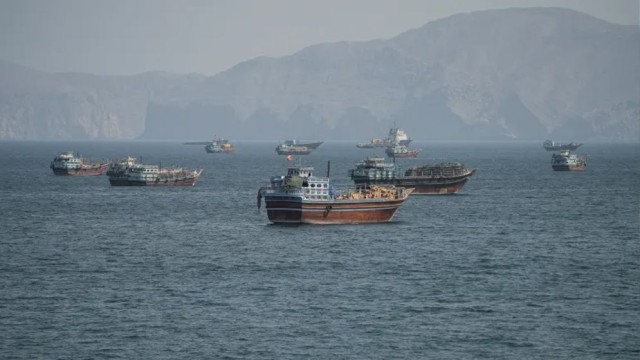
Dubai, Aug 22 (V7N)- Oil tankers are increasingly switching off their tracking systems and sailing under US military protection through the Strait of Hormuz amid growing tensions between Iran and the United States, according to CNN.
The Greek-owned supertanker Kiku is one example of the increasingly risky strategy. The vessel docked at Qatar’s Mesaieed oil export terminal on July 25 and left four days later carrying crude oil toward the Strait of Hormuz.
However, on the afternoon of July 31, the ship disappeared from tracking systems near the coast of Dubai after switching off its Automatic Identification System (AIS) transponder. Its signal reappeared on the other side of the Strait of Hormuz on the morning of August 1.
According to reports, commercial vessels are increasingly using this so-called “dark transit” strategy to reduce the risk of Iranian drone attacks. The strategy involves deliberately disabling tracking systems while ships pass through the strategically important waterway.
However, the narrow 23-mile-wide Strait of Hormuz remains difficult to cross undetected because ships can still be tracked through radar and other surveillance systems.
Two vessels from the United Arab Emirates have recently come under attack. The Kiku was also reportedly struck by a drone about a month ago, although the device did not explode.
According to data from maritime intelligence firm Kepler, around 80 percent of vessels passing through the Strait of Hormuz are now using dark-transit methods along the coast of Oman.
US Navy provides protection
With assistance from the US Navy, oil companies from Saudi Arabia, Kuwait, Qatar and the United Arab Emirates are reportedly turning off tanker tracking systems while transporting crude oil from the Persian Gulf toward the Gulf of Oman.
Once there, the tankers transfer their cargo to other waiting vessels before returning.
The strategy has effectively shifted some of the risks and insurance costs associated with commercial shipping onto the US government and oil producers.
According to the US Department of Energy, the arrangement currently allows between 8 million and 9 million barrels of oil to move through the Strait of Hormuz each day—nearly twice the volume indicated by publicly available tracking data.
The covert shipping operation has provided temporary relief to Asian oil markets at a time of heightened supply concerns.
The Kiku was spotted near the UAE port of Fujairah on August 1, where it anchored alongside another Greek-owned supertanker, the Nav Electron. The two vessels reportedly transferred oil over the following week.
Temporary relief for global oil markets
The dark-tanker strategy has helped maintain oil supplies despite the escalating military and political confrontation surrounding the Strait of Hormuz.
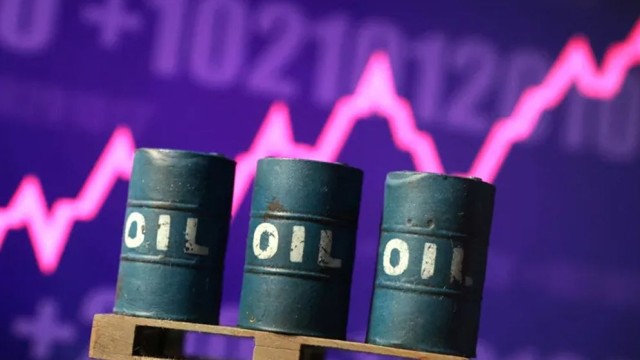
However, analysts say the arrangement is only a temporary solution. With US military pressure on Iran continuing and crude oil prices approaching $100 a barrel, uncertainty in global energy markets is expected to persist until a lasting political settlement is reached.
Trump claims US control over Hormuz
US President Donald Trump has claimed that the United States currently has complete control over the Strait of Hormuz.
Speaking at an event in South Carolina, Trump said he considered the strategic waterway to be US territory and claimed that the American naval blockade was already in place.
Trump has also said that Iran wants to reach an agreement with Washington but is not yet prepared to accept the conditions demanded by the United States.
Tehran denounces US sanctions
Iran has strongly condemned Washington's latest decision to impose tougher economic sanctions on Tehran.
Iranian Foreign Ministry spokesman Esmail Baghaei said that imposing sanctions on a sovereign country while disregarding international law violates the rights of independent states.
He described the US policy as an attempt to undermine the independence of UN member states and called it a new form of colonialism.
Iraqi tankers receive special permission
Meanwhile, Iran has granted special permission for certain Iraqi oil tankers to pass through the Strait of Hormuz following a request from Baghdad.
The development came during Iranian Parliament Speaker Mohammad Bagher Ghalibaf's recent visit to Iraq. Iran's state news agency IRNA confirmed that Tehran had agreed to facilitate the movement of specific Iraqi oil tankers through the strategically important waterway.
END/SMA/AJ