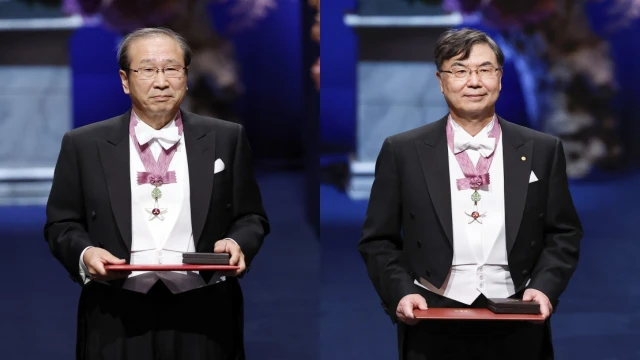
Stockholm, Dec 12 (V7N) – Two Japanese scientists, Shimon Sakaguchi and Susumu Kitagawa, received the prestigious Nobel Prizes in Stockholm on Wednesday, awarded by Sweden’s King Carl XVI Gustaf in a formal ceremony attended by fellow laureates and international researchers.
Shimon Sakaguchi, 74, honorary professor at Osaka University, won the Nobel Prize in Physiology or Medicine for discovering regulatory T (Treg) cells. These cells are vital for maintaining immune tolerance, preventing the body from attacking itself, and balancing immune responses. Sakaguchi’s groundbreaking work is considered one of nature’s most elegant balancing mechanisms in the human body.
Susumu Kitagawa, also 74 and a distinguished professor at Kyoto University, was awarded the Nobel Prize in Chemistry. He pioneered the development of metal-organic frameworks (MOFs), advanced porous materials capable of storing and transporting targeted gases efficiently. His work on flexible MOFs, which can adapt their structures on demand, is expected to revolutionize gas storage, catalysis, and material science.
The ceremony was held in a concert hall, followed by a formal banquet at Stockholm City Hall. During the event, both laureates interacted with the Swedish royal family and other Nobel winners. “I’m deeply grateful to receive such an award,” Sakaguchi told reporters. “I believe this is a special day in my life.”
These awards increase the number of individual Japanese Nobel laureates to 30, including three who hold U.S. citizenship. Japan’s contributions to scientific research have been widely recognized, with the Nobel Peace Prize last year awarded to Nihon Hidankyo, the Japan Confederation of A- and H-Bomb Sufferers Organizations.
The achievements of Sakaguchi and Kitagawa underscore Japan’s leadership in medicine and chemistry, highlighting decades of innovation and global impact. Their discoveries are expected to have lasting influence on immunology, material science, and applied chemistry worldwide.
END/WD/SMA/