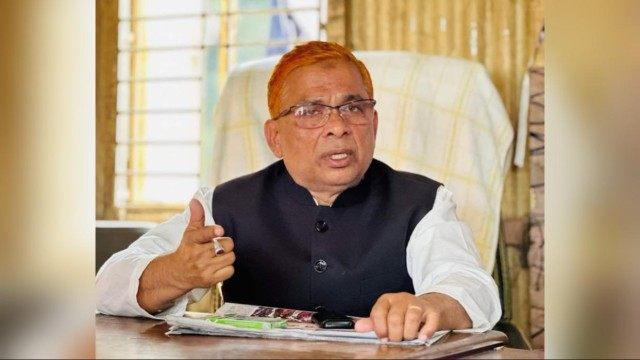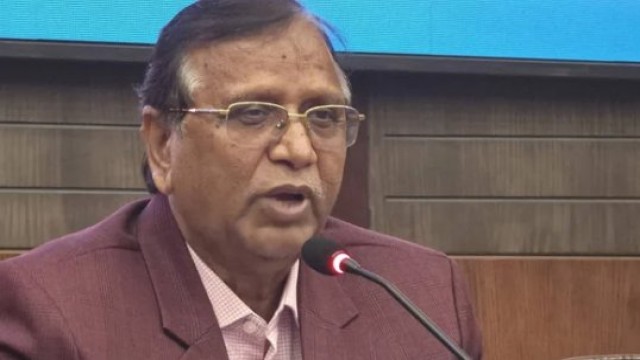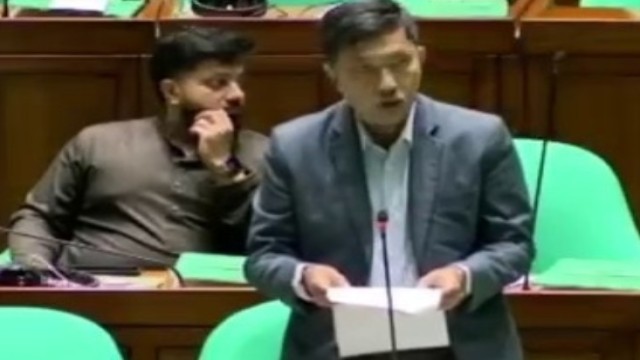
Rangamati, June 20 (v7n)— Dipen Dewan, the Member of Parliament for the Rangamati constituency, has issued an urgent appeal to the public to refrain from spreading confusion or politically motivated propaganda on social media regarding a recent speech he delivered in the National Parliament (Jatiya Sangsad).
The lawmaker issued a formal written statement on Saturday following intense online debates and criticism surrounding his recent remarks during the parliamentary budget session, where he advocated for maintaining long-standing tax exemption facilities for the tribal and small ethnic minority groups of the Chittagong Hill Tracts (CHT).
Clarification on Tax Exemptions
In his statement, MP Dipen Dewan noted that during the scheduled parliamentary debate on the national budget on June 18, he raised specific arguments concerning proposed amendments to the Finance Bill. He advocated strongly for the continuation of tax-free privileges that CHT’s tribal communities have historically relied upon.
Dewan provided historical context, pointing out that tax exemptions for the indigenous hill communities of the CHT were first codified over a century ago under the Income Tax Act of 1922. This structural relief was subsequently sustained under the Income Tax Ordinance of 1984 and reinforced under the recent Income Tax Act of 2023. However, because the current Finance Bill introduced an amendment aimed at bringing certain types of hill-district income into the tax net, he felt compelled to formally oppose the move on the parliament floor.
The Terminology Debate: 'Upajati' vs 'Adibashi'
Addressing aggressive online criticism regarding his use of the Bengali word "Upajati" (tribal/sub-tribe) instead of "Adibashi" (indigenous) during his speech, the lawmaker explained that his remarks were strictly bound by parliamentary rules and existing legislative terminology.
He clarified that he was simply quoting the exact administrative language and nomenclature embedded within the draft Finance Bill. Dewan emphasized that his speech was fundamentally an analysis of tax policy—not a sociological debate on ethnic identity—and accused certain quarters on social media of deliberately distorting his words to manufacture unnecessary controversy.
Representing All Communities Equitably
Responding to critics who claimed he only champions the interests of tribal groups, Dewan countered that the specific section of the Finance Bill under review solely concerned the tax status of CHT's small ethnic minorities. Because there were no separate tax proposals involving the permanent Bengali population in that particular clause, there was no legislative scope to address them at that moment.
However, the Rangamati MP strongly reaffirmed his commitment to protecting the socio-economic welfare of all citizens in his district, regardless of ethnicity, race, or religion. To prove his balanced advocacy, Dewan highlighted his successful efforts in blocking two other major tax proposals that would have severely damaged the local economy:
-
Source Tax on Timber: He actively fought against and successfully repealed a proposed source tax on timber transported from the three hill districts to other parts of the country.
-
Source Tax on Fisheries: He vehemently opposed a new tax on fish harvested from Kaptai Lake destined for outer-district supply chains, successfully stalling the measure at the preliminary stage.
Dewan pointed out that the vast majority of local business owners, laborers, and traders operating within the Kaptai Lake fisheries and the regional timber trade belong to the Bengali community. Therefore, his successful interventions against these source taxes directly protected the livelihoods of local Bengali residents.
Concluding his statement, MP Dipen Dewan urged the public and community leaders to evaluate his parliamentary contributions through a lens of objective reality rather than social media speculation. He expressed optimism that this comprehensive clarification would clear up any lingering public misconceptions, calling for unity to protect the shared development interests of Rangamati.
end/amr/rh/