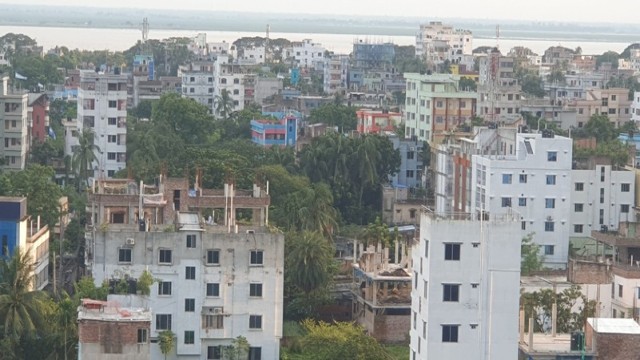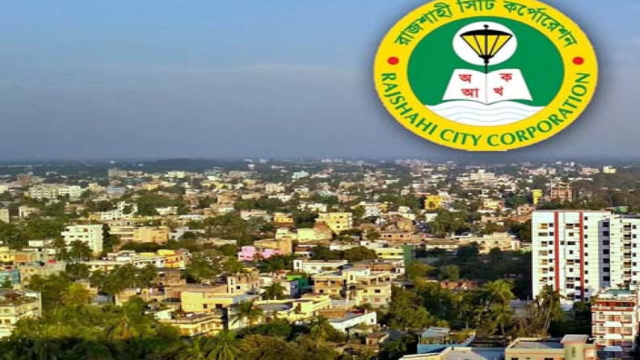
Rajshahi, Feb 7 (V7N) — Despite a steady rise in new houses and multi-storey buildings, Rajshahi City Corporation (RCC) is facing a sharp decline in holding tax collection, significantly reducing its revenue and raising concerns over future civic services.
According to RCC data, around 12,000 new houses were added in the 2024–25 fiscal year, taking the total number of holdings in the city to over 82,000. However, holding tax collection during the same period fell to just 27.31 percent, one of the lowest rates among Bangladesh’s city corporations.
The city corporation had set a target of Tk 82.73 crore in holding tax revenue, including arrears, for the fiscal year. Against this, only Tk 22.59 crore was collected. Of the Tk 45.74 crore in outstanding arrears from previous years, merely Tk 1.99 crore was recovered. In as many as 30 wards, less than 10 percent of the due holding tax was collected.
Trade licence revenue — another major income source — has also declined. RCC issued 2,451 trade licences in 2024–25, down from 2,519 the previous year. Renewals fell from 8,767 to 7,954, officials said.
Chief Revenue Officer Abu Saleh Md Noor-e-Sayed attributed the poor performance to administrative and structural challenges, including political instability following the July uprising, loss or displacement of records, and the absence of an executive magistrate to run mobile courts against chronic defaulters.
He said RCC is preparing to introduce an online holding tax payment system, which is expected to be launched soon. Regarding trade licences, he noted that many small traders have delayed renewals, citing weak business conditions.
Revenue pressure has been further compounded by newly implemented national tax rules, including a mandatory Tk 2,000 withholding tax on new trade licences and income tax return requirements for small traders. In response, RCC recently closed 16 branches, resulting in the layoff of 142 employees.
Several regular civic services — including health check-ups, market monitoring and food safety inspections — have also been suspended. The mayor was removed in August 2024, followed by the removal of councillors in September. A 19-member interim committee is currently managing RCC, but officials acknowledge that decision-making and enforcement have slowed without an elected board.
Despite the revenue shortfall, RCC has proposed a Tk 806 crore budget for the 2025–26 fiscal year, largely dependent on tax collection, grants and project-based funding.
Urban planners warn that weak revenue mobilisation could undermine essential services such as road maintenance, drainage, waste management and street lighting.
Dr Md Abdul Wakil, Professor of Urban and Regional Planning at Rajshahi University of Engineering and Technology, said reduced core revenue would inevitably affect service delivery. “City corporations plan and implement services based on expected revenue. When that revenue drops significantly, both routine operations and development activities come under strain,” he said.
Comparatively, Dhaka North and South City Corporations have achieved holding tax collection rates exceeding 60 percent, while Rajshahi remains at the bottom with around 27 percent, a gap analysts describe as indicative of deeper structural and administrative weaknesses in local tax management.
END/RAR/RH/