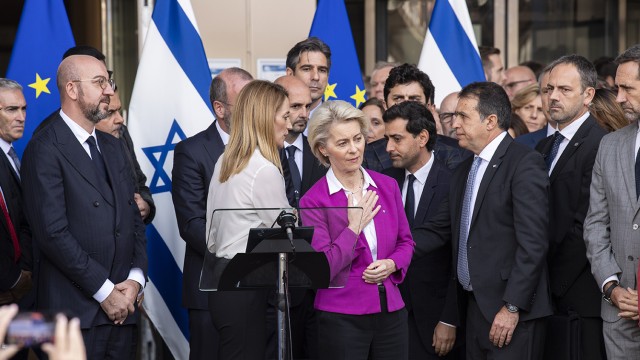
APR 20 (V7N) - European allies reaffirmed their commitment to the Palestinian Authority (PA) and the two-state solution on Monday, as shifting geopolitical focus toward a conflict between the US, Israel, and Iran has threatened to overshadow the crisis in Gaza. During a meeting of the "Global Alliance for the Two-State Solution" in Brussels, European leaders emphasized that the Israeli-Palestinian issue remains the central "compass" for stability across the entire Middle East.
This diplomatic push serves as a direct response to the marginalization of the PA under US President Donald Trump’s "Board of Peace" initiative. While the Trump administration's plan favors a transition of Gaza's governance to a technocratic committee of Palestinians, the European Union—the Palestinians' largest financial backer—insists that the Ramallah-based Authority must play a central role in a post-war landscape.
EU foreign policy chief Kaja Kallas underscored the urgency of the moment, calling for increased accountability and a renewed focus on human rights to place the two-state solution "solidly on the table again." These remarks highlight a growing divide between European strategies and the current US peace plan, which is currently in its second phase focused on the disarmament of Hamas and the withdrawal of Israeli forces.
Palestinian Prime Minister Mohammed Mustafa, who attended the conference, maintained that Gaza is an "integral part of the state of Palestine." He argued that governance should ultimately be handed back to the PA, viewing the current period of "immense tragedy" as a narrow but significant opportunity to transition from conflict to a lasting and just peace.
The gathering also reflected a hardening stance among several European nations toward Israel, driven by the escalating situation in the West Bank and Israel's military actions in Lebanon. Leaders like Belgian Foreign Minister Maxime Prevot warned that abandoning diplomatic efforts now would have global repercussions, insisting that the international community must "hold the course" despite the regional "storm."
In a notable move of dissent, Spanish Prime Minister Pedro Sanchez announced plans to renew his demand for the EU to suspend its cooperation agreement with Israel. Sanchez’s push for sanctions highlights the internal pressure within the bloc to take more decisive action against Israeli policies, even as some member states remain hesitant to disrupt existing regional truces.
Despite Spain’s vocal stance, diplomats suggest that a total suspension of cooperation with Israel is unlikely to gain unanimous approval. Many EU states are reportedly wary of taking steps that could jeopardize the fragile ceasefire in Lebanon, illustrating the complex balancing act Europe must perform while trying to maintain its influence in the region.
END/WD/RH