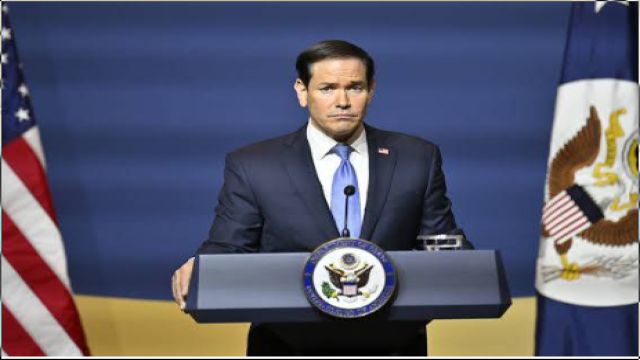
Tehran, Novm10, (V7N) – US Secretary of State Marco Rubio said Tuesday he saw no need to attack Iran again, as diplomatic efforts to end the war increased and Tehran urged Washington to accept its demands in order to reopen the Strait of Hormuz.
Hours after President Donald Trump said he saw "positive momentum" towards resolving the eight-month war, Rubio said the United States' successful squeezing of Iran's economy made further attacks unnecessary.
"The economic campaign (against Iran) is so devastating that right now there is no need for major combat operations," the secretary of state said after a meeting of G7 foreign ministers in Paris. "That's what I told our allies here today."
Iran's blockade of Hormuz, the major exit route for Gulf energy exports, has sent oil prices soaring — a major factor in the humbling of Trump's Republicans in last week's midterm elections.
Washington has imposed a counter-blockade on Iranian ports and in August announced what it called an "economic asphyxiation" campaign aimed at strangling Iran's economy, already battered by years of sanctions.
Britain's foreign minister Ed Miliband called for greater effort to end the conflict, while warning of the economic damage of an ongoing stalemate. "We need to move beyond the 'no war, no peace' stalemate, which is causing deep economic pain for our countries," he said in Paris. "We must see an all-out diplomatic effort to end this conflict, prevent a nuclear Iran and the threats it poses around the world, and get the Strait of Hormuz properly reopened."
Tehran said its offer to reopen Hormuz within two days, if Washington agrees to a raft of conditions, remains on the table. Iran's demands have included ending the war on all fronts, unfreezing Iranian assets, lifting oil sanctions and ending the US counter-blockade of Iranian ports.
"The conflict with Iran will not be resolved through military means, nor by intensifying sanctions," Foreign Minister Abbas Araghchi told Iran's IRNA news agency. "The only solution is to adopt a language of respect, engage in diplomacy, and address Iran's demands and conditions — which were outlined in the two-day proposal and remain on the table."
Washington has appeared to taper down threats of renewed strikes on the Islamic republic after the Republicans' heavy defeat in the midterms. On Monday, Trump said there was momentum towards ending the conflict after meeting Qatar's prime minister at the White House. In a post on social media, Trump reiterated that the US was "locked and loaded," but said further strikes were "quite unlikely" given that key US allies in the Gulf "would prefer the status quo." "We are seeing positive momentum toward an end to this Conflict, and will ensure that America's interests are at all times protected," Trump wrote.
Qatar and Pakistan are leading diplomatic efforts to resolve the war, which began with US-Israeli strikes that killed Iran's supreme leader Ayatollah Ali Khamenei in late February.
Qatari foreign ministry official Ibrahim al-Hashmi confirmed there had been progress in the negotiations. "The mediator is making a persistent and earnest effort to bridge the gaps between the parties' positions," he told a regular briefing, adding: "We remain hopeful."
Iranian political analyst Ali Bigdeli said the outcome of the US elections appeared to have "somewhat reduced Iran's flexibility, whereas the Americans have become more flexible." He noted that the Iranian terms were "demanding and heavy for the United States to accept" but added that "engaging in direct talks" could bear results. "The two nations have reached such a deep state of mutual distrust and uncertainty that the situation has become extremely difficult," said Bigdeli, a professor of political science at Shahid Beheshti University.
Iran's security chief Mohsen Rezaei urged Washington to "surrender" to the Iranian demands. "The war on Iran has already wrecked the US government. But Washington flails like a desperate gambler. FOLD YOUR HAND," Rezaei, the head of Iran's Supreme National Security Council, posted on X.
In Saudi Arabia, whose long-running conflict with Yemen's Tehran-backed Houthis has reignited during the US-Iran war, blasts rang out over the capital Riyadh early on Tuesday. The Saudi-led coalition fighting the Houthis and backing Yemen's government since 2015 said it shot down a Houthi ballistic missile targeting the city.