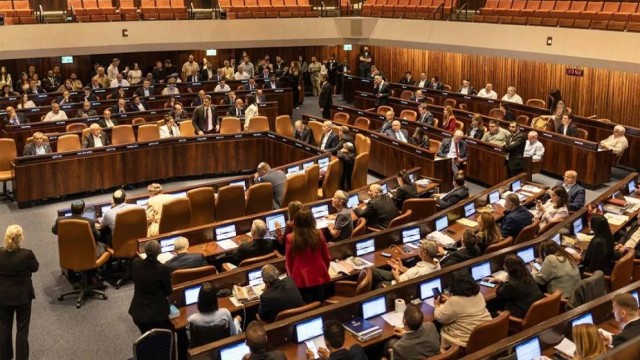
Jerusalem, Nov 10 (V7N)- Israel's newly elected 120-member parliament, the Knesset, is being sworn in today amid uncertainty over the formation of the country's next government following last month's inconclusive election.
Former army chief Gadi Eisenkot has been given the first opportunity to form a government, but faces a complicated political equation. His options include forming a minority government with support from Arab parties, securing an agreement with ultra-Orthodox Jewish parties or reaching a unity deal with his political rival, Prime Minister Benjamin Netanyahu.
If all efforts fail, Israel could be forced to hold another election.
The election was held on October 27, but no political bloc secured the 61 seats required for a parliamentary majority. Netanyahu's bloc won 53 seats, while Eisenkot's four-party alliance secured 48. Arab-led parties won the remaining 19 seats.
Israeli President Isaac Herzog tasked Eisenkot with forming the next government after consultations with political parties. He has 28 days to complete the process, with a possible 14-day extension.
One possible route for Eisenkot is to form a minority government with the backing of Arab-led parties. Together, his bloc and the Arab parties could command support from 67 lawmakers in the 120-seat parliament.
However, relying on Arab parties remains politically sensitive. Several members of Eisenkot's alliance have opposed such cooperation, while Eisenkot himself has ruled out forming a government with Arab-led parties.
Another option is to secure support from ultra-Orthodox Jewish parties, including Shas and United Torah Judaism. Together, they hold enough seats to potentially provide the numbers needed for a majority.
But negotiations could prove difficult, particularly over exemptions from compulsory military service for ultra-Orthodox religious students, a longstanding point of political disagreement.
Eisenkot could also consider a national unity arrangement with Netanyahu, although the two leaders have sharply conflicting political positions. Netanyahu has called for a unity government, while Eisenkot has rejected the idea of allowing him to remain prime minister under such an arrangement.
If Eisenkot fails to form a government, Netanyahu could be given another opportunity to secure a parliamentary majority. His bloc currently holds 53 seats and would also need support from lawmakers outside its alliance.
If neither leader succeeds, Israel could face another round of elections, prolonging the political uncertainty.
END/SMA/AJ