Taiwan, May 12 (V7N)- A rapidly escalating hypothetical conflict scenario involving the United States, Israel, and Iran has drawn intense international attention in strategic analysis circles, with experts linking its implications to future great-power tensions, particularly over Taiwan.
According to the scenario, a large-scale military confrontation dubbed “Operation Epic Fury” marks the start of a direct conflict between the US, Israel, and Iran. The United States is described as deploying advanced platforms such as F-35 fighter jets and B-2 stealth bombers, alongside precision-guided munitions and long-range strike systems targeting Iranian military infrastructure.
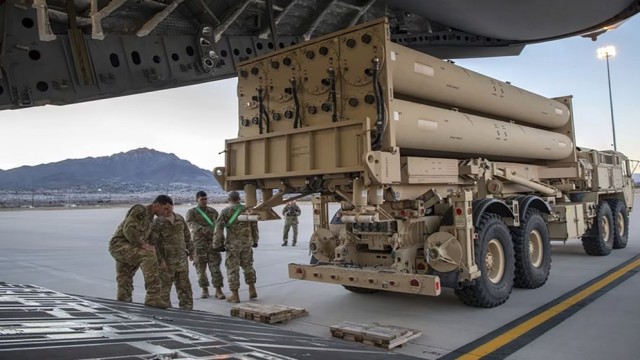
Iran, in contrast, is portrayed as relying on asymmetric warfare tactics, including low-cost drones, ballistic missile salvos, and coordinated multi-directional strikes designed to overwhelm advanced air defense systems such as Patriot and THAAD.
Changing nature of modern warfare
Military analysts cited in the scenario argue that the conflict highlights a shift in modern warfare: expensive, high-tech defense systems can be challenged by relatively low-cost, mass-produced unmanned systems. This asymmetry suggests that future conflicts may depend less on technological exclusivity and more on strategy, production capacity, and operational speed.
Chinese defense observers reportedly view the conflict as a “pre-exercise” for a potential Taiwan contingency, emphasizing lessons about air defense saturation and drone warfare effectiveness.
China–US strategic rivalry intensifies
The narrative places China in a close monitoring role, observing US operational patterns amid broader tensions over Taiwan and ongoing economic competition. Chinese military analysts are described as studying vulnerabilities in US defense systems exposed during the conflict.
China’s rapid advances in hypersonic missiles, stealth aircraft such as the J-20, and long-range strike systems are highlighted as part of its effort to narrow the military gap with the United States. However, analysts also note that China lacks recent large-scale combat experience compared to the US military’s operations in Iraq and Afghanistan.
Taiwan and regional escalation risks
The scenario extends the implications of the Middle East conflict to East Asia, where Taiwan remains a major flashpoint. Analysts suggest that future warfare around Taiwan could heavily involve drone swarms and missile saturation tactics similar to those observed in the Iran conflict narrative.
Taiwan, meanwhile, is described as strengthening anti-drone and air defense capabilities, while continuing to receive military support from the United States.
Global economic risks
Experts warn that simultaneous instability in the Middle East and East Asia would have severe global consequences. The Middle East remains central to global energy supply chains, while Taiwan is a critical hub for semiconductor production. Any prolonged conflict in either region could disrupt global trade, energy markets, and technology supply chains.
Strategic conclusion
The scenario underscores a broader conclusion in military analysis: battlefield success does not automatically translate into political victory. Historical cases such as Iraq, Afghanistan, and Vietnam are often cited as examples where military superiority did not ensure long-term political stability.
Analysts conclude that the emerging global security environment is increasingly defined by interconnected regional conflicts, technological asymmetry, and great-power competition shaping a new and uncertain international order.
END/SMA/AJ