


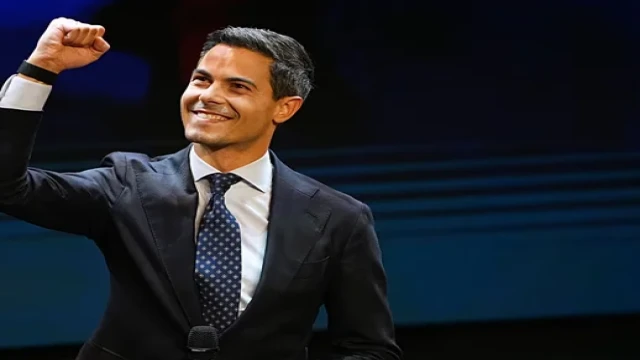
THE HAGUE, Feb 23, (V7N) — The new Dutch government is set to be sworn in on Monday, with 38-year-old Rob Jetten making history as the country's youngest-ever prime minister and the first openly gay leader. Jetten's stunning victory in October's snap election ended the dominance of the far-right Freedom Party (PVV) led by Geert Wilders, who had been a central figure in Dutch politics for years.
The snap election was triggered by the PVV’s withdrawal from the previous coalition, which had been the most right-wing government in Dutch history. This government lasted only 11 months, and Jetten's centrist party, D66, emerged victorious in the election, though it will not have a majority in parliament. Jetten's D66 will form a coalition with the centre-right CDA party and the liberal VVD, though together they only have 66 seats, nine short of a majority.
The parties reached a coalition agreement after 117 days of negotiations, significantly faster than the 223 days it took to form the previous government. Despite not having a parliamentary majority, Jetten remains optimistic, declaring after his win that defeating populist movements was possible "if you campaign with a positive message for your country."
A key pillar of Jetten's platform was his commitment to strengthening European cooperation. On the campaign trail, he emphasized the importance of bringing the Netherlands back to the heart of Europe. His government has pledged unwavering support for Ukraine and promises to meet NATO defense spending commitments.
However, experts point out that the new government, while more moderate than the previous one, still retains a "right-wing signature." According to Sarah de Lange, a professor of politics at Leiden University, the coalition has opted for budget cuts instead of running a deficit to fund investments. There will also be a continuation of the previous administration's strict immigration policies, with plans to tighten rules on family reunification and reduce social benefits, including unemployment assistance, in order to finance investments in military defense.
With only a slim parliamentary majority, Jetten’s government will need support from opposition parties to pass key legislation, making large reforms more difficult to implement swiftly. The coalition, while not as far-right as its predecessor, still carries significant right-wing influence in its policies.
In a notable shift, Jetten initially sought a broad coalition that would include left-leaning parties like Groenlinks/PvdA, but this was opposed by VVD leader Dilan Yesilgoz. As a result, Jetten's coalition relies on center-right parties and has been able to exclude far-right figures like Wilders from the political process.
Wilders, who shook European politics with his victory in the 2023 election, saw his political fortunes decline dramatically in 2025, as the PVV dropped from 37 to 26 seats. Despite remaining in second place, all coalition parties ruled out cooperating with him, leaving the PVV sidelined in the new government.
Other far-right movements have made gains, however. The Forum for Democracy, led by 28-year-old Lidewij de Vos, gained four seats in the 2025 election with its anti-immigration and anti-EU rhetoric. Hard-right party JA21 also saw significant growth, securing eight seats but failing to make it into the coalition government, thanks to Jetten's intervention.
Jetten and his cabinet will be officially sworn in on Monday by King Willem-Alexander at the Huis Ten Bosch in The Hague, marking the beginning of a new chapter for the Netherlands under its youngest and most progressive prime minister to date.
END/WD/RH/












Comment: