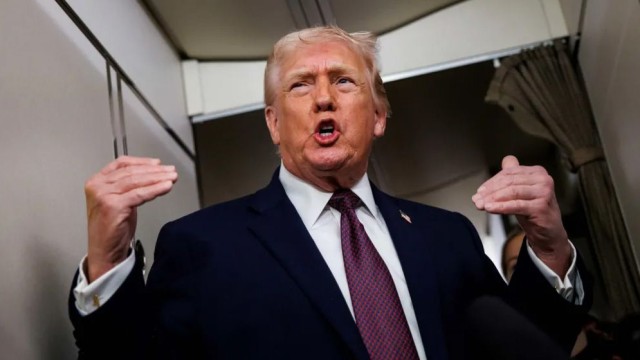
Washington, Feb 12 (V7N) - President Donald Trump is expected on Thursday to revoke a landmark scientific determination that greenhouse gases endanger public health — a finding that has long underpinned US regulations aimed at limiting climate-changing pollution.
White House Press Secretary Karoline Leavitt described the move as the “largest deregulatory action in American history.” Trump is scheduled to appear alongside Environmental Protection Agency (EPA) Administrator Lee Zeldin for the announcement.
Background of the Endangerment Finding
The 2009 “endangerment finding,” implemented during former president Barack Obama’s administration, concluded that six greenhouse gases threaten public health and welfare by contributing to climate change.
The determination followed a protracted legal battle that culminated in the 2007 Supreme Court ruling in Massachusetts v. EPA. The court held that greenhouse gases qualify as pollutants under the Clean Air Act and instructed the EPA to assess whether they pose a danger to public health and welfare.
Although the finding initially applied to vehicle emissions, it later became the legal foundation for a wide range of federal climate regulations.
Repealing the finding would also eliminate federal greenhouse gas standards for automobiles and could jeopardize other climate rules, including limits on carbon dioxide emissions from power plants and methane emissions from oil and gas operations.
Administration’s Argument
The administration’s draft proposal — which received more than 500,000 public comments — argues that greenhouse gases should not be regulated as traditional pollutants because their health impacts are indirect and global rather than localized. It further contends that regulating such emissions within US borders cannot effectively solve a global problem.
The proposal also questioned the scale and impacts of human-caused climate change, citing a report commissioned by an Energy Department working group that included climate change skeptics.
That report was widely criticized by researchers, who said it contained significant errors and misrepresented cited studies. Environmental groups later filed lawsuits alleging the panel violated federal transparency rules, and Energy Secretary Chris Wright subsequently disbanded the group.
Legal and Economic Debate
The administration has claimed that repealing the endangerment finding could result in more than $1 trillion in regulatory savings, though it has not detailed how the estimate was calculated. Officials also argue the move would reduce the cost of new vehicles.
Environmental advocates dispute those claims, saying the administration is overlooking benefits such as improved public health, reduced pollution-related deaths, and fuel savings from more efficient vehicles.
Critics also warn that rolling back emissions standards could favor less fuel-efficient vehicles, potentially undermining the US auto industry’s competitiveness in the growing global market for electric vehicles.
Legal experts expect swift court challenges once the final rule is published, and opponents have expressed confidence that the repeal will not withstand judicial scrutiny.
END/WD/RH