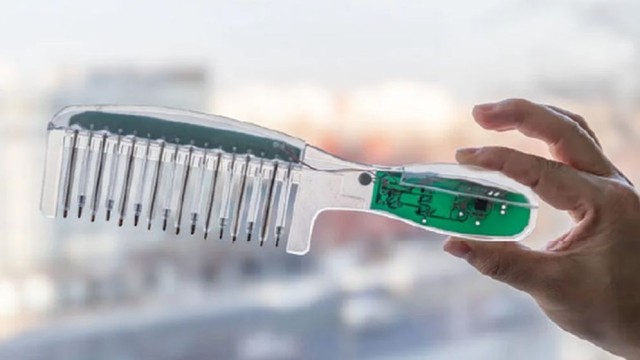
Beijing, Nov 18 (V7N)- Chinese scientists have developed an experimental electric comb that they say could help tackle baldness and hair loss by stimulating hair growth. The device, named ‘Detangle’, has reportedly produced promising results in tests on mice, but its effectiveness in humans remains unproven.
Researchers from Beihang University in Beijing developed the device, which they believe could eventually help treat androgenetic alopecia, commonly known as hereditary or male-pattern baldness.
A study published this month in the journal Nature Communications details the technology and its experimental results. Titled ‘Combing-Triggered Electrostimulation Synchronizing Deep Delivery for Rapid Hair Regrowth in Androgenetic Alopecia’, the research compares the device's performance with that of minoxidil, a widely used hair-loss treatment whose active ingredient is found in the brand Rogaine.
The comb's teeth are equipped with specialised electrical electrodes and drug-carrying molecules. The electrodes, designed at different heights, generate an electric field around hair follicles. This process is intended to deliver therapeutic ingredients to the hair roots while providing electrical stimulation.
According to the researchers, the device produced significant hair-regrowth results in mice with a condition resembling male-pattern baldness. The study reported a hair-regrowth rate of around 70 per cent with conventional minoxidil treatment, compared with nearly 100 per cent after one month of using the electric comb.
The researchers said the system substantially improved the effectiveness of hair restoration compared with conventional minoxidil treatment. However, the findings are based solely on animal experiments, and it remains uncertain whether the technology will produce similar results in humans.
Male-pattern baldness is a widespread condition. According to the UK's National Institute for Health and Care Excellence, up to 80 per cent of men may experience it at some point in their lives. Hair loss can also affect mental well-being and quality of life.
Treatment options remain limited. Minoxidil is commonly used to reduce hair loss and promote regrowth, but its effectiveness varies among individuals. Results can take up to a year to become noticeable, and continued use is generally necessary to maintain the benefits. Possible side effects include scalp irritation, while some users have also reported headaches.
Another established treatment is finasteride, marketed under the brand name Propecia. It can be effective in the early stages of hair loss, although potential side effects include sexual dysfunction, particularly erectile problems, and depression.
Hair transplantation has also become increasingly popular. The procedure involves taking hair follicles from areas where hair remains relatively dense, such as the back and sides of the head, and transplanting them into thinning or bald areas. Although it can be effective, the procedure may be complex, painful and expensive.
Despite the promising results, there is currently no evidence that the Detangle comb can effectively treat hair loss in humans. The researchers say further studies are needed to establish its safety and effectiveness before human clinical trials can begin.
For now, the technology remains experimental and should be viewed as a potential future treatment rather than a proven solution to baldness.
END/SMA/AJ