Rajshahi, Nov 16 (V7N) – Dengue has emerged as a serious public health crisis in Rajshahi and Chapainawabganj, with infections spreading from household to household across neighbourhoods in both districts. Multiple members of the same family are falling ill at the same time, while one patient is often hospitalised just as another recovers. Residents say they feel trapped in a prolonged battle against the mosquito-borne disease.
Mariam, a resident of Shibganj in Chapainawabganj, brought her sister-in-law to Rajshahi Medical College Hospital (RMCH) for treatment. Her husband lives abroad, and nearly every member of her household, including her in-laws and herself, had been infected with dengue.
"Just as one family member recovers, another becomes infected. We have to rush to the hospital repeatedly. It feels as though we are fighting a war against dengue," Mariam said.
Her family's experience reflects the situation facing many households across the two districts.
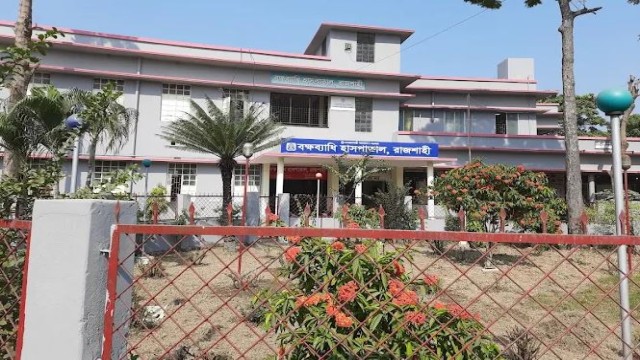
The scale of the crisis is evident in RMCH's statistics. Between January 1 and November 11 this year, 23 dengue patients died at the hospital. Ten of them were from Chapainawabganj, accounting for nearly 43 per cent of the total. Rajshahi recorded the second-highest number, with six deaths.
Two patients each died from Natore and Kushtia, while one death each was reported from Pabna, Jhenaidah and Sirajganj. Together, Rajshahi and Chapainawabganj accounted for 16 of the 23 deaths, or nearly 70 per cent.
RMCH spokesperson Dr Sheikh Shamim Ahmed told journalists that the latest death occurred on Tuesday afternoon, when Bulu Begum, 40, a housewife from the Dargapara area of Rajshahi city, died while undergoing treatment for dengue haemorrhagic fever. Earlier, on November 1, Runa Begum, 40, from the Namopara area of Chapainawabganj, died of dengue shock syndrome.
Dr Shamim said 45 new patients were admitted between Thursday morning and Friday morning, while 29 patients were discharged during the same 24-hour period. A total of 183 dengue patients were receiving treatment at the hospital at the time.
According to the Chapainawabganj district health department, 3,111 dengue patients were admitted to hospitals in the district between January 1 and November 5, while another 2,403 cases were identified through outpatient services. A further 214 patients were referred elsewhere for advanced treatment.
Official records show 15 dengue-related deaths in the district, although local residents claim that several more people have died after developing dengue-like symptoms.
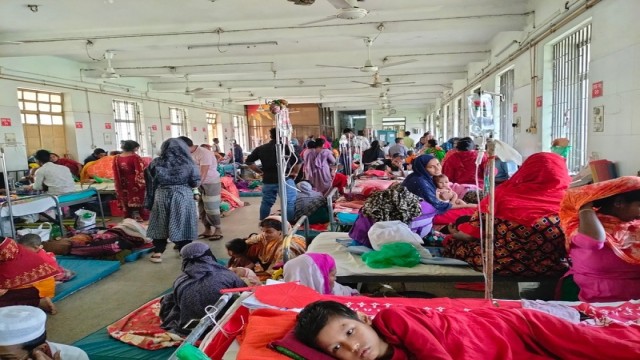
The growing patient load has forced many people to receive treatment on the floors and verandas of the 250-bed Chapainawabganj District Hospital. A shortage of doctors has added to the pressure, while some healthcare workers have also contracted the infection.
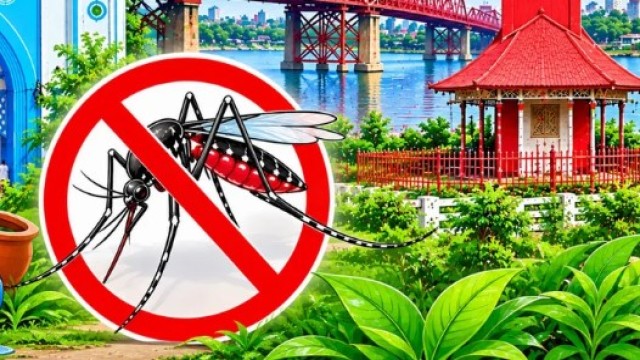
Aedes larvae found in more than one in three homes
A survey by the Institute of Epidemiology, Disease Control and Research (IEDCR) has highlighted the extent of mosquito breeding in the affected areas.
In Chapainawabganj municipality, IEDCR examined 150 homes in Mosjidpara, Mistripara, Notun Islambpur, Udayan Sangha Mor and Charjotpratap. Aedes mosquito larvae were found in 54 homes, meaning more than one in three inspected households had evidence of the dengue-carrying mosquito.
The spread of Aedes mosquitoes has also reached concerning levels in Rajshahi city.
During a survey conducted from August 3 to 10 in Kajihata, Chandipur, Uparbhadra, Namobhadra and Hajrapukur, larvae were found in 24 of 75 houses and 46 of 68 water containers examined.
Of the 685 larvae collected, 505 were identified as Aedes albopictus and 86 as Aedes aegypti.
Rajshahi Divisional Director of Health Dr Habibur Rahman said that, according to World Health Organization guidelines, an area with a Breteau Index above 20 is considered high-risk. The latest survey recorded a Breteau Index of 61.33 in Rajshahi, indicating a particularly serious risk of Aedes mosquito infestation.
Administration and city corporation step up measures
Authorities in both districts have announced special programmes to address the situation.
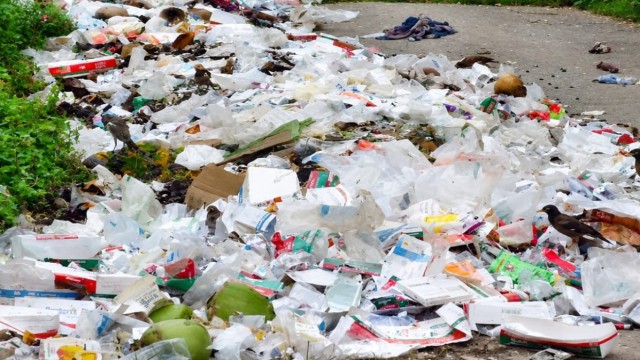
Chapainawabganj Municipality Executive Officer Mamun Or Rashid said inadequate and unplanned drainage systems were contributing to waterlogging and creating favourable breeding conditions for mosquitoes. Special teams were working to reduce waterlogging and control mosquito populations.
Chapainawabganj Deputy Commissioner Abu Saleh Md Musa said eight special teams had been formed to destroy mosquito breeding sites and raise public awareness in municipal areas.
Civil Surgeon Dr AKM Shahab Uddin said awareness campaigns were being conducted through public announcements and Friday prayers, with imams asked to inform worshippers about dengue prevention.
In Rajshahi, the city corporation has launched a three-month special programme across its 30 wards under the direction of Administrator Mahfuzur Rahman Riton. The programme includes phased insecticide spraying using fogging machines.
Rajshahi City Corporation mosquito-control officer Syed Zubayer Hossain said the campaign also involved block-based cleaning drives, drain clearance and the application of larvicide.
The city corporation administrator has urged residents to keep their homes, yards and surrounding areas clean and eliminate stagnant water to prevent mosquito breeding.
END/MRA/SMA/