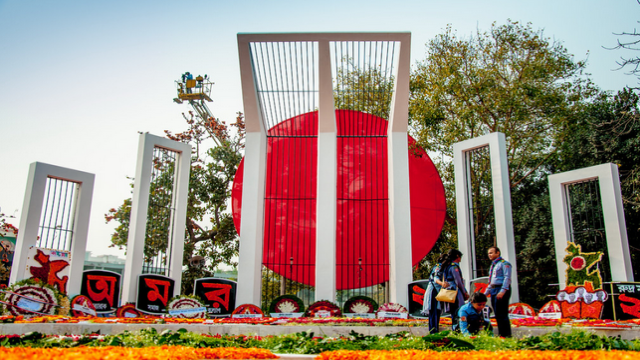
DHAKA, Feb 21, (V7N) – The rhythmic tolling of the midnight bell across the sprawling landscape of Dhaka on February 21, 2026, signaled more than just the arrival of a new day; it marked the seventy-fourth anniversary of a moment that redefined the soul of a nation and the linguistic conscience of the world. As a profound silence enveloped the capital, the haunting, melodic strains of the immortal song, "Amar Bhaiyer Rokte Rangano Ekushey February," began to resonate through the air, carrying the weight of decades of grief, pride, and unyielding resilience. Today, Bangladesh observes Martyrs' Day and International Mother Language Day with unprecedented fervor, honoring the valiant sons of the soil who, in 1952, made the supreme sacrifice to establish the rights of their mother tongue, Bangla. The atmosphere around the Central Shaheed Minar was one of deep solemnity and spiritual reflection, as thousands of people from all walks of life, many wearing black badges of mourning, converged to pay their glowing tributes. This day, now recognized globally by UNESCO since 1999, stands as a testament to the fact that language is not merely a tool for communication but the very bedrock of cultural identity and national sovereignty, a lesson the people of this land taught the world through their blood and bravery.
The official observance of Amar Ekushey commenced in the early hours of Saturday with a display of state solemnity that bridged the gap between the historical past and the aspirations of the future. President Mohammed Shahabuddin arrived at the Central Shaheed Minar at 11:59 pm on Friday, greeted by the Vice-Chancellor of Dhaka University, Professor Dr. Niaz Ahmed Khan, as the nation held its breath for the zero hour. As the clock struck 12:01 am, the President placed a floral wreath at the altar of the Shaheed Minar, standing in a moment of profound silence to honor the memories of the language heroes. Shortly thereafter, Prime Minister Tarique Rahman arrived at the monument at 12:04 am, placing his wreath at 12:07 am to pay rich tributes on behalf of the government and the people. The image of the two highest leaders of the state walking barefoot toward the monument, flanked by the rhythmic beat of a mourning procession, served as a powerful reminder of the unity that the language movement continues to inspire within the Bangladeshi psyche. Following the state leaders, a procession of distinguished personalities, foreign diplomats, and political representatives began to lay their own wreaths, transforming the base of the Shaheed Minar into a vibrant sea of flowers under the watchful eyes of law enforcement agencies ensuring a disciplined and secure environment.
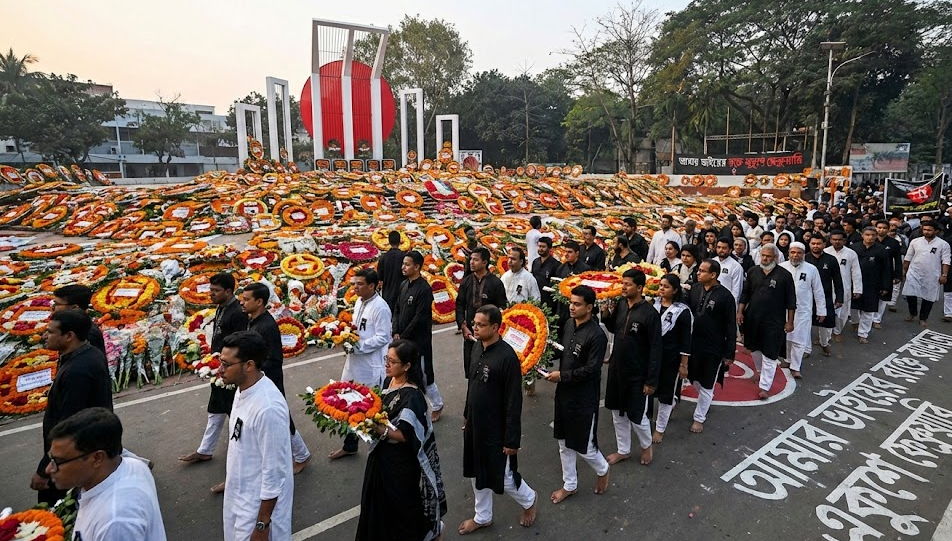
In a departure from traditional state protocol that often sees high-ranking officials depart immediately after the wreath-laying ceremony, Prime Minister Tarique Rahman set a unique historical example by staying on the premises to offer collective prayers for the departed souls. Standing before the towering pillars of the Shaheed Minar at 12:08 am, the Premier joined a solemn gathering for a special doa conducted by the Senior Imam and Khatib of the Dhaka University Central Mosque, Hafez Mowlana Nazir Mahmud. This prayer was not limited only to the martyrs of 1952; it was an inclusive spiritual bridge that sought divine forgiveness and eternal peace for the heroes of the 1971 Liberation War, the 1990 Anti-autocracy Movement, and the 2024 July Uprising. The congregation also offered special prayers for the welfare of the country, seeking divine blessings for the late Shaheed President Ziaur Rahman and former three-time Prime Minister Begum Khaleda Zia. By incorporating the martyrs of the recent 2024 uprising into the official Ekushey prayers, the government signaled a new era of national narrative-building, one that acknowledges the continuous struggle for justice and democracy that began with the defense of the mother tongue and continues to evolve in the contemporary political landscape.
To understand the weight of today’s observance, one must look back to the tumultuous years following the 1947 partition of India, when the seeds of this linguistic revolution were first sown. The creation of East and West Pakistan was a geographical anomaly held together by a fragile political thread that snapped when the ruling elite attempted to erase the cultural identity of the majority. In 1948, the declaration by Muhammad Ali Jinnah that Urdu alone would be the state language of Pakistan sparked a fire of protest in the hearts of the Bangla-speaking population. This was not merely a dispute over alphabets; it was a resistance against a colonial mindset that sought to disenfranchise the people of East Bengal from their administrative, economic, and cultural rights. By February 21, 1952, this simmering tension reached its breaking point when students of Dhaka University and common citizens defied Section 144 to take to the streets. The subsequent police firing in front of the Dhaka Medical College and Hospital resulted in the martyrdom of Salam, Rafique, Shafique, Jabbar, and Barkat, whose names are now etched forever in the annals of history as the primary architects of Bangladeshi independence.
The movement for Bangla did not end with the tragedy of 1952; rather, it became the catalyst for a decade-long struggle against repression and misrule that eventually forced the Pakistan government to recognize Bangla as one of the state languages in the 1956 constitution. However, the recognition was only a partial victory, as the spirit of Ekushey had already transformed into a broader demand for self-determination and socio-political equity. The blood-stained path of February 21 paved the way for the six-point movement, the mass upsurge of 1969, and ultimately the glorious War of Independence in 1971. Today’s seventy-fourth anniversary serves as a reminder that the emergence of Bangladesh was a linguistic necessity as much as it was a political one. The national flag, flying at half-mast today at all government, semi-government, and private organizations, symbolizes a nation that remembers its grief even as it celebrates its sovereignty, ensuring that the sacrifices of the language martyrs are never relegated to the dusty shelves of forgotten history but remain a living, breathing part of the national identity.
In a poignant message issued on the eve of the day, Prime Minister Tarique Rahman emphasized that the movement to protect the mother tongue was the bedrock upon which the struggle for self-rule and democracy was built. He extended his sincere congratulations to Bangla-speaking people worldwide and to all ethnic groups fighting to preserve their unique linguistic heritage. The Prime Minister articulated a vision for a "self-reliant, secure, humane, and democratic state," one that upholds the aspirations of all martyrs from 1952 to the 2024 struggle to protect independence. His call for the global community to work together to uphold the dignity of all languages reflects the international dimension of the day, acknowledging that the fight for one’s mother tongue is a universal human right. This sentiment was echoed by the Chief Justice of Bangladesh, Zubayer Rahman Chowdhury, who, along with judges of the Appellate and High Court Divisions, paid his respects at 6:00 am, underscoring the judiciary's commitment to the values of justice and cultural preservation that the language martyrs died to defend.
The physical landscape of Dhaka and the rest of the country has been transformed to reflect the solemnity of the occasion, with various street islands and key intersections decorated with festoons featuring the alphabets of all ethnic communities of the country. This inclusive approach highlights that while Bangla is the primary state language, the spirit of International Mother Language Day encompasses the protection of every mother tongue within the nation’s borders. The Ministry of Cultural Affairs has undertaken an extensive range of programs, including mobile musical concerts on trucks across the metropolis and boat-based cultural performances on the waterways surrounding the capital. These initiatives, organized by the Mass Communication Department, aim to bring the history of the language movement to the doorsteps of the common people. Furthermore, the Bangladesh National Museum, along with its branch museums and archaeological sites, has offered free entry to children, senior citizens, and persons with special needs, facilitating a day of educational reflection for those who might otherwise be disconnected from these cultural hubs.
As the day progresses, the focus shifts toward the intellectual and literary celebrations that have become synonymous with the month of February in Bangladesh. The Bangla Academy is currently hosting the iconic Ekushey Book Fair, a month-long event that serves as the center of the nation's literary life, featuring participation from the Shilpakala Academy, the Islamic Foundation, and numerous private publishing houses. This fair is more than a commercial endeavor; it is a pilgrimage for bibliophiles and a platform for new voices to contribute to the rich tapestry of Bangla literature. Meanwhile, the Shishu Academy has organized drawing competitions and recitations of rhymes and poems for children, ensuring that the younger generation understands the "unspoken words" of the anti-fascist movements and the historical context of their linguistic freedom. Even the digital realm has not been ignored, with the Election Commission and other government bodies working on regulatory reforms to prevent the misuse of artificial intelligence in misrepresenting historical narratives, ensuring that the truth of the 1952 movement remains untainted for future digital archives.
Ultimately, the observation of February 21, 2026, serves as a bridge between the historical struggles of the mid-twentieth century and the evolving democratic challenges of the twenty-first. From the midnight tributes at the Shaheed Minar to the mobile film screenings in remote upazilas, the nation has collectively renewed its vow to protect the dignity of its mother tongue and the sovereignty of its land. The prayers offered at mosques, temples, and churches across the country for the eternal peace of the martyrs’ souls reflect a multi-faith recognition of the sacredness of the sacrifice made seventy-four years ago. As the sun sets on this public holiday, the echoes of the Prabhat Pheri and the sight of the national flag at half-mast remind every citizen that their voice is their power. The legacy of the language martyrs continues to inspire a nation that refuses to be silenced, proving that as long as the heart of a Bangladeshi beats, the language of the martyrs will resonate through the halls of history, guiding the country toward a future defined by the same courage that once stood defiantly in the face of bullets at the gates of Dhaka Medical College.
END/RH/