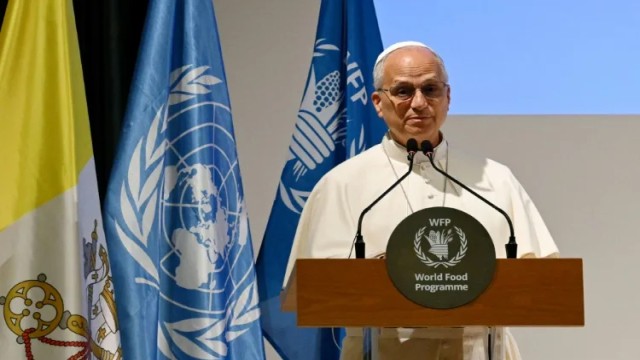
ROME, June 22 (V7N) — Pope Leo XIV on Monday condemned the “progressive bureaucratisation of solidarity” that slows aid to the world’s hungry, while weapons continue to move freely and fuel conflicts.
During a visit to the World Food Programme (WFP) headquarters in Rome, the pope called on the international community “to increase the resources dedicated to combating hunger and its root causes, and to remove the obstacles that prevent aid from reaching those in need.”
He said humanitarian needs are often sidelined despite global pledges to ease suffering.
“It is precisely within the gap between acknowledgement in principle and prioritisation in practice that we witness the progressive bureaucratisation of solidarity alongside the quiet commodification of human life,” Leo said.
“On one hand, humanitarian action is increasingly burdened by bureaucratic procedures that can delay assistance. On the other hand, access to essential goods, including food, is too often influenced by economic or strategic considerations,” he said. “As a result, those who do not generate quantifiable value risk becoming invisible.”
The 70-year-old pontiff noted that while aid and development efforts face obstructions, the flow of weapons does not. “In effect, conflicts are ‘fed’ more readily than people are nourished,” revealing “a fundamental imbalance in political and moral priorities,” he said.
Pope Leo XIV, the US-born leader of the world’s 1.4 billion Catholics, urged governments and the public to boost support for groups fighting hunger, including the UN’s WFP, which assisted 121 million people in 2025.
“The world today could live without hunger,” Leo said during an informal video call with WFP staff in South Sudan, Venezuela, and Lebanon. “The resources should be available. The capacity of food production exists, and yet oftentimes the resources are spent on... promoting war and conflict and other kinds of, if you will, less important end results. And so that the hunger continues even to increase in some parts of the world.”
The WFP says it has been severely affected by sharp funding cuts from Europe and the United States in recent years, even as challenges grow. The war in the Middle East has added logistical hurdles and driven up costs for aid delivery in multiple countries.
END/WD/RH/