RAJSHAHI, Aug 9 (V7N) — Grape cultivation is gradually shifting from a hobby to a commercial agricultural venture in Rajshahi's Barind region, as farmers explore foreign varieties and modern cultivation techniques suited to the local climate.
Farmers and young entrepreneurs in Paba and neighbouring upazilas are increasingly cultivating varieties such as Baikunur and Aclor, with early results indicating good yields and promising prospects for commercial production.
Rajshahi has already gained recognition for the cultivation of fruits such as strawberries, malta and dragon fruit. Grapes are now emerging as another potential commercial crop, with farmers in Paba, Bagmara, Durgapur and Godagari showing growing interest.
The region's climate is considered favourable for producing sweet grapes, encouraging farmers to expand their orchards. The Department of Agricultural Extension is also providing technical guidance to farmers to help reduce production risks and improve commercial prospects.
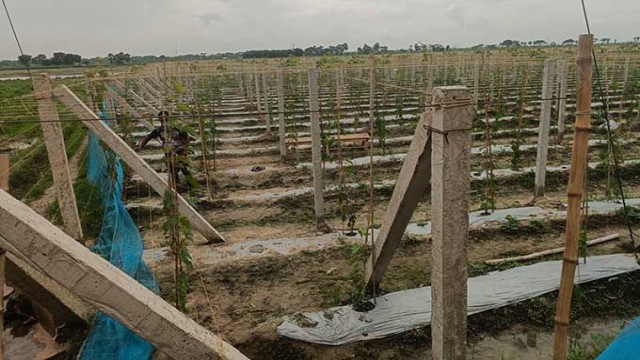
At a field in Basantapur village of Paba, rows of concrete posts can be seen supporting grapevines growing across a large area of farmland. Two young entrepreneurs from the nearby Baya area, Mahbub and Samrat, are cultivating grapes there.
Samrat said they have planted grapes on four bighas of land in Basantapur and another bigha in Baya. Their orchards include Baikunur, Apollo, Dasunia and Australian King varieties.
Although they have not received formal academic training in grape cultivation, the two entrepreneurs have visited grape farms in several parts of Rajshahi as well as Cumilla, Chuadanga, Jashore and Natore to learn from other growers.
Samrat said he had long dreamed of becoming an entrepreneur and creating employment opportunities through his own agricultural venture.
He said the initial investment required for grape cultivation is relatively high, which discourages some potential growers.
According to him, farmers may need to spend around Tk 4.5 lakh to Tk 5 lakh per bigha before the vines reach full production. Some fruit can be harvested relatively soon after planting, although the vines require regular pruning and careful management during their growth.
The entrepreneurs have so far planted around 2,050 grape saplings across their orchards. They believe healthy vines can remain productive for several decades if properly managed and protected from disease.
A grape grower from another upazila in Rajshahi, who requested anonymity, said one farmer harvested around 7,000 kilograms of grapes from 360 plants during the current season, with the produce valued at approximately Tk 20 lakh.
According to growers, around 30 to 32 farmers are currently cultivating grapes on approximately four hectares of land across three upazilas of Rajshahi. Their early success has encouraged other farmers to consider establishing grape orchards.
The farms are also attracting visitors and aspiring entrepreneurs interested in learning about the cultivation process.
A prospective grower named Dulal visited one of the orchards to assess whether grapes could be successfully cultivated on his own land.
“We want to find out whether grapes can grow in our soil. I plan to plant two or three saplings on a trial basis. If they perform well, we will consider expanding into commercial cultivation,” he said.
Farmers in Rajshahi had previously attempted grape cultivation but struggled to achieve satisfactory results. Growers now say changing weather conditions, improved cultivation methods and the use of protected structures such as polyhouses have increased the prospects for successful production.
The Department of Agricultural Extension has also increased its support by providing farmers with technical advice and guidance on commercial grape production.
An official familiar with agricultural activities in Paba said preliminary assessments indicated that the soil and climatic conditions of Paba and other parts of the Barind region were suitable for experimental grape cultivation.
The official said the development could open a new avenue for commercial grape production in the region, adding that agricultural officials were providing farmers with necessary technical advice.
END/MRA/SMA/