Dhaka, Nov 14, (V7N) – A peer review of a forensic audit report on Bangladesh's Gross Domestic Product (GDP) estimates has found that the country's GDP figures were overestimated by 0.8 to 1.13 percentage points, particularly since fiscal year 2014-15, through deliberate manipulation of data in seven economic sectors during the fallen regime.
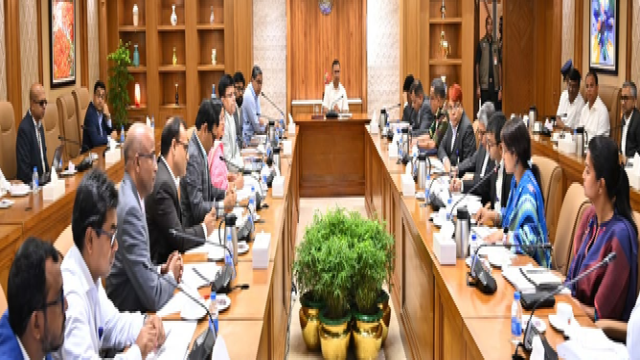
Dr Rashed Al Mahmud Titumir, Prime Minister's Adviser on the Ministries of Finance and Planning, informed this while speaking at a seminar as the chief guest on the peer review of the draft forensic audit report on GDP estimates at the Bangladesh Bureau of Statistics (BBS).
He said the forensic audit findings exposed deliberate and systematic attempts to manipulate economic data, describing the distortion as a planned effort to destroy the country's national institutions and use statistics as a political tool to promote a development narrative.
Bangladesh Economic Association (BEA) Convener and eminent economist Prof Dr Mahbub Ullah spoke as the guest of honour, while President of the Bangladesh Statistical Association Prof Syed Shahadat Hossain also spoke.
Md Firoz Sarker, Secretary of the Statistics and Informatics Division under the Ministry of Planning, chaired the seminar and also gave the address of welcome. Director General of BBS Md Shamimul Haque gave the vote of thanks.
Dr A K Enamul Haque, Director General of the Bangladesh Institute of Development Studies (BIDS), and Dr Atonu Rabbani, Professor of the Department of Economics at Dhaka University and Research Director of BIDS, presented the keynote paper.
Titumir said the review identified inconsistencies in 22 subsectors of the industrial sector and found that GDP estimates had been inflated mainly in areas where administrative and secondary data, rather than reliable survey-based information, served as the sources. "The findings show that GDP estimates were overvalued by 0.8 to 1.13 percentage points," he said, adding that the discrepancies became particularly noticeable after 2014-15.
Titumir said the government wants to leave behind a credible and politically neutral statistical system that will remain unchanged even after a change of government. "Our objective is to establish a statistical system where the neutrality and credibility of data will not change with a change of government," he said.
Titumir alleged that the previous fallen government had used manipulated statistics to construct a development narrative and project an exaggerated picture of economic growth. He said the review identified specific areas of data manipulation, particularly in sectors where the government collected administrative information and where independent verification remained difficult.
The report found inconsistencies in cement production and its corresponding value addition, as the reported figures did not match related economic indicators. It also identified unusual fluctuations in petroleum-sector data, where production figures showed substantial increases followed by sudden declines.
He said the researchers carefully excluded statistical outliers, including the exceptional impact of the COVID-19 pandemic, to ensure that the assessment followed scientific methods.
The adviser said the review did not identify similar manipulation in the readymade garment sector because reliable industry data remained available, making any artificial inflation easier to detect. He cited discrepancies among export data maintained by the Export Promotion Bureau (EPB), Customs and Bangladesh Bank as another example of weaknesses in the country's statistical system.
Titumir said the government had already started addressing these weaknesses, including a decision to use actual Bangladesh Bank data instead of relying on inconsistent figures from the EPB and Customs for export-related calculations.
He said the government initiated the forensic review immediately after assuming office to restore public confidence in national statistics and ensure that political considerations did not influence the assessment. The review followed established research methodologies, including an initial draft prepared by two researchers and subsequent peer reviews involving economists, statisticians and researchers from different professional backgrounds.
Explaining the government's reform measures, Titumir said the BBS had introduced the Computer-Assisted Personal Interviewing (CAPI) system to improve the reliability of survey data. The system incorporates geographical coding to verify whether enumerators actually visit designated locations and collect information from the field.
He said the government also planned to verify GDP estimates against independent indicators, including electricity and gas consumption, to establish whether reported production figures reflected actual economic activities. The adviser said the government aimed to introduce quarterly GDP estimates, with first-quarter figures published within the second quarter, but weaknesses in data collection and statistical methodologies had prevented timely publication.
He also said the government was considering introducing the income-based approach to national income accounting alongside the existing production-based and expenditure-based methods. The government would also reform sampling and data collection methods, particularly in industrial sectors where the review identified inconsistencies, and improve the preparation of input-output tables through standardised templates.
Emphasising transparency, Titumir said the government was preparing an open-data policy to ensure wider access to statistical information for researchers and the public. He said reliable statistics were essential for preparing budgets, formulating development plans and ensuring government accountability to citizens.
"National statistics belong to the state and the people, not to any individual or government. GDP is neither merely a number nor a political instrument. Its accuracy is extremely important," he said. He expressed gratitude to the researchers who prepared the forensic review without remuneration, saying the government wanted to establish a statistical system whose neutrality and credibility would remain intact irrespective of changes in government.
BEA convenor and eminent economist Prof Dr Mahbub Ullah said the BBS needs to strengthen field-level data collection to ensure more reliable GDP estimates and improve the accuracy of national economic statistics. "Future GDP estimates must be more reliable and of higher quality. For this, we need to go further into the field to collect more accurate data," he said.
He stressed that greater attention should go to field-level data collection, particularly in agriculture and the informal sector, where a large number of people remain engaged. Although agriculture contributes around 11-12 percent to GDP, he said, the sector still employs a significant portion of the population and deserves closer examination to ensure accurate measurement of its economic contribution.
He also called for a comprehensive assessment of the informal economy, saying its contribution through labour income, market creation and economic activities often remains inadequately captured in national statistics. Mahbubullah emphasised the need for scientifically designed and representative samples to ensure that collected data properly reflect the country's overall population and economic activities.
"Although extensive field-level data collection increases costs, the BBS must exercise sound judgement in sample determination to ensure that the samples properly represent the population," he said. He also recommended greater adherence to the UN System of National Accounts and developing a national input-output matrix to improve GDP estimation and economic planning.
end/aj/rh/