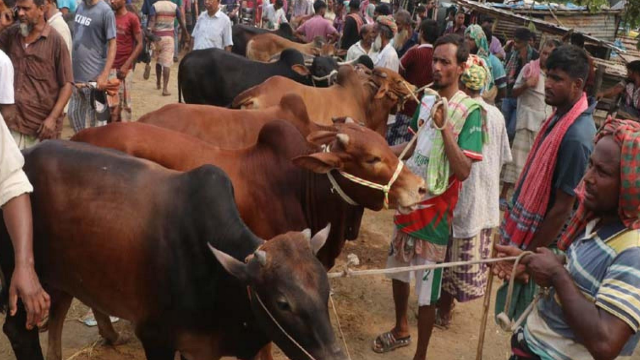
RAJSHAHI, May 23 (V7N): With only two days remaining until the holy Eid-ul-Azha, traditional cattle markets across Rajshahi are struggling to attract buyers as a growing number of consumers turn toward private livestock farms. To avoid harassment from market lessees, aggressive middlemen, and the general chaos of crowded urban setups, shoppers are increasingly choosing farm-to-consumer purchases. Inside these farms, buyers can select healthy livestock in a stress-free environment, relying on modern digital weighing systems rather than intensive haggling.
Both buyers and farm owners in the region report that trading cattle via digital weight scales offers distinct economic advantages and eliminates mutual distrust. Under this system, cows are priced transparently between 550 Taka and 600 Taka per kilogram based on their live weight. This transparent measurement allows families to purchase healthy, certified livestock that fits their precise budgets without the fear of being cheated or overcharged.
According to data compiled by the Department of Livestock Services across Rajshahi district and its metropolitan areas, there are currently 26,234 small and large livestock farms in operation. These commercial facilities house a diverse pool of breeds, including Shahiwal, Deshal, Albino, Buffalo, Hasha, Ulbari, Nepali, and Bhutti cattle. Pricing inside these organized structures varies vastly depending on the breed and mass, with individual animal valuations ranging from one lakh Taka to as high as 100 lakh Taka for premium varieties.
These private farms are experiencing a steady, daily influx of corporate professionals and families looking for early holiday deals. Once a buyer selects an animal, it is weighed on-site, paid for, and left at the farm under specialized care until the eve of the festival. Buyers arrange to pick up their livestock just one or two days before Eid to minimize urban residential housing hassles, while several large-scale farms have introduced their own logistics and transport vehicle services to deliver the booked cattle directly.
Despite robust sales, commercial farmers emphasize that the cost of raising livestock has skyrocketed compared to previous fiscal cycles. Sharp price hikes in processed cattle feed, veterinary medicine, manual labor, and regular maintenance overheads have significantly narrowed profit margins. In response to these compounding financial pressures, prominent farms like SJ Padma Agro have intentionally downsized their breeding capacity, scaling back from preparing 200 to 300 cows in previous years to much smaller, manageable batches this season.
While the direct farm-to-consumer model significantly benefits both farmers and local buyers by removing middleman fees, it has introduced an unintended fiscal consequence for the regional administration. Because these private transactions bypass municipal borders and official government-authorized marketplaces, no market revenue or official lease taxes are collected on these high-value sales. As a result, the national exchequer is losing a substantial amount of potential tax revenue during this high-volume festive window.
In stark contrast to bustling private farms, City Haat—Rajshahi’s largest open animal market which traditionally operates every Sunday and Wednesday—is witnessing a severe slump. During recent market hours, both animal supply and buyer footfall remained unusually low. Traders note that prices have risen across the board, pointing out that a medium-sized cow that easily sold for 70,000 Taka to 75,000 Taka last year is now being priced between 85,000 Taka and 90,000 Taka, deterring local buyers and regional wholesale traders alike.
Bulk wholesalers arriving from major demand hubs like Dhaka and Chittagong are also largely avoiding traditional open markets this season. Veteran wholesale operators revealed that while official tax rates have not scaled yet, excessive harassment from local market brokers demanding unauthorized cuts, coupled with soaring transport truck rents, have destroyed potential profit margins. Furthermore, local sellers are refusing to drop their base prices this early in the cycle, causing outside buyers to lose commercial interest.
Despite localized market friction, administrative data confirms that Bangladesh's northern zone has achieved solid production security. Data from the Department of Livestock Services shows that Rajshahi Division has prepared 43 lakh sacrificial animals against a regional demand of 24 lakh, leaving a massive surplus of 19 lakh animals to supply other districts. Rajshahi District Livestock Officer Dr. Md. Atowar Rahman confirmed that the local district alone holds an inventory surplus of 91,953 animals, assuring that emergency veterinary medical camps have been deployed across all legal markets to support incoming farmers.
END/RAR/RH/