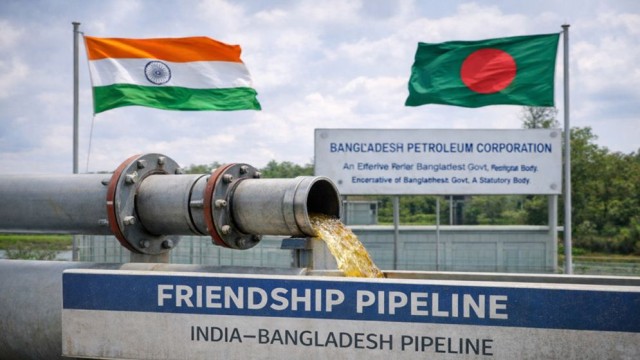
Dhaka, Mar 29 (V7N) — The ongoing tensions in the Middle East have begun to impact global fuel transportation, creating uncertainty in international shipping and putting pressure on Bangladesh’s fuel supply chain. In response, the Bangladesh Petroleum Corporation (BPC) has intensified efforts to import diesel through pipeline routes alongside traditional sea shipments.
As part of this initiative, approximately 7,000 tonnes of diesel are currently being imported from India’s Numaligarh Refinery Limited. The supply began entering the pipeline on Saturday evening (March 28), and officials expect the full shipment to be received within the next one to two days.
BPC Chairman Md. Rezanur Rahman stated that there is no immediate risk of fuel shortages, as alternative supply mechanisms are actively in place.
According to sector insiders, diesel is the backbone of Bangladesh’s agriculture, road transport, and power generation sectors. Even minor disruptions in supply could therefore have widespread consequences. While 17 diesel-laden ships were scheduled to arrive this month, only nine have reached ports so far. One vessel is currently en route, while the arrival schedule of the remaining seven remains uncertain.
In light of these challenges, reliance on the Bangladesh-India Friendship Pipeline has increased significantly. Around 15,000 tonnes of diesel have already been imported via this route, including an earlier consignment of 5,000 tonnes that began arriving on March 25.
Officials attribute the disruptions to rising transportation costs and a shortage of available vessels in the global market, both linked to instability in the Middle East. Under these conditions, the pipeline is emerging as a more stable and cost-effective alternative.
The Bangladesh-India Friendship Pipeline, constructed under a bilateral agreement in 2017 and operational since December 2022, directly supplies diesel from India to the Parbatipur depot in Dinajpur over a distance of approximately 130 kilometers. The agreement предусматри annual supply of 120,000 tonnes, with an additional provision of 60,000 tonnes if required.
However, limited domestic storage capacity remains a constraint, preventing large-scale imports at once. Currently, the system allows for shipments of around 7,000 tonnes per cycle. Notably, the cost of transporting diesel via pipeline stands at approximately $5.50 per barrel, which is often lower than maritime transport.
Energy analysts emphasize that while diversifying supply routes is crucial during global instability, the full benefits cannot be realized without expanding long-term storage infrastructure. Concerns have already surfaced regarding diesel availability in certain regions, especially with the upcoming agricultural season.
According to BPC data, diesel accounts for nearly 63 percent of Bangladesh’s total energy consumption. In the 2024–25 fiscal year, demand is estimated at approximately 4.35 million tonnes, a significant portion of which depends on imports.
END/SMA/AJ