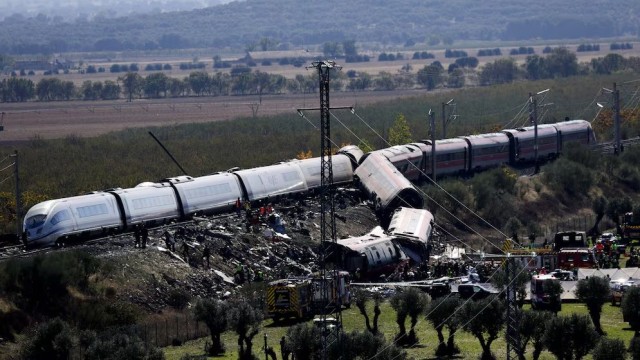
Madrid, Oct 29 (V7N)- The death toll from a collision involving two trains in Spain has risen to 68, with another 80 people injured, including 15 in critical condition, as rescue workers continue searching the wreckage for victims.
The accident occurred at around 9am local time on Wednesday, October 28, in a rural area of the Castilla-La Mancha region. Several carriages reportedly derailed and plunged down a slope, trapping passengers inside the mangled wreckage.
Ambulances, rescue helicopters and emergency personnel rushed to the scene following the collision. Rescue teams continued their search after dark, although authorities said they could not yet determine whether additional bodies would be found when the damaged carriages were removed.
Spanish Prime Minister Pedro Sánchez expressed condolences to the victims and their families, saying the country was mourning the tragedy. He promised a comprehensive investigation and said any errors or failures identified would be addressed.
Sánchez also said the two deadly rail accidents reported in Spain this year appeared to be unrelated. He acknowledged that two high-speed train accidents in a single year were unacceptable and said additional safety measures could be introduced if necessary to restore public confidence in the rail network.
Investigation Focuses on Train Movements and Signalling
Spanish Transport Minister Óscar Puente said investigators were examining the circumstances surrounding a red signal issued to a Renfe train because another train was stationary ahead.
According to Puente, a computer communication error triggered the signal and automatically stopped the Renfe train. The operator subsequently decided to restart it, a decision the minister described as a mistake.
Renfe said its train collided with a train operated by Iryo after receiving permission to move. The company said the reason the Iryo train had stopped was not yet known.
The operator added that investigators would need to establish the precise sequence of events, the condition of the trains and the cause of the collision. Iryo said it had activated emergency procedures following the accident.
Passengers Describe Scenes of Panic
Survivors described scenes of confusion and panic as passengers attempted to escape from the damaged carriages.
Salvador Ariza, 62, said he managed to get out because he was sitting near a door. Other passengers broke windows to escape, while some remained trapped between seats and were unable to move.
Another survivor, Rafael Barceló, said he had left his seat to get coffee shortly before the collision. He described passengers being thrown around by the force of the impact and believed at least eight people had died in his carriage.
Spanish Health Minister Mónica García said 15 of the 80 injured passengers were in critical condition. Some injured people were evacuated along a nearby road with visible wounds and bandages.
Families Await News of Missing Passengers
Authorities arranged a facility at a school for relatives of passengers who remained missing. Among those waiting was a woman identified as Ana, whose husband, Pepe, had not been located. Although his name was absent from the list of identified victims, rescuers reportedly found the couple's dog.
Renfe established a special telephone hotline to assist the families of dead and missing passengers. The company also suspended ticket sales on the Madrid–Andalusia high-speed route until December 13.
Spain's opposition People's Party cancelled its election campaign events following the disaster. The country is scheduled to hold elections next month.
Rail Safety Under Renewed Scrutiny
The latest collision has renewed concerns about railway maintenance, infrastructure and operational safety in Spain.
The supplied account also refers to another fatal rail accident earlier this year, in which 46 people reportedly died after a train derailed and collided with an approaching train. A preliminary Civil Guard report on that incident examined possible track defects, rail damage and a faulty weld at a junction between two sections of track, while leaving other potential causes open.
The accidents have intensified calls for scrutiny of railway investment and maintenance. However, investigators have yet to establish the cause of the latest collision, and any conclusions about responsibility will depend on the findings of the official inquiry.
END/SMA/AJ