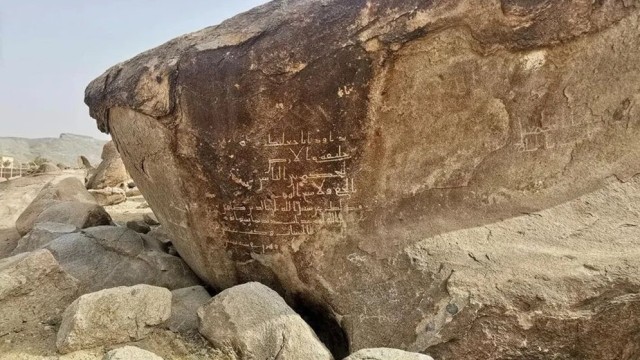
Mecca, Sep 13 (V7N)- More than 60 ancient Islamic inscriptions and two historical wells linked to early Hajj pilgrimage routes have been discovered in Wadi Al-Usaylah, northeast of Mecca in Saudi Arabia.
Archaeologists believe the discoveries could provide valuable information about the development of early Arabic script and the routes used by pilgrims and travelers heading to Mecca.
According to the Saudi Press Agency (SPA), Wadi Al-Usaylah stretches approximately six kilometers in length and two kilometers in width and was historically an important travel route. Caravans of pilgrims and travelers from Iraq and surrounding regions used the valley to reach Mecca.
The inscriptions, carved into rocky mountainsides, are estimated to date from the seventh and eighth centuries, corresponding to the first and second centuries of the Hijri calendar.
The inscriptions refer to individuals from the early Islamic period and provide insights into the development, structure and artistic features of early Arabic writing.
Water was particularly important for pilgrims and travelers crossing the region’s rugged and arid terrain. Muslim rulers therefore established water-supply infrastructure at various points along the route over the centuries.
Four historical wells have been identified in Wadi Al-Usaylah, two of which remain intact. Located near the rocky areas containing the inscriptions, some of the wells are believed to date back to the Abbasid Caliphate.
The Royal Commission for Makkah City and Holy Sites is implementing a comprehensive preservation program to protect the inscriptions and wells, with particular attention being given to preventing environmental deterioration.
According to SPA, the preservation work at Wadi Al-Usaylah forms part of Saudi Arabia’s broader efforts to protect its archaeological heritage and develop sustainable cultural tourism destinations under the Kingdom’s Vision 2030 program.
The discovery is also expected to contribute to ongoing archaeological research into the history of writing, human settlement and travel routes across the Arabian Peninsula.
In July, SPA reported that the King Salman bin Abdulaziz Royal Reserve contains thousands of ancient inscriptions and rock carvings, including Thamudic and Nabataean scripts, as well as depictions of animals, hunting and aspects of daily life. More than 400 archaeological and historical sites have so far been identified in the reserve, with some remains estimated to date back as far as 8,000 BC.
Another major center for studying the development of writing in the Arabian Peninsula is the Hima Cultural Area in Saudi Arabia’s Najran region. The UNESCO World Heritage site contains extensive inscriptions and rock art in Ancient South Arabian, Thamudic and Islamic scripts.
Archaeological discoveries in Najran include tribal symbols and inscriptions in Thamudic, Sabaean, Himyaritic and early Islamic scripts. Rock art also depicts humans, camels, horses and wild goats, along with hunting and warfare scenes.
In 2024, a bilingual inscription was discovered in the village of Alkan in the Tabuk region. According to SPA, the fifth-century inscription contains two lines in Thamudic script and one line in ancient Arabic script.
The Heritage Commission said the Tabuk discovery demonstrated that Thamudic script remained in use alongside ancient Arabic as late as the fifth century, providing further evidence of the coexistence and subsequent evolution of the region’s writing systems.
The archaeological discoveries underscore the historical importance of Saudi Arabia’s mountains, valleys and deserts as repositories of the Arabian Peninsula’s written and cultural heritage.
In particular, the combination of early Islamic inscriptions and surviving water infrastructure at Wadi Al-Usaylah offers a glimpse into the connections between Mecca and the pilgrims and travelers who journeyed there during the early centuries of Islam. Preservation of these sites is expected to remain important for future archaeological research and cultural tourism.
END/SMA/AJ