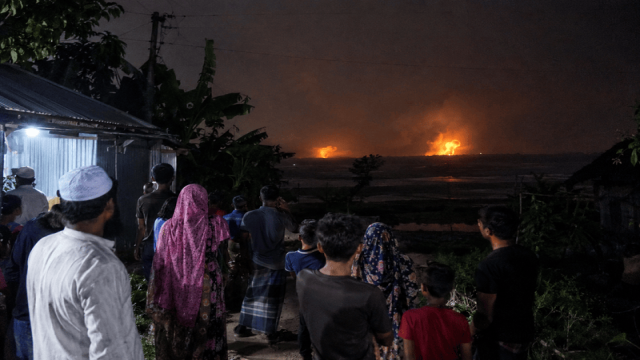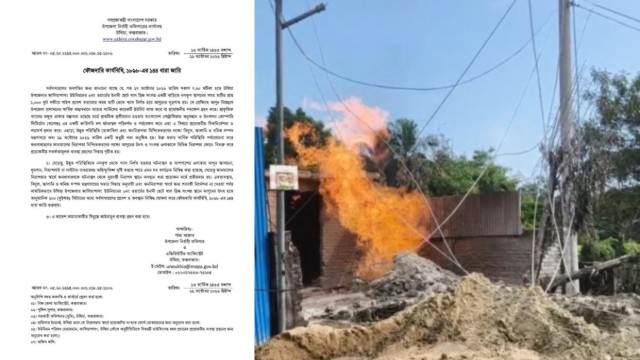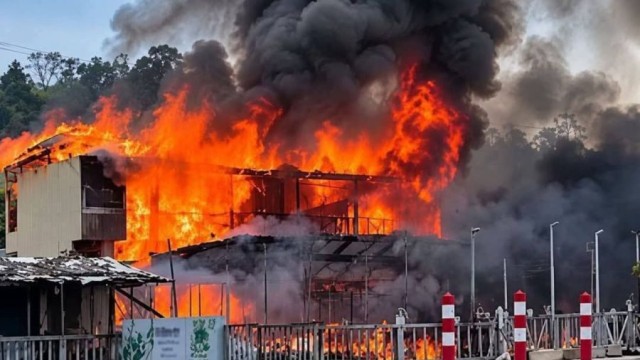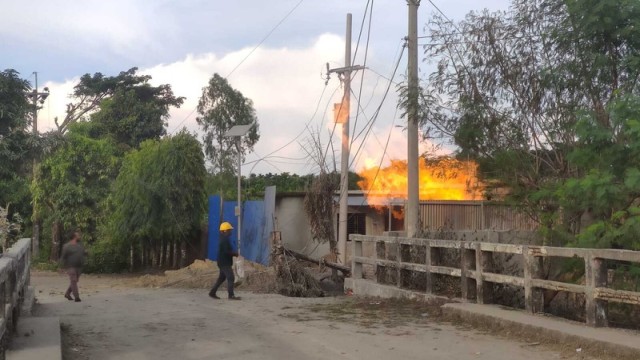
Ukhiya, Oct 31 (V7N) – A fire fuelled by gas emerging from underground during the installation of a deep tube well in Inani, Ukhiya, has continued to burn for four days, raising concerns about the risk of a major accident. The upazila administration has imposed restrictions under Section 144, prohibiting public entry and presence within 200 metres of the site.
Despite the restrictions, curious visitors continue to gather near the site every day. Meanwhile, Petrobangla suspects that the fire may have originated from a shallow underground gas reservoir. The state-owned corporation plans to monitor the situation for 15 days before deciding whether to drill a relief well to stop the gas flow and extinguish the fire.
A high-level team from the Bangladesh Petroleum Exploration and Production Company Limited (BAPEX) and the Bangladesh Oil, Gas and Mineral Corporation (Petrobangla) visited the site on Friday evening, October 30. Officials examined the nature of the fire, gas emissions and surrounding geological conditions.
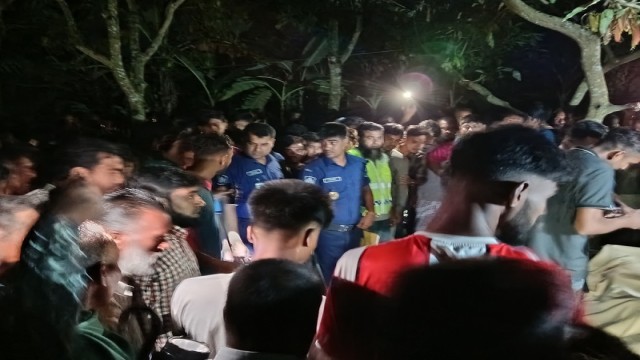
Local residents said crowds begin gathering at the site after around 4pm every day. Many visitors take photographs and record videos of the flames. This has made it increasingly difficult for law enforcement personnel assigned to maintain security.
Officials warned that allowing people to gather near the site while gas continues to escape could lead to a serious accident.
How the fire started
According to the upazila administration, the incident began at around 7am on October 27 while a deep tube well was being installed at a house near Inani Chhotokhal Bridge in Ward 6 of Jaliapalong Union.
Gas began escaping after a drilling pipe was inserted to a depth of approximately 1,000 feet underground. The escaping gas subsequently caught fire, and the flames have continued since then.
Several Fire Service units worked to control the blaze under the supervision of the upazila administration. However, the fire could not be completely extinguished because gas continued to flow from underground.
After the possibility of an underground natural gas deposit emerged, a technical team from BAPEX visited the site to assess the situation.
Section 144 imposed for public safety
An emergency meeting was held at the Ministry of Power, Energy and Mineral Resources on Thursday, October 29, to discuss public safety and the risks associated with the continuing fire.
The meeting decided to divide the fire site and surrounding areas into different security zones and introduce precautionary measures.
Following the decision, Ukhiya Upazila Nirbahi Officer (UNO) and Executive Magistrate Panna Akter issued an order prohibiting public entry and presence within a 200-metre radius of the site. The restriction will remain in force until further notice.
The order also prohibits lighting fires, smoking, using matches or lighters and engaging in any activity that could create sparks in or around the area. Violators will face legal action.
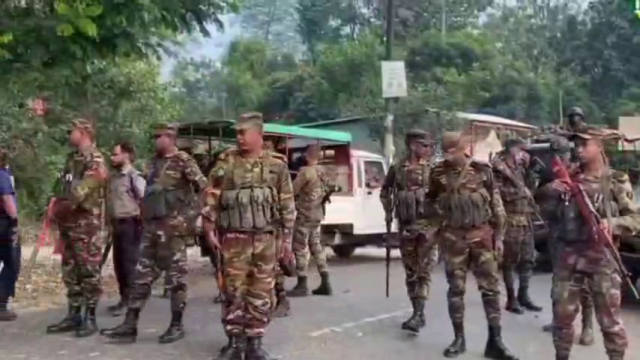
The administration has conducted public announcements to enforce the restrictions and installed barbed-wire fencing and red flags to mark the danger zone. However, crowds continue to gather despite the safety measures.
Gas may contain oil or condensate
Following Friday evening's inspection, BAPEX and Petrobangla officials said they had examined the flames and the characteristics of the escaping gas.
Shamsia Muktadir, general manager of BAPEX's Geology Division, said the company had the experience and technical capacity to deal with such situations and could manage the incident using its own resources.
However, she said safety considerations required careful decisions because an unexpected accident could occur at any time.
Mohammad Shoaib, director (Operations and Mines) of Petrobangla, said a meeting involving BAPEX and Petrobangla officials, along with several retired general managers, had been held on Thursday.
He said the initial assessment suggested that the escaping gas could be thermogenic or biogenic in origin. The colour of the flames also indicated the possible presence of oil or condensate mixed with the gas.
According to Shoaib, preliminary observations suggested that the fire might be originating from a shallow gas reservoir.
He explained that gas deposits in Bangladesh are generally found at depths ranging from 1.5 to five kilometres. However, the actual source and size of the suspected Inani reservoir remain uncertain.
Petrobangla will monitor the situation for 15 days, closely observing the height of the flames and the rate of gas emissions before deciding on the next course of action.
Relief well may be considered
Shoaib said that if the flames remain at the same height or increase after the 15-day observation period, authorities may consider drilling a relief well to stop the gas flow.
The proposed operation could involve side-tracking technology, in which a separate well is drilled to intercept or control the underground gas flow. Such technology is used internationally to manage similar situations.
However, if gas emissions decrease or stop during the monitoring period, authorities will determine the next steps based on the prevailing conditions, he said.
The Petrobangla official also said gas flames had been observed emerging from several nearby geological layers. Officials suspect that changes in underground geological formations may have contributed to the gas escaping through multiple points.
3D seismic survey planned
BAPEX plans to conduct a three-dimensional (3D) seismic survey in the area at a later stage to investigate the possibility of underground gas reserves.
The survey data will be analysed to determine whether a gas deposit exists and to assess its potential. If commercially viable reserves are identified, the authorities may consider drilling new exploration wells in the area.
For now, the immediate priority remains monitoring the continuing gas emissions, assessing the geological conditions and preventing any accident.
As the flames continue to burn for a fourth consecutive day, residents of the Inani Chhotokhal area remain concerned about their safety. The next 15 days of monitoring are expected to be crucial in determining how the authorities will manage the underground gas flow and bring the fire under control.
END/MSI/SMA/