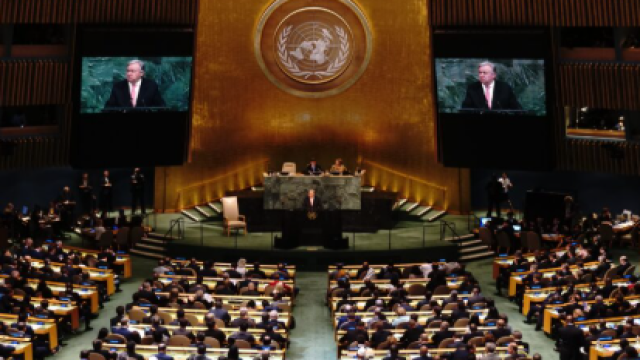
UNITED NATIONS, March 25, (V7N) – The UN General Assembly is set to vote on a groundbreaking resolution Wednesday, aiming to designate the transatlantic African slave trade as "the gravest crime against humanity." Advocates of the resolution view this move as a crucial step toward healing and justice for the African diaspora and descendants of enslaved people.
Ghana's President John Mahama, a prominent supporter of slavery reparations and a strong advocate within the African Union, visited the United Nations to champion the resolution. Addressing the assembly, Mahama described the motion as "historic," emphasizing that it would allow the global community to "collectively bear witness to the plight of more than 12.5 million men, women, and children" whose lives were stolen over 400 years of brutal trafficking.
He also criticized efforts, particularly in the United States, to prevent the teaching of slavery and its legacies, particularly actions like banning books on slavery, segregation, and racism. "This resolution is a safeguard against forgetting," Mahama said, pointing out that some political leaders are working to suppress education about slavery's history and its ongoing effects.
The draft resolution specifically condemns the transatlantic slave trade, labeling it as "the gravest crime against humanity." It highlights the persistent legacy of racial discrimination and neo-colonialism, which continues to affect society today.
"Justice Begins with Naming Atrocities"
Amma Adomaa Twum-Amoah, the African Union's Commissioner for Health, Humanitarian Affairs, and Development, stated that acknowledging these atrocities clearly is essential for justice. "It is to say that what was done to Africans was not a tragic accident of history, but the result of deliberate policies whose legacies structure today's inequalities," she explained. "Justice begins with calling things by their proper names."
Beyond mere acknowledgment, the resolution calls for nations involved in the slave trade, including European powers and the United States, to engage in restorative justice processes. Ghana’s Foreign Minister, Samuel Okudzeto Ablakwa, stated, "The perpetrators of the transatlantic slave trade are known, the Europeans, the United States of America. We expect all of them to formally apologize to Africa and to all people of African descent."
Ablakwa further emphasized the need for reparations, particularly in the form of returning looted artifacts to Africa, addressing structural racism, and providing compensation for the descendants of the enslaved.
Addressing Criticism of "Hierarchy of Suffering"
Some members of the General Assembly have criticized the resolution's language, arguing it could create a "hierarchy" of suffering by singling out the transatlantic slave trade. In response, Okudzeto Ablakwa rejected this interpretation. "We are not ranking suffering when we say that the transatlantic slave trade represents a 'gravest crime against humanity,'" he clarified. "What we are saying is that if you look at all of the atrocities in history, none have been as systemic, as prolonged, as pervasive as the transatlantic slave trade, and its lingering consequences still affect us today."
He stressed, "We are not ranking pain. We are not saying that our pain should be valued more than your pain."
The passing of this resolution would mark a significant step in global recognition of the horrors of the transatlantic slave trade and could pave the way for further dialogue on reparations and justice for its enduring impact on African descendants worldwide.
END/WD/RH