Habiganj, Aug. 15 (V7N) — Gas supplies have remained completely shut off for a third consecutive day in Habiganj’s industrial belt, bringing production at most of the district’s 171 small and large factories to a halt and raising concerns over potential job losses.
With factories unable to operate, workers at some establishments are spending idle hours, while others have been sent on leave. Workers fear prolonged shutdowns could eventually lead to layoffs and leave them struggling to support their families.
Factory owners, meanwhile, continue to bear expenses including wages, electricity, maintenance and other operational costs despite having no production. Industrialists say the gas shortage is causing losses worth hundreds of crores of taka in production and export earnings every day. Some factories have already begun receiving cancellations of foreign orders.
Mohammad Majed Hossain, general manager of Square Denim Ltd, said gas supply to the factory remained at zero until 3pm on Friday.
“All the machinery and power systems are shut down. If the situation continues for long, the machinery itself could be damaged,” he said.
He said one production line requires 102,597 cubic metres of gas a day, while another requires 86,028 cubic metres. However, the factory has received no gas for nearly three days.
Mohammad Abul Bashar, general manager of SM Spinning, said the factory requires around 1.035 million cubic metres of gas per month, equivalent to approximately 34,500 cubic metres a day.
He said the factory received gas at around 60 per cent of its requirement on Friday morning, but the supply suddenly dropped to 20 per cent at noon.
“It is extremely difficult to operate machinery under these conditions. Repeated interruptions in power supply can also damage the machines,” he said.
Abul Bashar said losses were increasing every day and warned that prolonged disruption could eventually cost workers their jobs.
He said the company’s exports had already fallen by 13 per cent and that some orders from different companies were being cancelled.
“Several lakh people are directly and indirectly dependent on the industrial sector. If yarn production stops, followed by fabric production and exports, the entire supply chain will be affected,” he said.
An official of an industrial establishment, speaking on condition of anonymity, said several factories had been forced to shut down their effluent treatment plants (ETPs) because of the gas shortage.
“If ETPs remain closed for an extended period, essential bacteria inside the treatment systems may die. This could cause significant financial losses and create environmental risks,” the official said, calling for sufficient gas supply to keep the ETPs operational.
Workers are also growing increasingly anxious.
Faras Debnath, an employee at a local industrial establishment, said gas pressure had remained low for several days, making normal production difficult before the supply stopped completely.
“Workers are now sitting idle because the factory is closed. If this continues for a long time, our income will stop and it will become difficult to support our families. We are also worried about whether we will still have our jobs,” he said.
Rujina Begum, another worker, said she depended on daily work to support her family.
“If the factory remains closed, we have no work and no income. We do not know how long this situation will continue. Workers like us and our families will suffer the most unless gas supplies are restored quickly,” she said.
Impact Extends Beyond Factories
The prolonged gas shortage is also raising concerns over residential areas and the wider local economy around Madhabpur’s industrial zone.
Many landlords in residential areas surrounding the industrial belt depend heavily on rent paid by factory workers. Some have also built houses using bank loans. If factories remain closed for an extended period, workers could face difficulties receiving wages and paying rent on time, creating financial pressure for landlords as well.
Landlord Mohammad Hossain Ahmed said many residents of Madhabpur had taken housing loans from banks to build rental properties occupied mainly by industrial workers and employees.
“If factories remain closed for a long time, workers may not receive their salaries. Without salaries, many will struggle to pay rent on time. Landlords will then face difficulties because we also have bank instalments to pay,” he said.
He added that a factory shutdown affects far more than its employees, as shopkeepers, transport workers and other local businesses also depend on the industrial economy.
171 Factories Affected
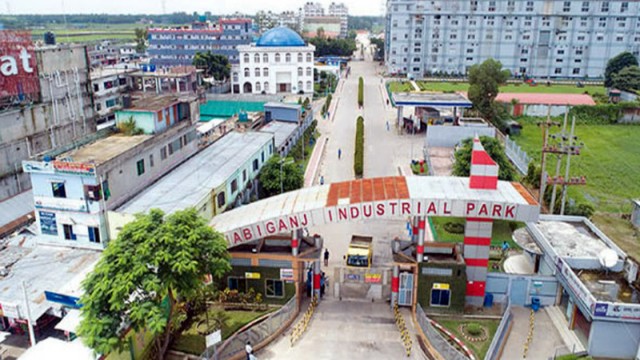
Hilul Ray, officer-in-charge of the Sylhet Zone Industrial Police, said Habiganj has 171 small and large industrial establishments and that industrial police are working to ensure their security.
However, some factory owners and officials said they had yet to see an effective presence of industrial police during the current crisis.
According to people familiar with the situation, more than 150,000 people are directly and indirectly employed in the district’s industrial sector. They fear the economic impact could become much wider if the gas shortage continues.
Industrial officials said Habiganj had been experiencing a gas shortage for around 20 days. Initially, factories received only one-third or one-quarter of their required supply but managed to keep production running to some extent.
The situation deteriorated sharply on Wednesday, Aug. 12, when gas supplies were completely cut off.
The shortage has also forced many factories to shut down their captive power plants, creating additional difficulties for both production and electricity management.
Gas Distributor Says No Improvement Yet
Mohammad Ruhul Karim Chowdhury, deputy general manager of Jalalabad Gas Transmission and Distribution System Ltd, said the situation remained unchanged.
“The situation here is the same as elsewhere in the country. There has been no improvement. We received some gas last night (Thursday), but the supply stopped again after a short time,” he said.
He said there had been reports that the situation could improve from Aug. 15, but the gas distributor had received no official confirmation.
“We only distribute the gas. Petrobangla controls the supply,” he said.
Gas authorities had earlier indicated that the situation could improve within 72 hours.
Industrial entrepreneurs fear that if supplies are not restored soon, the impact will extend beyond production losses to Bangladesh’s export market. Repeated cancellation of foreign orders could damage the confidence of international buyers in the long term.
At the same time, prolonged factory closures could reduce workers’ incomes, disrupt rent collection and increase pressure on borrowers struggling to repay bank loans.
The gas crisis in Habiganj’s industrial belt has therefore evolved beyond a production problem, placing workers, landlords, businesses and borrowers across the local economy under growing financial pressure.
Industrialists, workers and local residents have urged the authorities to restore gas supplies as quickly as possible and allow factories to resume normal production.
END/MMA/SMA/