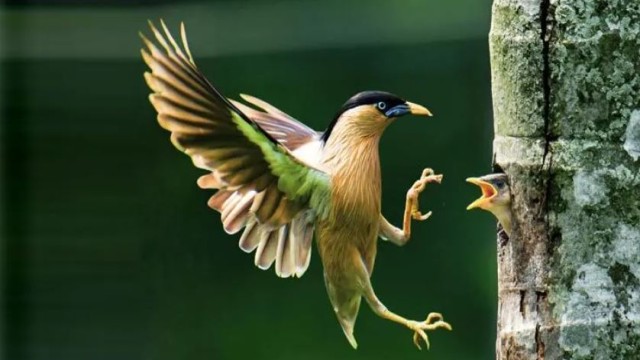
Rajshahi, Aug. 13 (V7N) — While the Brahminy Starling has become relatively uncommon in many parts of Bangladesh, the distinctive bird is thriving at Rajshahi University, where its presence has become a familiar sight across the green campus.
Known scientifically as Sturnia pagodarum and commonly as the Brahminy Starling or Brahminy Myna, the species is found across parts of the Indian subcontinent. It is associated with open areas, scrubland, dry woodland and cultivated landscapes, often living close to human settlements.
The university campus appears to offer several of the conditions the species needs, including mature trees, vegetation, food sources and suitable nesting sites. Local birdwatchers say the birds can be seen in several parts of the campus throughout the year.
A distinctive appearance
Measuring about 20–21 centimetres in length, the Brahminy Starling is easily recognisable by its dark, pointed crest and contrasting plumage. Adults have a greyish upper body, reddish-brown colouring around the head and underparts, and pale markings beneath the tail. Males and females look broadly similar, although females are generally slightly smaller and have a shorter crest. Young birds are duller in colour and lack the pronounced crest of adults.
The species is also known for its varied vocalisations and ability to mimic sounds, adding to its appeal among birdwatchers.
Habitat and diet
Brahminy Starlings typically inhabit dry forests, scrubland, open country and cultivated areas. They are also found around gardens and human settlements. Tree cavities and other suitable openings provide important nesting sites.
The species is omnivorous, feeding on a combination of fruit, insects and other invertebrates. It may also feed on flowers and nectar. This varied diet allows the bird to make use of different food sources available across natural and semi-natural landscapes.
Breeding and nesting
The Brahminy Starling is a cavity-nesting bird. It commonly builds its nest inside tree holes or other suitable cavities, using materials such as grass and feathers. A typical clutch contains three to four pale bluish eggs.
Breeding activity varies according to location, with the breeding season generally extending through the warmer and wetter months. During this period, protecting nesting sites from unnecessary disturbance is particularly important.
Why Rajshahi University suits the species
The extensive tree cover, vegetation, open spaces and availability of food have made the Rajshahi University campus a favourable environment for the species.
The birds have been spotted around the university's Shaheed Minar, Zuberi Building, Silsila area, helipad and main gate, among other locations.
Fahim Muntasir Rafin, a student of the university's Department of Bangla and a photographer, said he first photographed a Brahminy Starling behind Siraji Building in February 2024.
He said the birds appear to be particularly attracted to areas around waste-disposal sites, where food is relatively accessible. He called for greater monitoring during the breeding season to minimise disturbance and prevent the removal of chicks from nests.
Professor Dr Aminuzzaman Md Saleh Reza of the Department of Zoology at Rajshahi University said the availability of food, security and suitable environmental conditions had helped make the campus a favourable habitat for the species.
He stressed that preserving natural vegetation, trees and shrubland would be more effective than relying on artificial interventions to protect the birds.
Why the bird matters to the ecosystem
The Brahminy Starling is more than an attractive addition to the university campus. As an omnivorous bird that consumes insects and fruit, it forms part of the local food web and contributes to the ecological interactions within its habitat.
Birds can also serve as useful indicators of environmental quality. The continued presence of diverse bird species in an urban or semi-urban landscape can reflect the availability of food, vegetation, shelter and suitable breeding habitats.
The Brahminy Starling's presence at Rajshahi University therefore highlights the ecological value of maintaining mature trees, natural vegetation and relatively undisturbed green spaces within urban environments.
Protecting its natural habitat
Conservation of the species does not necessarily require elaborate measures. Protecting old trees, retaining suitable vegetation and avoiding unnecessary disturbance around nesting sites can provide birds with the conditions they need to survive and reproduce.
Birdwatchers and visitors should observe the birds from a respectful distance and avoid touching nests, removing chicks or disturbing breeding pairs.
For Rajshahi University, preserving its existing green landscape could benefit not only the Brahminy Starling but also a wide range of other birds and wildlife.
The continued presence of this distinctive bird is a reminder that even within a busy university campus, nature can flourish when trees, vegetation and natural habitats are given space to survive.
END/MRA/SMA/