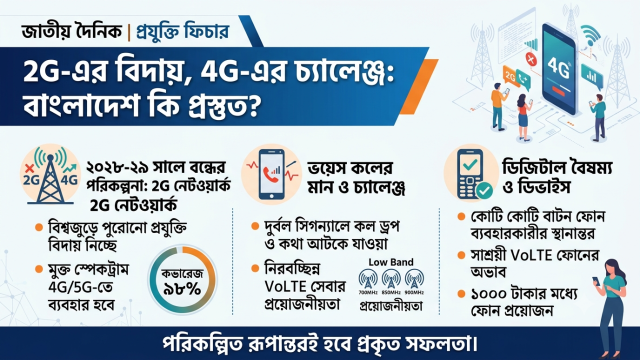
Pabna, July 24 (V7N) — Bangladesh's mobile telecommunications sector appears to be heading toward another major transformation. Industry discussions and telecommunications reports suggest that the country is preparing for a phased shutdown of its 2G mobile network between 2028 and 2029. Although no official government policy has yet been announced, such a move would mark one of the most significant transitions in the history of Bangladesh's mobile communications.
The key question remains: Is Bangladesh ready for the end of 2G?
A Global Shift Away from Legacy Networks
Around the world, mobile operators are gradually retiring legacy 2G and 3G networks to free up valuable radio spectrum for more advanced technologies such as 4G, 5G, and future-generation mobile services. Reallocating spectrum enables operators to deliver faster internet speeds, improved voice quality, greater network efficiency, and increased capacity for mobile users.
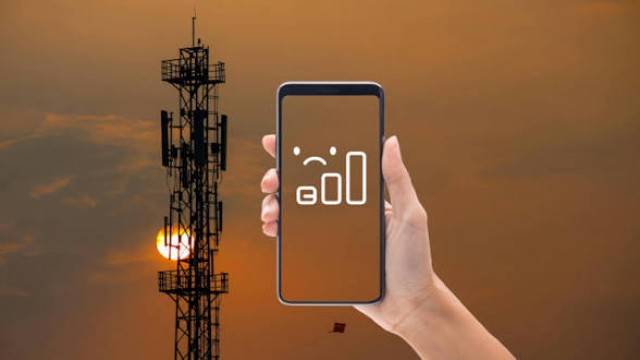
Bangladesh has also made substantial progress in expanding its mobile broadband infrastructure. According to industry sources, 4G coverage now reaches approximately 98 percent of the country's populated areas, with further expansion expected over the next few years.
However, coverage alone does not guarantee service quality.
Voice Calls Could Become the Biggest Challenge
The greatest concern in a post-2G environment is the reliability of voice communications.
Unlike 4G, which was primarily designed for high-speed data services, 2G technology was originally built to provide dependable voice calling. It is often capable of maintaining stable voice connections even under weak signal conditions.
By contrast, voice services on 4G depend on Voice over LTE (VoLTE), where voice calls are transmitted as data packets. If network quality deteriorates, users may experience dropped calls, delayed audio, distorted voice quality, or interrupted conversations.
These challenges are expected to be more pronounced in remote and rural areas, where large geographical regions often rely on a single cellular tower.
Low-Band 4G Spectrum Will Be Critical
Telecommunications experts argue that Bangladesh should not consider shutting down 2G services until 4G coverage on low-band spectrum has been widely deployed.
Spectrum bands such as 700 MHz, 850 MHz, and 900 MHz offer significantly better coverage over long distances and superior indoor signal penetration compared with higher-frequency bands. These characteristics make them particularly important for ensuring reliable VoLTE services in rural, remote, and densely built-up areas.
Experts also note that successful migration will require not only appropriate spectrum allocation but also sufficient bandwidth, continuous network optimisation, and investment in infrastructure.
Millions of Feature Phone Users Face Uncertainty
Another major challenge is the country's large population of feature phone users.
Millions of Bangladeshis—particularly elderly citizens, low-income households, and rural residents—still rely on basic mobile phones that operate primarily on 2G networks.
If 2G services are phased out, affordable 4G-enabled VoLTE feature phones will need to become widely available. Industry analysts suggest that reliable VoLTE feature phones should be priced at around Tk 1,000 to remain accessible for low-income consumers.
Without affordable alternatives, the digital divide could widen significantly, leaving vulnerable communities with reduced access to essential communication services.
Equally important is ensuring that low-cost devices can deliver stable voice performance even under challenging network conditions.
A Carefully Managed Transition Is Essential
Countries that have successfully retired 2G networks generally adopted gradual transition strategies rather than abrupt shutdowns. These approaches included expanding network infrastructure, improving device availability, educating consumers, and allowing sufficient time for users to migrate to newer technologies.
Bangladesh is likely to require a similarly well-planned roadmap.
Mobile telecommunications today underpin not only internet access but also emergency communications, business operations, financial services, healthcare, education, and everyday social interaction. Any disruption could have far-reaching consequences.
Looking Ahead
From a technological perspective, retiring 2G is a logical and inevitable step in the evolution of Bangladesh's telecommunications sector. However, the success of that transition will depend on how effectively the country strengthens its 4G infrastructure, deploys low-band spectrum, expands high-quality VoLTE coverage, and ensures that affordable compatible devices are within reach of all citizens.
Modernising mobile networks is relatively straightforward. Ensuring that every citizen benefits from reliable, inclusive, and affordable connectivity will be the far greater challenge.
As Bangladesh prepares for the next phase of its digital transformation, the transition away from 2G will test not only the country's technological readiness but also its commitment to leaving no mobile user behind.
END/MSR/SMA/