JHALAKATHI, Sept 7 (V7N) — Classes are being held in hazardous conditions at Keota Ghigra Fazil (Degree) Madrasa in Rajapur upazila of Jhalakathi, where deteriorating infrastructure and a shortage of classrooms are disrupting academic activities.
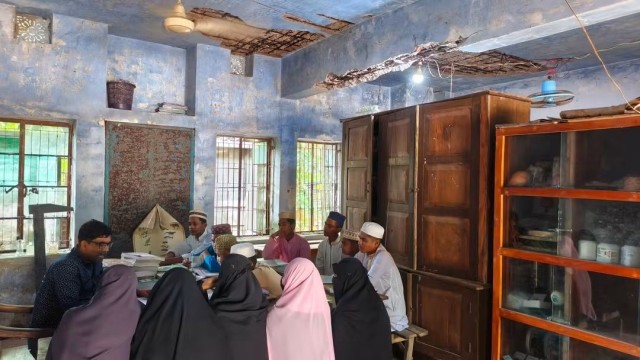
The madrasa has around 450 students, but inadequate classrooms and ageing infrastructure have created serious difficulties for both teachers and students. In the science building, plastic sheets have been placed over the roof to prevent rainwater from leaking into the classrooms.
Plaster has also fallen from the ceilings and walls of the ageing buildings on several occasions, reportedly injuring teachers and students and damaging tables, chairs and benches.
Against this backdrop, teachers, students and local residents have called for the construction of a modern academic building equipped with adequate facilities at the madrasa.
According to madrasa authorities, Keota Ghigra Fazil (Degree) Madrasa was established in 1947 and is one of the oldest educational institutions in Rajapur upazila. The institution currently has around 450 students, 29 teachers and six staff members.
With the number of students exceeding the available classroom capacity, teachers are struggling to conduct lessons properly due to the shortage of adequate classrooms and other infrastructure.
Madrasa Acting Superintendent Mobasher Hossain said the old buildings had become considerably unsafe.
“Most of the old buildings have become risky. In particular, rainwater leaks through the roof of the science building. We are using plastic sheets to somehow prevent the water from entering the classrooms and continue classes. Incidents of plaster falling from the building have also occurred. Constructing a modern academic building would significantly improve the educational environment,” he said.
Mathematics teacher Anik Ahmed said the number of students was increasing day by day, while the institution continued to face a shortage of classrooms.
“Teachers and students feel frightened when classes are held in such an unsafe environment,” he said.
ICT teacher Khalilur Rahman said adequate infrastructure was essential for technology-based education.
“If a new academic building is constructed, it will be possible to conduct lessons more effectively and provide students with a better learning environment,” he said.
Several ninth-grade students, including Swaib, Alim and Sumaiya, said rainwater entered their classrooms during rainfall and they remained anxious because of falling plaster from the building.
They urged the authorities to take immediate steps to construct a new academic building.
Meanwhile, Jhalakathi-1 MP Rafiqul Islam Jamal has submitted a demi-official (DO) letter to the Ministry of Education seeking the construction of an academic building at the madrasa.
In the letter dated August 18, the MP said the construction of a modern academic building with adequate facilities had become essential to improve the learning environment for children from ordinary and disadvantaged families.
He also made a special request to the Education Minister to take the necessary measures to construct an academic building at the institution.
END/MAI/SMA/