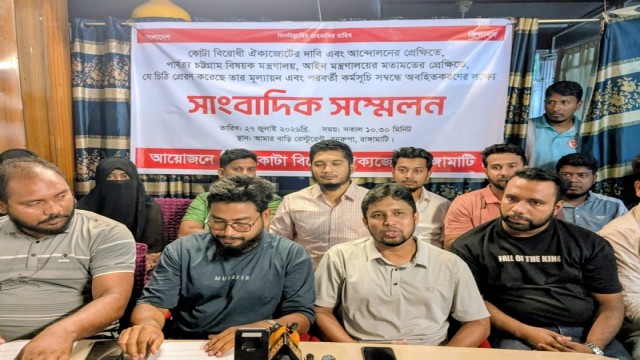
RANGAMATI, July 28 (V7N) – The Quota Reform Alliance in Rangamati has demanded the cancellation of the existing 67 percent quota system in the recruitment process of the transferred departments under the Hill District Councils, calling for a 93 percent merit-based and 7 percent quota system.
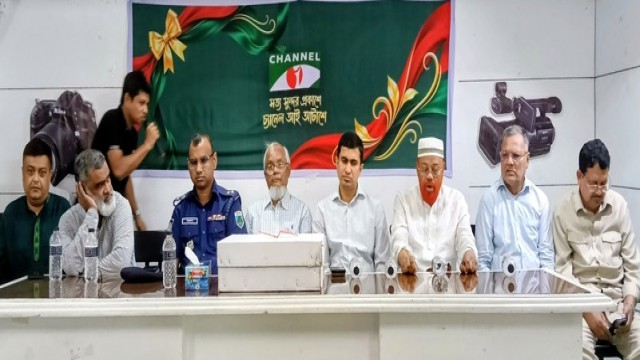
The organisation also placed a six-point demand, including transparency, accountability, and neutrality in recruitment examinations, at a press conference held at Aayojon Restaurant in Banarupa area of Rangamati town on Monday morning.
The press conference was attended by Quota Reform Alliance Rangamati adviser Md Kamal Uddin, member secretary Md Nurul Alam, senior joint convener Mizanur Rahman Majumder, joint convener Md Ibrahim Rubel, member Md Yusuf Ali, and other leaders and media representatives.
In a written statement, the leaders said recruitment in the three Hill District Councils—Rangamati, Khagrachhari, and Bandarban—has long been conducted under a system of 67 percent quota for indigenous communities and 33 percent for Bengali communities.
They claimed that the existing quota system is discriminatory and has no legal basis. According to the organisation, the Ministry of Law, Justice and Parliamentary Affairs has clarified that the Hill District Council laws do not specify any fixed quota system but only provide for priority consideration of equally qualified candidates.
The leaders further said that, according to the government notification issued on July 23, 2024, the recruitment policy of 93 percent merit and 7 percent quota should also be applied to appointments under the Hill District Councils.
They argued that denying qualified candidates equal opportunities based on merit violates the principles of fairness and equal competition. They urged authorities to abolish the existing quota arrangement and follow the government recruitment policy.
The six-point demands include introducing a 93 percent merit-based and 7 percent quota system for all recruitment under the transferred departments of the Hill District Councils; preparing standardised examination questions centrally under the supervision of the Ministry of Public Administration and the Ministry of Education; and ensuring secure storage of question papers at government treasuries under the direct supervision of district administrations.
The alliance also demanded that answer scripts be evaluated under the supervision of district administrations, recruitment rules and evaluation methods be published through official notifications, and details of selected candidates—including names, roll numbers, fathers’ names, and addresses—be made public.
The leaders warned that if the recruitment process is delayed or lacks transparency despite legal clarification, the Quota Reform Alliance would announce tougher programmes involving students and the general public in the hill districts.
They called for the immediate resumption of stalled recruitment examinations, saying government institutions funded by taxpayers’ money must ensure fairness, transparency, and accountability in their recruitment processes.
END/AMR/SMA/