Washington, Aug 04 (V7N) – US President Donald Trump has claimed that the United States is engaged in talks with Iran, despite Tehran firmly denying any direct negotiations between the two countries.
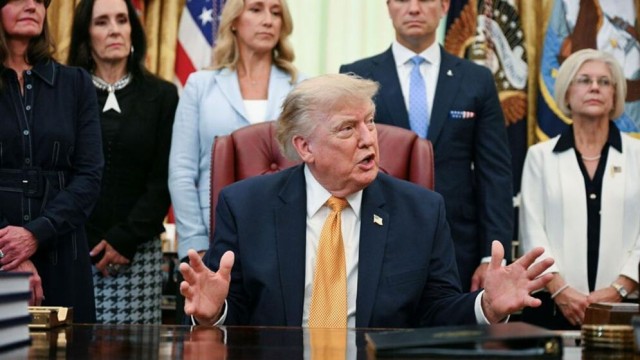
Speaking to reporters at the White House on Monday, Trump said Iran now has a “last chance” to reach an agreement before facing severe consequences.
Trump said he decided to continue diplomatic efforts at the request of several countries, including Saudi Arabia, the United Arab Emirates (UAE), and Qatar. However, Iran’s Foreign Ministry reiterated on Monday (August 3) that there are currently no negotiations with Washington.
Rejecting Tehran’s statement, Trump insisted, “We are talking right now.”
He added, “This is the last chance for them to sign a good deal. I want to give them the last chance possible before the beheading.”
According to Trump, reopening the Strait of Hormuz is one of the key issues under discussion. He suggested that the strategic waterway could reopen “very soon,” possibly even “tomorrow,” though he acknowledged that resolving Iran’s nuclear program and broader disarmament issues could take longer.
The conflict between the United States and Iran has continued since the US and Israel launched coordinated strikes on Iran on February 28. Despite months of intermittent diplomatic efforts before the conflict, tensions repeatedly escalated into military confrontation.
More than five months into the conflict, Iran continues to maintain the capability to launch missile and drone attacks against US and allied targets across the Middle East and retains significant stockpiles of enriched uranium.
Trump’s rhetoric toward Iran has shifted in recent days. Last week, he threatened a “very tough” military response and hinted at new strikes targeting Iran’s energy infrastructure. On Saturday, however, he indicated that the framework for a possible agreement had begun to emerge.
Iran, meanwhile, maintains that it is not engaged in direct talks with Washington.
Iranian Foreign Ministry spokesperson Esmail Baghai said Tehran is only holding discussions with Oman regarding maritime navigation in the Strait of Hormuz.
The Strait of Hormuz remains one of the world's most critical energy shipping routes. Disputes over navigation through the strait have become a major obstacle to easing the conflict.
Following the collapse of the ceasefire, Iran reimposed restrictions on shipping through the strait, disrupting commercial maritime traffic and leading to several attacks involving merchant vessels.
Trump accused Tehran of pursuing a “two-track policy,” claiming that while Iranian officials publicly deny negotiations, private discussions are taking place behind the scenes.
In a post on social media, Trump said the talks are aimed at resolving problems that Iran has created over decades.
He also referred to the US counter-blockade targeting Iranian ports, stating that nothing would enter Iran without US approval until either a comprehensive agreement is reached or Iran fully surrenders.
Before the conflict, international shipping moved freely through the Strait of Hormuz. Iran now insists that vessels use designated routes near its coastline and pay transit-related fees, demands that Washington has rejected.
Tehran maintains that ships must travel along routes close to Iranian territorial waters and opposes alternative shipping lanes.
However, in an interview with Iranian state television on Sunday, Baghai said negotiations with Oman over shipping management in the Strait of Hormuz are nearing completion.
He explained that both countries are working toward a mutually acceptable navigation route that respects the sovereignty, national interests, and security concerns of both Iran and Oman.
Baghai stressed, however, that such an agreement would not mean the complete reopening of the Strait of Hormuz.
Meanwhile, the UK Maritime Trade Operations (UKMTO) reported that an explosion occurred near an oil tanker off the coast of Oman on Sunday (August 2), although the vessel and its crew remained unharmed.
Trump again emphasized that dismantling Iran’s nuclear program remains a central objective of US policy.
“Iran’s nuclear disarmament must take place,” he said.
Western governments have long accused Iran of pursuing nuclear weapons under the guise of its civilian nuclear program, allegations that Tehran has consistently denied, insisting its nuclear activities are exclusively for peaceful purposes.
Earlier, aboard Air Force One, Trump claimed that Iran and several US allies in the Middle East had urged him to refrain from launching further military attacks, saying any future strike would be the largest since World War II.
Iranian state media rejected that claim, insisting Tehran has made no request asking the United States to halt military operations.
As a result, major disagreements over the Strait of Hormuz and Iran’s nuclear program continue to dominate relations between Washington and Tehran, while conflicting statements from both sides have deepened uncertainty over prospects for diplomacy or further escalation.
END/SMA/AJ