Gaza, July 28 (V7N)- Gaza’s education system has been pushed into a severe crisis due to Israel’s prolonged military campaign, with universities, laboratories and key academic infrastructure suffering widespread destruction. Despite the devastation, the Islamic University of Gaza is attempting to continue its educational activities amid the ruins.
Before the war, the Islamic University of Gaza was one of the most significant higher education institutions in the Palestinian territories. It had developed modern laboratories and research facilities, particularly in fields such as medicine, health sciences and engineering, where students received practical, hands-on training.
Students regularly used laboratory equipment, conducted experiments and applied classroom theories to real-world situations to prepare for professional careers.
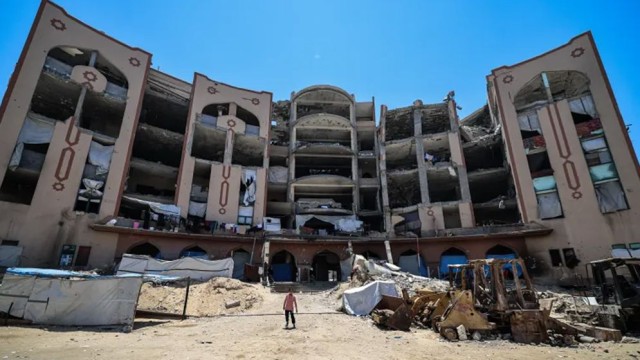
However, the situation changed dramatically after the Israeli military campaign began on October 7, 2023. A large portion of the university campus, laboratories and training facilities were destroyed in attacks, while restrictions on Gaza made it increasingly difficult to bring in educational materials and equipment.
Yassin, the university’s laboratory coordinator, said new anatomy models and medical training equipment had arrived just days before the war began. The equipment was intended to provide students with practical experience, but the initiative could not move forward after the conflict started.
University Campus Reduced to Ruins
The Israeli attacks caused extensive damage to the Islamic University of Gaza. According to university officials, 19 academic buildings were destroyed, while around 500 classrooms, 200 scientific laboratories and 75 computer labs were damaged.
The university’s central library also lost more than 240,000 books, research journals, academic references and theses.
Abdul Rauf Al-Manama, Dean of the Faculty of Health Sciences, described the past three years as one of the darkest periods in the university’s history.
He said the destruction affected not only buildings but also research equipment, training clinics, scientific facilities and decades of accumulated academic resources.
Many university buildings have also been used as shelters for displaced people. Shortages of classrooms, electricity and internet access, along with the psychological pressure faced by students and teachers, have made continuing education extremely difficult.
Virtual Labs Replace Practical Training
A joint assessment by the Palestinian Ministry of Education and UNESCO found that most higher education institutions in Gaza suffered major damage after 2023, leaving many specialized laboratories unusable.
As a result, practical subjects are increasingly being taught through theoretical lessons, online simulations, recorded laboratory sessions and video-based assessments.
These alternative methods are being used in medical sciences, biochemistry, hematology, molecular diagnostics, medical optics and physiotherapy.
However, Al-Manama said these methods are only temporary solutions. He emphasized that students cannot fully develop professional confidence and technical skills without real laboratory experience.
Hospitals Become Classrooms for Medical Students
Medical student Dima Muhaisen said her education changed completely after the destruction of the Faculty of Medicine in December 2023.
Before the war, she received regular laboratory training. Now, much of her practical education takes place in hospitals, where she often attends lessons in corridors or near patients’ rooms.
"In many cases, we took lessons in hospital corners or near patient rooms surrounded by doctors. There were not even basic facilities for a proper learning environment," she said.
Despite the challenges, Dima continued volunteering in emergency departments, surgical units and wound care sections in hospitals across Gaza. Through these experiences, she gradually gained more responsibility in medical work.
Efforts to Preserve Education
University officials said one of the biggest challenges is the growing gap between students’ theoretical knowledge and practical skills.
To address this issue, the university is working with hospitals, health centers and local organizations to provide students with practical training opportunities.
Five alternative education centers have also been established in different areas of Gaza to reduce travel risks for students.
Online classes, virtual simulations, recorded practical lessons and hospital-based training are being used to keep education alive despite the difficult circumstances.
Reconstruction Faces Major Obstacles
University authorities say rebuilding damaged buildings alone will not be enough. The institution will require new laboratories, medical equipment, microscopes, incubators, sterilization systems, specialized computers and scientific supplies.
However, restrictions on Gaza have created major obstacles to importing construction materials and educational equipment.
Despite these challenges, the Islamic University of Gaza says it remains committed to continuing education. University officials believe that students studying among the ruins today will play a key role in rebuilding Gaza in the future.
Medical student Dima Muhaisen said, “Investing in education today means investing in the reconstruction of tomorrow. Because rebuilding people is just as important as rebuilding buildings.”
END/SMA/AJ