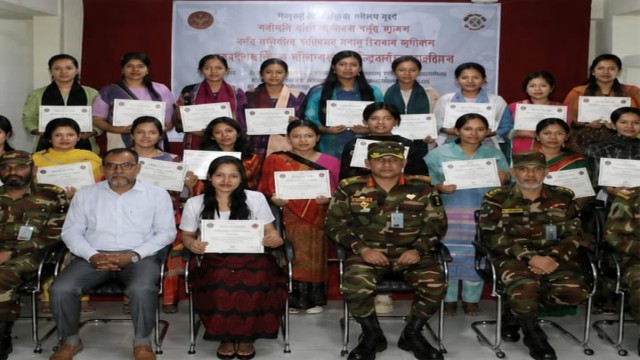
Rangamati, Sept 04 (V7N) - In the remote hill communities of the Chittagong Hill Tracts, many young people have the willingness to work but lack the practical skills needed to secure employment. Many women, too, aspire to earn an income beyond the confines of their homes, but have limited access to training and livelihood opportunities.
For them, access to technical and vocational training is opening a new door — one that could lead to greater economic independence, employment and confidence about the future.
Across Khagrachhari, Rangamati and Bandarban, as well as in different army zones under the Guimara Region, vocational and skills-development programmes are being conducted for young people from both indigenous and Bengali communities.
The training covers a wide range of practical fields, including healthcare, mobile phone repair, computer skills, electrical work, vehicle maintenance, driving, tailoring, agricultural technology and freelancing.
The programmes, being conducted in different phases from August through the final week of December, are aimed not merely at providing training or certificates. Their broader objective is to equip participants with skills they can use to earn a livelihood, contribute to their families and build greater confidence in shaping their own futures.
In the Khagrachhari Region, particular emphasis has been placed on healthcare, technology and mechanical skills.
During the first phase, 23 participants received midwifery and nursing training from 2 to 13 August. A second phase, running from 23 August to 10 September, is providing similar training to another 34 participants.
At the same time, 108 participants are receiving training in mobile phone repair. A further 73 young people from indigenous and Bengali communities are taking part in courses on computers, equipment repair and electrical work.
Being able to identify a fault in a mobile phone, operate a computer or repair electrical equipment may appear to be a modest achievement from the outside. But for a young person living in a remote hill community, such practical skills can represent the first step towards becoming economically self-reliant.
Similar vocational initiatives are under way in the Rangamati Region, where a total of 95 young people are being trained in different fields.
So far, 15 indigenous young women have received midwifery and nursing training. Further training in tailoring, computer skills, vehicle repair and mobile phone repair is planned for October and November.
Such opportunities are particularly significant for women living in remote hill areas. Many face family and geographical constraints that make regular employment outside the home difficult. Training in nursing, midwifery and tailoring can potentially enable them to earn an income either from home or within their local communities.
In the Bandarban Region, training programmes are being organised throughout September on air-conditioner and refrigerator repair, tailoring, driving and agricultural technology.
Further courses in mobile phone repair are planned for October, while freelancing training for young people is scheduled for December.
Healthcare training is also receiving attention, with two phases of midwifery and nursing programmes being arranged for women. In the first phase, 19 indigenous women received training from 2 to 13 August. A further 40 women are expected to receive training in the next phase.
The Guimara Region has likewise placed emphasis on healthcare and technical skills development.
Across three phases, a total of 49 indigenous and Bengali young people are receiving midwifery and nursing training. Another 40 participants are taking part in courses on mobile phone repair and vehicle mechanics.
The most significant aspect of these initiatives is that their focus extends beyond certificates. The emphasis is on developing practical skills that can be applied in everyday life.
A trained mobile phone technician may be able to open a small repair shop in a local market. A qualified vehicle mechanic may create employment for themselves and potentially for others. A woman trained in tailoring may contribute to her family's income, while a young person who acquires freelancing skills may explore opportunities to work online from home.
In this sense, vocational training is not simply a course. For many participants, it could become a potential pathway towards a more secure livelihood.
The initiatives also extend beyond employment and skills development, with efforts being made to strengthen social cohesion among young people.
Regular sports competitions and the ‘Sampriti Cup’ football tournament are bringing indigenous and Bengali young people together on the same playing field at the upazila level.
On a football field, players may wear different team jerseys and compete against one another. But once the match is over, the relationship can evolve into that of teammates, friends and fellow members of the same community.
Such activities create opportunities for young people to interact, build trust and develop stronger bonds across communities.
New opportunities are also emerging for talented footballers from the hill districts to pursue their ambitions at the national level.
Representatives of the Bangladesh Football Federation have visited the hill areas at different times to assess and identify promising players. This is creating a pathway for talented young people from remote communities to showcase their abilities on a larger stage.
When development in the Chittagong Hill Tracts is discussed, attention often focuses on major issues such as infrastructure, connectivity and tourism.
But at the heart of any development process are the people themselves.
The vocational training initiatives now under way are bringing that human dimension into sharper focus.
When a young person learns a practical skill, they gain more than a profession. They also gain confidence.
When a woman acquires a skill that enables her to earn an income, her ability to participate in household decision-making and shape her own future can also grow.
And when a young person is able to replace unemployment with a viable profession, the benefits can extend beyond the individual to the entire family.
This is why the ongoing technical and vocational training programmes in the Chittagong Hill Tracts should not be viewed simply as training projects.
They are closely connected to the possibility of changing lives, restoring a sense of dignity and creating new opportunities for people to dream about their future.
Empowering young people with practical skills, increasing women's participation in economic activities and strengthening interaction between indigenous and Bengali youth could, over the long term, contribute to employment generation, social harmony and the development of local economies across the hill districts.
Opportunities do not always come easily to people living in remote mountain communities.
That is why, when a young person enters a training centre and learns to repair a mobile phone for the first time, when a woman begins training in nursing, or when a young man sits behind a computer and discovers the possibilities of freelancing, the moment represents more than a training session.
It can mark the beginning of a new chapter — one with the potential to transform not only an individual's life, but the future of an entire family.
For the people of the hills, skills can mean opportunity. Opportunity can mean income. And income can mean the confidence to build a future with greater dignity, independence and hope.
END/AMR/SMA/