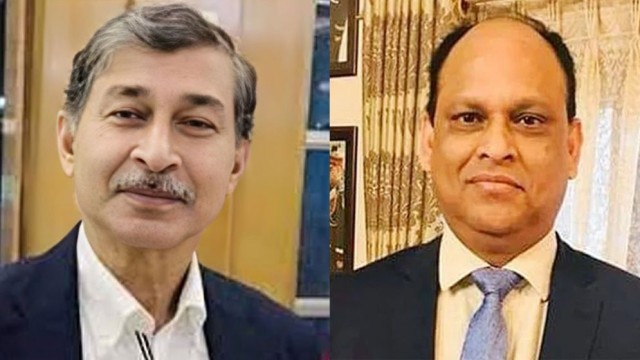
Dhaka, Jan 09 (V7N)- Former Army Chief General (Retd.) Iqbal Karim Bhuiyan has given a detailed statement to the investigation agency of the International Crimes Tribunal (ICT), shedding light on the culture of enforced disappearances and extrajudicial killings during the previous Awami League government.
According to his statement, serious allegations were raised against former army officer Maj. J. (Retd.) Ziaul Ahsan, particularly regarding his role in increasing extrajudicial killings while serving as Additional Director General (ADG) of the Rapid Action Battalion (RAB).
In his testimony, Iqbal Karim Bhuiyan said, “Ziaul became extremely disorderly after being appointed ADG of RAB. While performing his duties in this position, he significantly increased the number of extrajudicial killings.”
He further stated that after RAB Director General Benazir Ahmed took charge, Ziaul Ahsan assumed the ADG role, following which intelligence from the Army Security Unit (ASU) indicated an unusual rise in extrajudicial killings. The ASU also reported that Ziaul had stationed armed guards at his residence, stored weapons at home, and installed CCTV cameras throughout his apartment—violating military rules.
“He was immediately instructed to remove the guards, cameras, and weapons and to comply with military regulations. However, his behavior later became even more disorderly,” the former army chief said.
Iqbal Karim Bhuiyan revealed that Brigadier General Fazal once described discussions with Ziaul as futile, saying it was like “talking to someone whose brain was filled with stones or bricks.” Due to Ziaul Ahsan’s close ties with then Security Advisor Major General Tareq Ahmed Siddiqui and coursemate Major General Mahbub, Ziaul began openly challenging the army chief’s authority.
Left with no alternative, Iqbal Karim Bhuiyan declared Ziaul Ahsan “persona non grata” (PNG) in the cantonment west of the railway line, though he was allowed to remain in accommodation on the eastern side. The decision was implemented by then Log Area Commander Major General Mizan, who reportedly faced backlash from the security advisor for not being informed earlier.
The former army chief also accused ousted Prime Minister Sheikh Hasina of systematically reshaping the armed forces to consolidate political control. He said she was determined not to repeat what she considered the mistakes of the 1996–2001 period and took steps such as abolishing the caretaker government system, conducting war crimes trials, and introducing the death penalty for constitutional violations.
“She identified talented or independent-minded officers as BNP or Jamaat supporters and removed them. In their place, loyal but incompetent officers were promoted based on personal loyalty, kinship, or political alignment,” he said, adding that since 2009, a group of loyal officers had been prepared to implement Sheikh Hasina’s agenda.
Iqbal Karim Bhuiyan further alleged that Major General Tareq Ahmed Siddiqui, appointed as Security Advisor, emerged as the real power center by inserting himself between the Prime Minister and the Army Chief. According to the statement, Siddiqui exerted control over promotions, procurements, and key security agencies, including DGFI, NSI, RAB, BGB, Ansar, NTMC, DGDP, and AFD.
He alleged that under Siddiqui’s direction, security agencies were involved in enforced disappearances, murders, kidnappings, land grabbing, business extortion, torture, and extrajudicial killings.
Meanwhile, the International Crimes Tribunal-1, headed by Justice Md. Golam Mortuza Majumder, has concluded hearings on framing charges against Maj. J. (Retd.) Ziaul Ahsan in connection with the disappearance and murder of more than 100 people over the past 15 years. The tribunal has set January 14 for issuing its order.
Former Army Chief General (Retd.) Iqbal Karim Bhuiyan is scheduled to testify as a key witness against Ziaul Ahsan in the case.
END/SMA/AJ