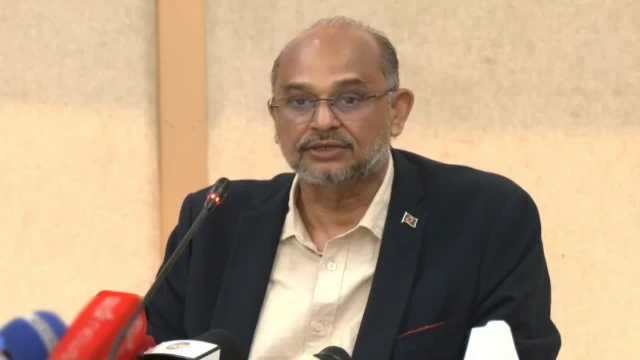
Dhaka, Sept 8 (V7N) – Prime Minister's Adviser on Finance and Planning Prof Dr Rashed Al Mahmud Titumir today said the government is taking a number of initiatives to strengthen the country's energy security, including setting up a land-based regasification unit at Matarbari and exploring offshore gas blocks.
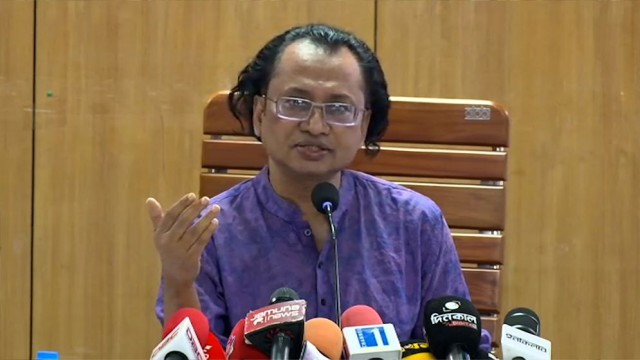
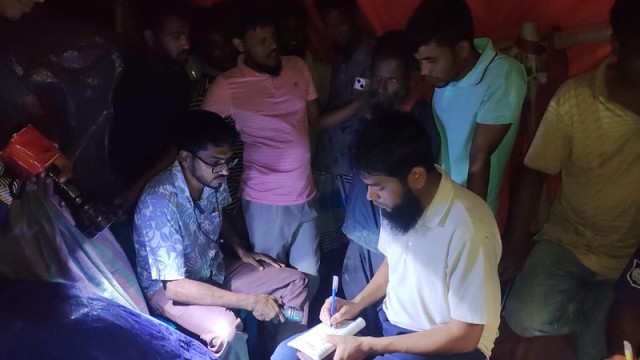
"The government is working on various fronts to ensure energy security, including establishing a land-based regasification unit at Matarbari and exploring offshore gas blocks," he said while addressing a seminar titled "Electricity, Energy Situation and the Way Forward" as chief guest at BRAC University's Merul Badda campus.
The seminar was organised by the university's newly launched Centre for Energy and Logistics (CEL) to discuss Bangladesh's electricity and energy challenges and identify possible ways forward. Titumir said ensuring a stable and reliable energy supply was crucial for sustaining economic activities and meeting the country's growing electricity demand, with government initiatives aimed at diversifying energy sources and strengthening infrastructure to reduce vulnerabilities in the supply system.
The adviser's remarks align with the government's broader five-point energy plan announced by Prime Minister Tarique Rahman in parliament on September 2, which focuses on raising domestic gas production, expanding seismic surveys, strengthening state-run explorer BAPEX, awarding production-sharing contracts, and expanding LNG infrastructure.
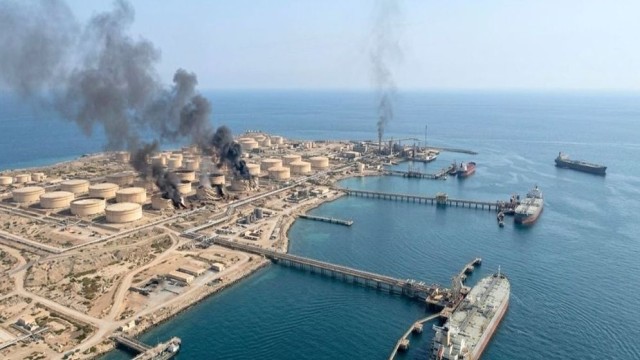
The land-based LNG terminal at Matarbari, being built under a build-own-operate-transfer arrangement, will have a capacity of 1,000 million cubic feet per day (mmcfd). Talks with a Chinese firm to build a floating storage and regasification unit (FSRU) with a capacity of 600 mmcfd in the deep waters off Maheshkhali are nearing completion. The government has also launched a bidding round for 26 offshore blocks—11 shallow and 15 deep-sea blocks—under the Offshore Model Production Sharing Contract 2026 to attract international investment.
Titumir put the country's current gas supply at 2,600 to 2,700 mmcfd against demand of 3,800 mmcfd. The power sector was in a "highly fragile condition" when the government took over, being financially bleeding and strategically without clear direction, according to the adviser.
The adviser stated that gas supply would return to normal within days as the government is importing gas from both government and alternative sources. Previously, State Minister for Power, Energy and Mineral Resources Aninda Islam Amit had expressed hope that the power and energy situation would improve significantly within the next two weeks, with 88 percent of the gas supply system already restored.
Regarding the Rooppur Nuclear Power Plant, Titumir said the plant would go into production only after ensuring full safety, with full-fledged operations expected in 2027. The government has also drawn up a National Rooftop Solar Initiative, offering to purchase electricity from rooftop solar systems at Tk 10.50 per unit, along with conditional tax and duty exemptions on essential solar equipment.
The adviser stressed the need to reduce dependence on fossil fuels and move towards a balanced energy mix to build a strong and competitive energy system, cautioning that energy-related decisions should not be based on short-term considerations but must take into account national interests, long-term energy security and economic stability.
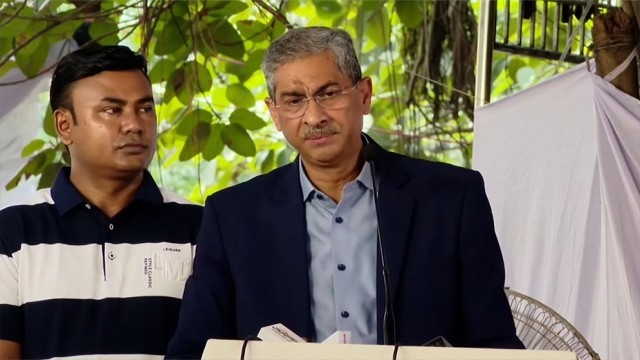
The seminar was also addressed by Shafiqul Alam, lead energy analyst for Bangladesh at the Institute for Energy Economics and Financial Analysis (IEEFA), who highlighted the potential of renewable energy, rooftop solar and energy efficiency to address the country's challenges. BRAC University Pro-Vice-Chancellor Professor Arshad Mahmud Chowdhury and CEL Director Dr M Fouzul Kabir Khan also spoke at the event.
end/aj/rh