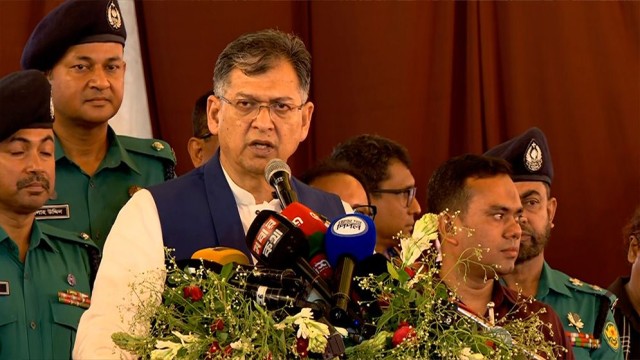
SANGSAD BHABAN, Sept 6, (V7N ) - Home Minister Salahuddin Ahmed on Sunday said the government is working to ensure greater transparency and accountability in public administration and provide quick, hassle-free services to people to reduce the scope of corruption.
He said this while responding to an emergency notice under Rule 71 of the Rules of Procedure raised by opposition Jamaat-e-Islami lawmaker M Moktar Ali of Jashore-6 at the Jatiya Sangsad. The minister is also assigned to handle Cabinet Division affairs in Parliament.
"The government's objective is not only to take action against corruption, but also to create an administrative and institutional environment where opportunities for corruption will gradually decrease and transparency and accountability in public services will be ensured," he said.
Referring to the government's electoral manifesto, Salahuddin said the "Bangladesh First" policy has been adopted as the guiding philosophy of governance.
Based on this philosophy, the government is prioritising the establishment of a transparent, accountable, fair and welfare-oriented state system to strengthen democracy and good governance, he said.
The minister said 495 corruption prevention committees have already been formed at the city, district and upazila levels as part of efforts to combat corruption.
He said the intelligence and enforcement units of the Anti-Corruption Commission (ACC) are conducting effective operations to prevent and investigate corruption.
He also highlighted the roles of the national hotlines 999, 333 and 106 in receiving complaints and allegations.
Necessary action is being taken under existing laws and regulations against corruption, irregularities, waste, negligence of duty and abuse of power, he said.
If allegations of misconduct or irregularities are found against government employees, investigation and administrative action are taken under the Government Servants (Discipline & Appeal) Rules, 2018, he added.
Legal action is also taken under the Anti-Corruption Commission Act, 2004, and other applicable laws, including the Penal Code and the Code of Criminal Procedure, the minister said.
Regarding oversight of development projects, Salahuddin said several mechanisms-including Project Implementation Committees (PICs), Project Steering Committees (PSCs), Project Implementation Cells, development sections and the Implementation, Monitoring and Evaluation Division (IMED)-play important roles in project implementation, monitoring and evaluation.
He said the government has also decided to form three-member monitoring teams comprising additional secretary-level officials from different ministries and divisions to closely oversee government activities.
The monitoring teams, formed by the Cabinet Division, have already started working, he added.
END/AJ/RH