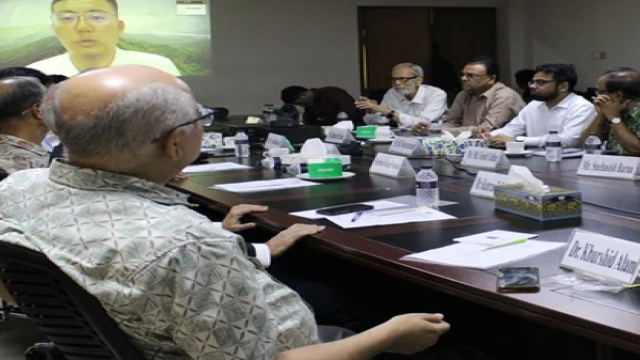
Dhaka, Aug 27 (V7N) – The Policy Research Institute of Bangladesh (PRI) today hosted a special lecture titled "Taxation System and Reform in China: Lessons for Revenue Mobilization in Bangladesh" at its conference room, bringing together policymakers, researchers, economists, business representatives, and development practitioners to examine China's tax reform experience .
The lecture was delivered by Professor Ping Zhang, Vice Dean of the School of International Relations and Public Affairs and Director of the Public Budgeting Research Center at Fudan University, China. Professor Zhang provided an overview of China's tax system, revenue structure, legal framework, and major phases of tax reform before highlighting potential lessons for Bangladesh .
Professor Zhang noted that China relies more heavily on indirect taxes, with VAT remaining its largest source of tax revenue. He highlighted that indirect taxes account for roughly 65 percent of China's tax revenue, while corporate income tax accounts for 26 percent, and personal income tax 9 percent .
He discussed key milestones in China's tax reform, including the 1984–1985 profit-to-tax reform for State-Owned Enterprises (SOEs) and the 1993–1994 Tax-Sharing System reform, which increased the central government's share of national revenue from roughly 20 percent to about 50 percent . He also explained how the resulting gap between local revenue and expenditure responsibilities contributed to local governments' reliance on central transfers and land-related revenues .
Professor Zhang further discussed China's "land finance" model, under which local governments used revenues from land-use rights to finance infrastructure development, contributing to the rapid transformation of major cities .
Drawing on China's experience, Professor Zhang proposed three broad areas for Bangladesh: clearer assignment of revenue and expenditure responsibilities across tiers of government; conditional revenue-sharing arrangements for property-related revenues; and modernization of local own-source revenue collection, particularly through improved property valuation and enforcement .
The lecture was followed by a panel discussion featuring distinguished experts from Bangladesh's public finance, taxation, business, media, and policy communities. Participants explored issues including tax administration, compliance, fiscal decentralization, property taxation, local revenue generation, and the challenges of expanding Bangladesh's tax base .
The session was moderated by Dr. Zaidi Sattar, Chairman of PRI, who led the discussion and question-and-answer session . PRI is a private, nonprofit, nonpartisan research organization dedicated to promoting understanding of the Bangladesh economy and its key policy challenges .