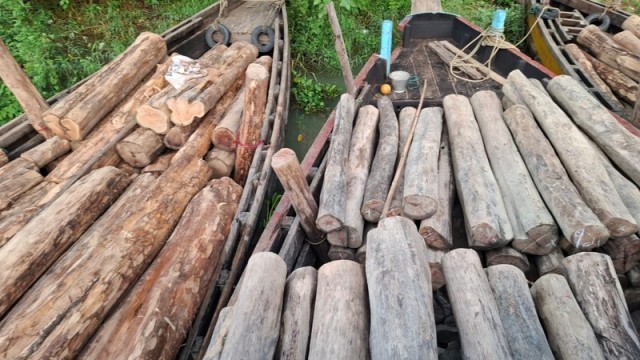
Rangamati, Sept. 06 (V7N) — The Rangamati South Forest Division has seized four boats carrying approximately 3,500 cubic feet of timber in the Jhagabil area of Kaptai Lake, amid allegations that an organised network has been illegally felling valuable teak and other trees from protected forests in the Chattogram Hill Tracts.
According to forest officials and local sources, illegal logging and timber smuggling from remote forest areas through Kaptai Lake have reportedly been taking place for a long time, often beyond the reach of regular monitoring.
Officials said shortages of manpower, difficult communication in remote areas and alleged pressure from influential local groups have made regular surveillance of some forest areas challenging.
Taking advantage of the situation, an organised group is allegedly cutting valuable teak trees from protected forests and transporting the timber through different routes.
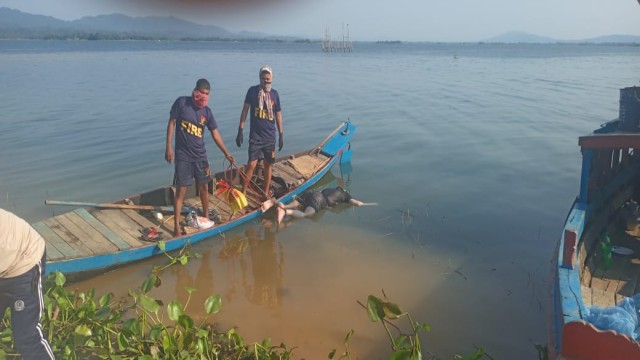
Four boats seized
The latest seizure took place on Friday afternoon after the forest department received information about several suspicious timber-laden boats in the Jhagabil area along the Rangamati-Kaptai waterway.
A team from the Rangamati South Forest Division, led by Sadar Range Officer Khandaker Mahmudul Haque Murad, conducted an operation in the area.
During the operation, four boats travelling towards Rangamati were intercepted.
Forest officials said several people aboard the boats jumped into the lake and fled after noticing the presence of the forest department personnel.
The timber-laden boats were subsequently seized and taken into forest department custody.
From Saturday morning, officials began unloading the round teak logs from the boats and transporting them to the forest department office.
Khandaker Mahmudul Haque Murad said Divisional Forest Officer (DFO) S.M. Sajjad Hossain had received information that several boats loaded with teak timber were entering Rangamati through Kaptai Lake.
“Based on confidential information received through local sources, we learned that timber-laden boats were heading towards Rangamati. Following instructions from senior officials, members of the Sadar Range conducted an operation in the Jhagabil area on Friday afternoon and seized the boats,” he said.
He said the four boats were carrying an estimated 3,500 cubic feet of teak timber.
A seizure list was being prepared and the process of filing a case was under way, he said.
The seized timber was estimated to be worth around Tk 1 crore, according to forest officials.
People involved in the local timber trade said high-quality teak can fetch up to around Tk 2,500 per cubic foot in the market.
Source and ownership under investigation
The forest department has not yet established who owns the four boats or where the seized timber originated.
Officials said an investigation would determine the source of the timber, its ownership and those allegedly involved in transporting it.
Murad said the seizure list was being prepared and legal proceedings were under way. Details regarding the ownership of the timber and those involved in the alleged smuggling would become clearer after the investigation, he said.
Allegations of organised timber collection
Meanwhile, several local sources claimed that an influential hill-based regional political organisation had recently given some timber traders in Rangamati a deadline of Sept. 4 to collect and transport timber.
According to the sources, the traders were allegedly warned that there would be no further opportunity to collect or transport timber after the deadline.
The sources claimed that, following the alleged deadline, an organised group attempted to collect timber quickly from several remote areas and transport it to sawmills and hidden storage locations in and around Rangamati.
Local sources further claimed that the timber seized in the latest operation had been transported from the Bilaichhari area towards Rangamati.
These allegations could not be independently verified.
Concerns over forest destruction
Local residents alleged that a network involved in illegal logging has been operating through remote forest areas, cutting trees and transporting the timber by waterways to Rangamati town and surrounding areas.
According to residents, remote protected forests are initially selected for logging. Trees are then felled and cut into different sizes before being transported to waterways.
The timber is subsequently moved by boats, often at night or when forest surveillance is limited. Some residents also alleged that influential individuals or armed groups are sometimes used to facilitate the transportation.
Forest officials acknowledged that limited manpower and logistical support make regular monitoring of every part of the remote protected forests difficult.
Environmentalists and concerned residents warned that illegal logging poses a serious threat not only to government resources but also to the environment and biodiversity of the hills.
They said the loss of large and mature teak trees and other valuable species could take decades to reverse, as restoring the natural ecosystem of a degraded forest requires considerable time.
They called for authorities to go beyond individual timber seizures and identify the alleged masterminds behind the network, as well as those involved in logging, transportation, storage and purchasing illegally sourced timber.
They also urged the government to increase manpower, logistical support and surveillance in remote protected forest areas.
END/AMR/SMA/