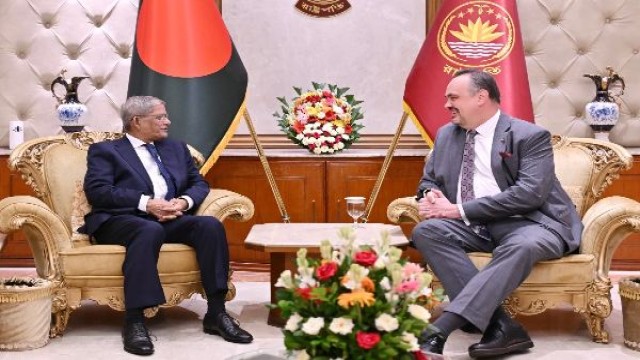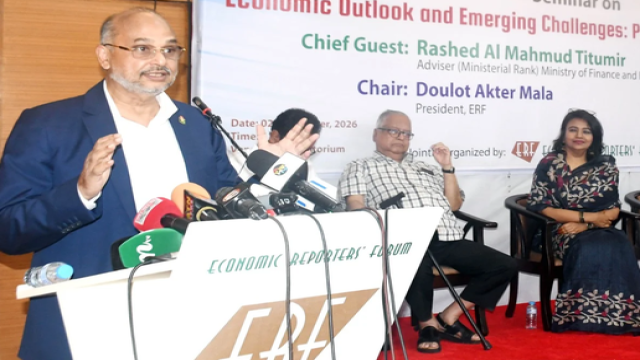
Dhaka, Sept 2 (V7N) – Adviser to the Prime Minister on Finance and Planning Prof Dr Rashed Al Mahmud Titumir today said the country's ongoing electricity and energy crisis is the result of the fallen government's flawed energy policies, excessive dependence on imports and failure to build national capacity .
"People must be clearly informed that the ongoing electricity and energy crisis has no connection with the present government. A major part of the crisis is the result of past wrong policies and decisions," he said.
The adviser was speaking as chief guest at a seminar titled "Economic Context and Emerging Challenges: Priorities for the Future," jointly organised by the Economic Reporters' Forum (ERF) and the Centre for Policy Dialogue (CPD) in the capital.
Titumir said the uncertainty over global fuel prices and supplies caused by the current situation in the Middle East is also affecting Bangladesh. "Bangladesh is currently spending around $11 per unit to import LNG from Qatar. If the country had adequate domestic gas supplies and exploration capacity, energy could have been supplied at a much lower cost," he said .
The adviser said the previous government had increased dependence on imports instead of ensuring national energy security. "Insufficient gas exploration, lack of development of domestic energy resources and inadequate initiatives to achieve renewable energy targets, including solar power, have contributed to the present situation," he added .
Oligarchic Structure and Economic Assessment
The adviser said a structure of oligarchic influence had developed in the country due to past patronage, excessive import dependence and failure to build national capacity in the energy sector . He stressed the need to assess the economic cost of past failures, including the "cost of inaction" and the "cost of wrong doing," and called for an assessment of money siphoned out of the country and liabilities accumulated in the energy sector .
"These four issues—the cost of inaction, cost of wrong doing, siphoned-off money, and debts and liabilities imposed on the present and future generations—need to be considered together in a comprehensive study," he said .
Government Response and Energy Security
Titumir said the present government is working not only to address the problems inherited from the past but also to ensure future energy security . "Steps have been taken to increase solar power generation, with a target of generating 4,000 megawatts of solar electricity," he said .
He said initiatives had also been taken to turn electricity consumers into producers through net metering . Under a recently issued notification, arrangements are being made to purchase electricity from solar power producers, while various incentives, including VAT and advance income tax exemptions, are being considered for solar power and related equipment .
The adviser's comments come as Bangladesh faces severe load-shedding and energy shortages, with gas supply in August 2026 falling to its lowest level in a decade . The conflict in the Middle East has disrupted LNG supplies from Qatar—one of Bangladesh's major long-term suppliers—forcing the country to rely on expensive spot-market purchases, with LNG prices exceeding $24 per MMBtu in September compared to pre-war rates of $10-$12 .
end/aj/rh/