RAJSHAHI, Sep 01 (V7N) — Farmers in Rajshahi are facing severe difficulties amid a shortage of fertiliser during the Aman rice cultivation season, with many forced to visit multiple dealers and wait for hours without receiving the quantities they need.
In some areas, farmers are reportedly being given only small quantities of fertiliser. Allegations have also emerged that some dealers are selling fertiliser at Tk 500 to Tk 700 above government-fixed prices, taking advantage of the shortage.
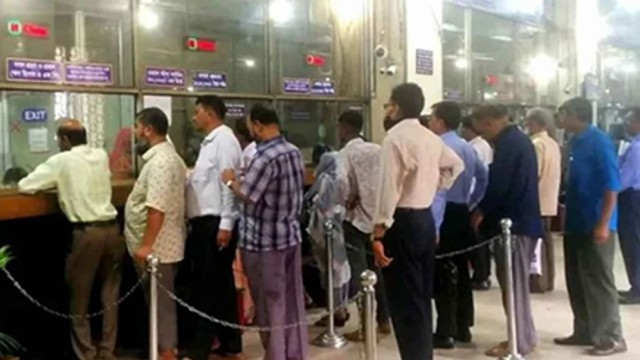
At a Bangladesh Chemical Industries Corporation (BCIC) dealer's shop owned by Nazrul Islam in Deopara Union of Godagari, farmers were seen standing in long queues. Some had reportedly been waiting for one to two hours.
Farmer Allam of Deopara village said he had been standing in the queue since morning but was still uncertain whether he would receive fertiliser.
Babul, a farmer from Kajihata village, cultivated Aman rice on 10 bighas of land this season. Unable to obtain urea from the dealer in his own area, he travelled to Deopara to purchase it. However, when he was told he could receive only 20kg, he returned home without buying any.
Harun-or-Rashid of Bhimer Dying village in Paba came looking for DAP fertiliser but could not obtain any. Rashidul Islam of Kadamshahar village in Godagari said he had travelled to another area because his local Bangladesh Agricultural Development Corporation (BADC) dealer, Rezaul Karim, had no fertiliser.
"Rice plants will not develop properly with only urea," he said.
Another farmer, Akbar Ali, managed to obtain two sacks of urea but could not get a sack of DAP.
"Even after coming with our own money to buy fertiliser, we cannot find it. If this situation continues, it will become difficult to cultivate our fields," he said.
Dealer Nazrul Islam said some farmers sometimes claim to have larger areas of farmland in order to obtain more fertiliser. He said fertiliser was being distributed after verifying the actual size of their land.
He also said his stock of 20 tonnes of DAP had already run out.
Farmers Receive Reduced Quantities
A similar situation was observed at Akash Enterprise in Bhayalakshmipur Union of Charghat, where farmers were seen waiting to purchase triple superphosphate (TSP).
Shafiqul Islam of Bankra village said he received only 25kg instead of a full sack.
Saiful Islam of Faridpur village wanted two sacks of TSP for two bighas of banana cultivation and two bighas of Aman rice. However, he said he was being offered only 15kg.
An employee of Akash Enterprise said the shop had received 10 tonnes of TSP and had only 29 sacks remaining.
"If we give every farmer the quantity they demand, many will have to return empty-handed. That is why we are distributing the fertiliser in smaller quantities," the employee said.
Allegations of Overpricing
Farmers have also alleged that some dealers are charging more than the government-fixed prices amid the shortage.
At Rajabarihat in Godagari, farmer Momin purchased a 50kg sack of DAP from Mulkidying Shahidul Traders for Tk 1,750, although the government-fixed price is Tk 1,050.
Urea was also reportedly being sold at Tk 1,500 per sack at the same shop, compared with the government-fixed price of Tk 1,350.
The proprietor of the establishment, Saidur Rahman, acknowledged selling DAP at Tk 34 per kilogram.
An employee of the nearby Saad Enterprise, Kabir Hossain, said their DAP was of relatively lower quality and was therefore being sold at Tk 1,600 per sack.
Farmers alleged that fertiliser in particularly high demand was being sold at inflated prices in some areas. They claimed that inadequate government allocations compared with demand were creating an opportunity for some traders to raise prices.
Supply Falls Short of Allocation
According to the Department of Agricultural Extension (DAE) in Rajshahi, the district was allocated 7,574 tonnes of urea for August, but received only 4,724 tonnes.
Against an allocation of 2,647 tonnes of DAP, the district received 2,182 tonnes. For TSP, the allocation was 1,511 tonnes, while actual supply stood at 1,240 tonnes. The district received 1,496 tonnes of MOP against an allocation of 1,760 tonnes.
According to the Agriculture Department, Rajshahi has approximately 185,262 hectares of cultivable land, while Aman rice has been cultivated on around 83,600 hectares this season.
The standard recommended use of DAP for Aman rice is around 10kg per bigha. However, the current allocation is reportedly insufficient to meet demand.
Rajshahi also has around 17,774 hectares of ponds. Although there is no separate fertiliser allocation for fish farming, the sector requires approximately 1,991.5 tonnes of DAP every three months, according to the Agriculture Department.
Officials said this additional demand is putting further pressure on the supply available for agricultural land.
The Agriculture Department is encouraging farmers to use DAP instead of TSP, saying the practice could save up to 100 per cent of TSP and around 40 per cent of urea.
However, farmers in many areas are reportedly unable to obtain even the DAP recommended by agricultural officials.
Mohammad Nasir Uddin, Deputy Director of the Rajshahi District Department of Agricultural Extension, said allocations were somewhat lower than demand.
"Supply is somewhat lower than demand. The fertiliser requirement for use in ponds is also not separately included in the allocation. If we receive complaints of fertiliser being sold at inflated prices or illegally stockpiled, we conduct operations," he said.
Enforcement Drives Fail to Halt Irregularities
Authorities have conducted several drives in recent days against allegations of unauthorised sales and illegal stockpiling of fertiliser in Paba, Puthia, Durgapur and Charghat upazilas.
Several businesses were fined during the drives. Fines of Tk 30,000 were imposed in Paba and Puthia, Tk 20,000 in Durgapur and Tk 5,000 in Charghat.
However, Kazi Shahidul Islam, chairman of the District Fertiliser and Seed Monitoring Committee and Rajshahi District Commissioner, said there was sufficient fertiliser in the district.
He said he was not aware of any shortage in allocation compared with demand.
The district administration, he said, was taking immediate action through mobile courts whenever complaints were received about fertiliser being sold at higher prices or smuggled out of the area.
He also said action would be taken if officials were informed of any location where farmers were unable to obtain fertiliser.
The sharp contrast between farmers' complaints and conditions observed at dealer outlets on one hand, and the administration's assertion that sufficient fertiliser is available on the other, has raised questions over distribution and supply management.
Farmers fear that unless fertiliser is made available on time and at government-fixed prices during the Aman season, cultivation costs could rise further and production could be disrupted, ultimately placing a heavier financial burden on them.
END/MRA/SMA/