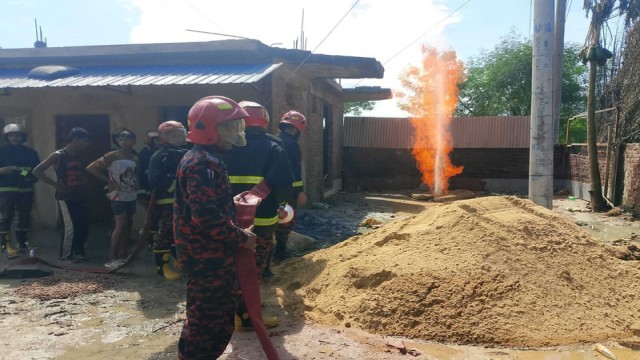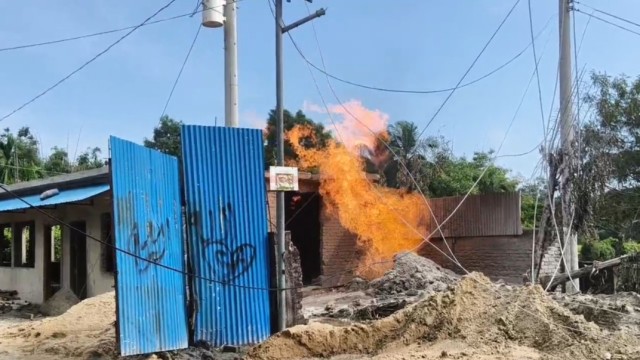
Ukhiya, Oct 29 (V7N) – A fire fuelled by gas escaping from underground during deep tube-well drilling in Inani, a tourist area of Ukhiya in Cox’s Bazar, continued burning for more than two days through Wednesday evening, raising fears among coastal residents.
The flames reportedly intensified on Wednesday evening as gas emissions increased. A specialist team from the Bangladesh Petroleum Exploration and Production Company (BAPEX) inspected the site, but technical operations to control the fire had not begun by Wednesday evening.
Meanwhile, electricity supply has remained suspended across an area stretching about 15 kilometres from Monkhali to Patuartek because of concerns that the flames could reach nearby electrical wires. More than 3,800 families have been without power for two days, disrupting tourism businesses, hotels, restaurants and daily life.
Residents have reported food spoiling in refrigerators and other difficulties caused by the prolonged outage.
Four Fire Service units have been working at the site but have been unable to extinguish the flames because the gas continues to escape. BAPEX experts have also warned that attempting to block the gas flow could force it through other underground fractures, potentially increasing the danger.
The gas's composition, the source of the leakage and the safest method of controlling the fire remain uncertain.
Experts Warn Against Blocking Gas Flow
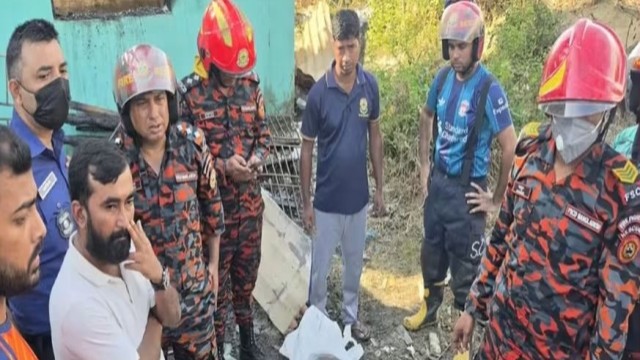
A BAPEX specialist team led by S M Nafifun Arham, manager of geology and head of the geological survey team, inspected the site at around 10pm on Tuesday.
Based on preliminary observations, the team suspects that drilling may have reached a gas-bearing layer at a depth of approximately 1,000 feet. Gas may then have travelled upwards through underground fractures or geological fault zones before escaping through the borehole.
“We initially suspect that drilling reached close to the upper part of a gas-bearing layer. After that layer was exposed, high-pressure gas may have found a path through small underground fractures or geological fault zones and reached the surface after several days,” Arham said.
He said a spark from human activity or an electrical source might have ignited the escaping gas.
The colour of the flames and the smoke has led experts to suspect the possible presence of relatively heavy hydrocarbons. However, Arham stressed that the gas's composition could not be confirmed without collecting samples and analysing them in a laboratory.
He also warned against attempting to seal the gas outlet before the underground conditions were understood.
“Trying to control or block the gas pressure could cause it to escape through another weak point, potentially increasing the risk. For now, ensuring safety is the priority rather than attempting to stop the gas flow,” he said.
The team has been exploring different methods of collecting samples to determine the gas's nature and source. Gas emissions may also extend to other nearby locations, he added.
Attempts to collect samples using alternative methods were made on Wednesday afternoon, but the composition, source and possible reserves cannot be established before laboratory analysis.
Four Fire Service Units Unable to Extinguish Flames
The incident began at around 7:30am on Tuesday at the homestead of local resident Mohammad Abdullah, beside a small bridge near a canal in Jaliapalong Union's Inani area.
Workers were digging to install a deep tube well when foul-smelling gas began escaping from the hole. Flames subsequently erupted at the site.
Fire Service personnel arrived and began efforts to control the fire, but the continuing gas emissions prevented them from extinguishing it.
Saidul Islam, an official at the Ukhiya Fire Service and Civil Defence station, said four units were working at the site.
“Despite our efforts, we have not yet been able to bring the fire under control. We are regularly updating the Fire Service headquarters, BAPEX, Petrobangla and other relevant agencies,” he said.
He added that the suspected gas was escaping from a depth of around 1,000 feet and that the scale of the incident required specialised technical support beyond the available personnel and equipment.
The BAPEX team inspected the site on Tuesday night. An attempt to collect samples on Wednesday morning was unsuccessful because of the intensity of the flames and gas emissions.
More Than 3,800 Families Face Power Disruption
Electricity supply along an approximately 15-kilometre stretch from Monkhali to Patuartek has been suspended because of fears that the flames could spread to a nearby 33-kilovolt transmission line.
More than 3,800 families have been affected, including residents and businesses dependent on tourism. Hotels, restaurants and other commercial establishments have faced disruption, while households have struggled to manage without electricity.
Kaiser Nur, deputy general manager of the Ukhiya Rural Electricity Association, said an alternative supply arrangement was being prepared in consultation with the BAPEX team.
“We are taking steps to arrange an alternative electricity supply over a 200-metre section. Work on the alternative line is progressing in accordance with advice from the BAPEX representatives. We are trying to restore power as quickly as possible,” he said.
Local resident Sadia Islam said the prolonged outage had caused food stored in refrigerators to spoil and made household activities difficult.
“We have been without electricity for two days. Food and other essential items stored in the refrigerator are going bad, and we do not know when the power will return. We are already frightened by the fire, and the power outage has made daily life even harder,” she said.
Mohammad Alamin, a local man working at a nearby five-star hotel, said several hotel employees lived in a room close to the site and were alarmed when the flames appeared.
Residents, including Sohag, Rafiquddin, Sirajul Islam and Saifullah Sikder, also expressed concern about their safety and the prolonged power disruption. Local representatives Jahed Hossain, Shamsul Alam and reserved women’s member Farida Yasmin voiced concern about the situation.
Administration Urges Residents to Remain Calm
Ukhiya Upazila Nirbahi Officer Panna Akter said authorities were working to address the power disruption and maintain normal law and order.
“We cannot say when the gas fire will be brought under control. Arrangements are being made to restore electricity through an alternative connection. We need everyone's cooperation to maintain law and order,” she said.
She urged residents not to spread panic and asked them to remain aware of official updates.
Despite the administration's appeal, uncertainty over the duration of the fire and the continuing gas emissions has left residents worried.
Incident Raises Questions About Coastal Gas Potential
The gas leak has renewed discussion about the geological potential of the Cox's Bazar coast. However, the appearance of gas through a tube-well borehole does not establish that commercially recoverable reserves exist in the area.
Professor Dr Md Shafiqul Islam, pro-vice-chancellor of Rangamati Science and Technology University and a marine scientist, said there were opportunities for gas exploration in Bangladesh's maritime territory.
He said the Bay of Bengal had 28 gas blocks and that the government was placing greater emphasis on strengthening BAPEX's domestic exploration capacity.
He added that the possibility of exploration along the Cox's Bazar coast should also be examined.
However, no direct link has been established between the Inani incident and the offshore gas blocks, and there is no confirmed evidence of significant gas reserves at the site. Geological surveys, laboratory testing and further technical assessments would be required before any conclusions could be drawn.
Safety and Power Restoration Remain Priorities
As of Wednesday evening, the fire remained active, and the next steps for controlling it were still uncertain. BAPEX experts had yet to reach a definitive conclusion about the gas's composition and source.
Authorities are prioritising safety because of the potential risks associated with underground pressure and the possibility of gas escaping through other weak points. Meanwhile, more than 3,800 families continue to face disruption because of the power suspension.
The next course of action will depend on sample analysis, an assessment of the underground geological conditions and recommendations from technical experts. Until then, residents and businesses in the Inani coastal area remain affected by the fire and electricity shortage.
END/MSI/SMA/